Special Correspondent
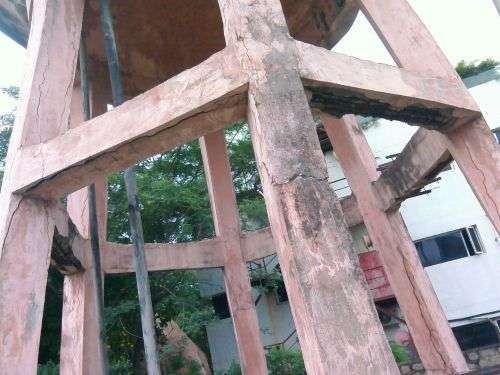
A potentially dangerous structure has been standing for years in the heart of Hyderabad’s First Phase of Journalists’ Colony at Banjara Hills, despite a written complaint drawing the authorities’ attention to its alleged dilapidated condition as far back as 2021.
The disturbing question now is not merely why the structure continues to stand, but what exactly are the authorities waiting for?
The issue assumes fresh urgency following the collapse of a five-storeyed building in the national capital, reportedly killing several students and triggering questions over whether timely warnings and complaints about the condition of the structure had been ignored. The tragedy has once again underlined a painfully familiar reality: disasters often announce themselves long before they happen, but bureaucratic systems frequently wake up only after lives are lost.
In Hyderabad, a similar warning appears to have been sitting on the official record for years.
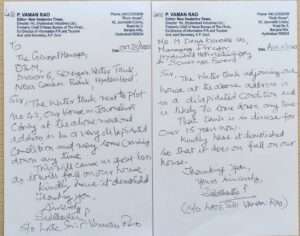
The complaint concerning the dilapidated water tank, which stands close to the late journalist’s house in First Phase, Journalists’ Colony, was reportedly submitted in writing by Siddhartha, son of the late senior journalist Vaman Rao, to a top official of the Hyderabad Metropolitan Water Supply and Sewerage Board (HMWS&SB) in 2021. The complaint specifically drew attention to the condition and location of the abandoned water tank, which stands perilously close to the compound wall of the veteran journalist’s residence. What is more concerning is that the Journalists Housing Society has reportedly also sent representations to the HMWS&SB.
What happened thereafter makes the matter even more intriguing.
Instead of simply brushing aside the complaint, the HMWS&SB reportedly took cognisance of the issue and sought the assistance of experts from Jawaharlal Nehru Technological University (JNTU) to conduct a survey of the structure and submit a report. The apparent purpose was to establish the condition of the tank and facilitate necessary action, including its demolition if it was found to be unsafe.
That raises a very straightforward question:
If the authorities themselves considered an expert assessment necessary, why has the matter remained unresolved for years?
More than five years have passed since the complaint was lodged. Governments have changed. Administrations have changed. Officials have changed. But the structure, according to the complaint and subsequent representations, continues to remain where it was.
And therein lies the real issue.
A structure that is alleged to have remained unused for three to four decades cannot simply be treated as another item on a department’s pending file. An old, disused and reportedly deteriorated water tank is not merely an eyesore. If its structural stability is genuinely in question, it potentially becomes a public-safety concern, particularly when it is situated close to occupied residential properties.
The authorities may well have technical reasons for not demolishing it. There may be ownership, structural, engineering, procedural or other considerations involved. But if that is the case, why has the complainant not been given a clear answer?
Has the JNTU survey actually been conducted?
If it was conducted, what did the experts conclude?
Was the tank declared structurally safe?
If it was found unsafe, why was it not removed?
If demolition was recommended, what prevented implementation?
If the structure was found to be safe, why was the complainant not formally informed?
These are not unreasonable questions. They go to the heart of preventive governance.
The most dangerous words in public administration are perhaps not “no” or “cannot be done”, but “the file is under process.”
Years can disappear into those three words.
Meanwhile, structures do not wait for files to move.
Weather does not wait for departmental approvals.
Heavy rainfall does not wait for an inspection report.
And gravity certainly does not wait for a government order.
Hyderabad, like several other cities, has witnessed its share of incidents involving ageing and poorly maintained structures. Every monsoon brings warnings about vulnerable buildings, retaining walls, trees, electrical installations and other structures that could potentially pose risks to people and property.
The fundamental principle should therefore be simple: where there is a reasonable apprehension of danger, authorities must investigate promptly and act on the findings.
That is precisely why the 2021 complaint assumes significance.
It was not a complaint made after an accident. It was a warning made before one.
That distinction matters.
If an individual citizen notices a potentially dangerous structure and brings it to the attention of the competent authority, the responsibility does not end with receiving the complaint and putting it on record. The administration is expected to examine the allegation, obtain technical opinion where necessary and take appropriate preventive measures.
In this particular case, the reported decision to seek a JNTU expert survey indicates that the complaint was serious enough to warrant technical examination.
Yet, years later, there appears to be no visible resolution.
That is where the familiar “chalta hai” culture becomes particularly dangerous.
“Let it be.”
“Nothing will happen.”
“It has been standing for decades.”
“We will see when the problem arises.”
Such an attitude might be tolerable when dealing with an inconsequential administrative delay. It becomes entirely unacceptable when the issue concerns a structure that could potentially affect human lives and residential property.
The question that citizens are entitled to ask is brutally simple:
Must something actually collapse before somebody takes responsibility?
Nobody wants that question answered through another tragedy.
The recent Delhi building collapse should serve as a warning—not merely for Delhi, but for every municipal and infrastructure authority across the country. A structure reportedly flagged by residents or citizens cannot be allowed to remain a forgotten hazard merely because no accident has yet occurred.
Prevention is not an optional extra in governance. Prevention is governance.
And this is where HMWS&SB needs to come clean.
The Board should clarify the present status of the water tank in First Journalists’ Colony. It should state whether the JNTU experts inspected it, when the inspection took place, what their technical assessment was and what action was recommended.
If the structure is safe, let the Board say so publicly and put the technical assessment beyond ambiguity.
If it is unsafe, there should be no further excuse for delay.
If demolition requires additional permissions or procedures, the authorities should explain precisely what those requirements are and what has been done to fulfil them.
What cannot be acceptable is silence.
The location makes the matter all the more sensitive. The tank is reportedly situated very close to the residence of veteran journalist Vaman Rao. Any structural failure—however unlikely officials may believe it to be—could potentially have consequences for neighbouring homes and people in the vicinity.
No responsible authority should wait for such a possibility to become a reality before acting.
The issue also raises a larger question about how Hyderabad treats ageing public infrastructure.
A city aspiring to become a modern metropolitan hub cannot afford to carry potentially hazardous relics of its past indefinitely simply because removing them requires somebody to take a decision.
There has to be an institutional mechanism to identify, inspect, classify and either rehabilitate or remove obsolete structures.
Every complaint cannot become a casualty of bureaucratic inertia.
The 2021 representation should therefore not be treated as an old grievance that has lost relevance with the passage of time. If anything, the passage of time makes it more pertinent.
A complaint about a potentially unsafe structure does not become irrelevant merely because no accident occurred yesterday.
On the contrary, every day that passes without a proper safety assessment leaves the same question hanging:
What if something goes wrong tomorrow?
And if that happens, the first question will inevitably be: Was the danger known beforehand?
In this case, the answer could apparently be yes.
The authorities were reportedly alerted in writing in 2021. An expert survey was reportedly contemplated. Years have passed.
That is more than enough time for a government department to determine whether an abandoned water tank is safe, unsafe, repairable or fit for demolition.
There should be no need to wait for a tragedy to provide the final inspection report.
Hyderabad does not need another disaster to discover the importance of preventive action.
The water tank in First Journalists’ Colony may ultimately prove to be structurally safe. If so, the authorities have an easy opportunity to put the matter to rest by producing the technical assessment and reassuring residents.
But if there is even a genuine question mark over its structural stability, the clock should not be allowed to run indefinitely.
Because when it comes to public safety, a warning ignored today can become a headline tomorrow.
And the most uncomfortable question for HMWS&SB is one that needs no technical expertise to answer:
After a written warning in 2021, how many more years does it take to decide whether an allegedly dilapidated, decades-old water tank needs to be removed?