MS Shanker
The question may sound provocative, even uncomfortable. But recent developments in the administration of state cricket associations make it impossible to ignore: are elected cricket bodies gradually surrendering their autonomy to the judiciary because they have repeatedly failed to govern themselves?
The danger is not that courts intervene when there is serious illegality, financial irregularity or a breakdown of governance. Courts have every right—and sometimes an obligation—to step in when institutions fail to protect their own rules and stakeholders.
The real danger is when exceptional judicial intervention becomes the normal method of running sports administration.
Bihar and Hyderabad offer two striking examples.
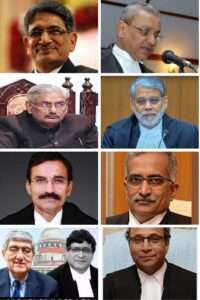
In the Bihar Cricket Association, the Supreme Court appointed former Supreme Court judge Justice L. Nageswara Rao as Ombudsman in 2025 to examine complaints and issues surrounding the association’s functioning and electoral process. After submitting his report, Justice Rao was relieved at his request, and the Supreme Court appointed former Supreme Court judge Justice Abhay S. Oka as Ombudsman in March 2026.
The matter has now moved further. Recent reports indicate that the Supreme Court has relied substantially on Justice Rao’s findings concerning the BCA’s electoral process while considering its next steps.
That should concern every sports administrator—not because judges are incapable of handling such assignments, but because sports associations were never designed to be administered permanently through judicial committees.
Hyderabad’s experience is even more revealing.
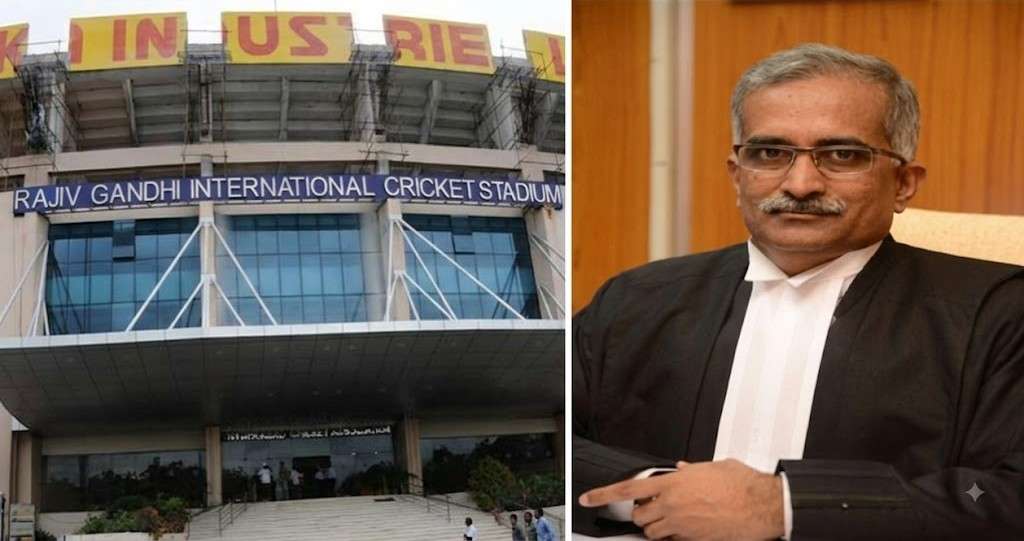
The Hyderabad Cricket Association has travelled through successive phases of judicial supervision. In 2023, the Supreme Court appointed Justice L. Nageswara Rao to oversee its affairs and conduct elections. His examination of the HCA’s membership structure resulted in 57 clubs being barred from voting or contesting elections for a specified period on conflict-of-interest grounds.
Yet judicial intervention did not end HCA’s problems.
The Telangana High Court subsequently appointed Justice P. Naveen Rao, a retired judge, as a Single Member Committee to supervise the association. The HCA itself records that the committee’s mandate followed the earlier Supreme Court intervention.
And that is the fundamental question: if one judicial intervention is followed by another, and another, has the disease actually been cured—or are we merely changing the doctors?
The answer is uncomfortable.
The problem is not the judiciary. The problem is the failure of cricket administrators to establish a system in which disputes are resolved before they reach the courts.
Conflict of interest, multiple club affiliations, electoral disputes, financial transparency, selection controversies and allegations of favouritism should not require a Supreme Court-appointed administrator or a High Court-appointed committee to become the first serious line of defence.
They should be dealt with by the associations themselves, under clearly written rules, independently audited accounts, transparent electoral rolls and credible disciplinary mechanisms.
Instead, cricket administration has too often become a battlefield between factions.
And when factions refuse to resolve their disputes internally, the courts inevitably become the referee.
But courts are not cricket administrators.
A judge’s principal responsibility is adjudication—not deciding who should run a cricket association, how its leagues should be organised, which districts should receive representation, how selectors should be appointed or how day-to-day administration should function.
Judicial oversight may be necessary as a temporary corrective mechanism. It should never become a substitute for institutional governance.
There is an even bigger constitutional and institutional principle at stake here.
India’s Constitution envisages distinct roles for the legislature, executive and judiciary. The judiciary is undoubtedly a powerful constitutional institution, but that power is not a licence to permanently administer every institution that fails. The same principle should apply to autonomous sporting bodies.
Otherwise, a dangerous precedent could emerge.
Today it is Bihar.
Today it is Hyderabad.
Tomorrow it could be another state association.
And if the pattern continues, what prevents a situation in which retired judges or court-appointed committees gradually become the permanent administrators of state cricket associations—and eventually acquire an increasingly influential role in the larger structure of Indian cricket?
That possibility should not be dismissed merely as hypothetical.
The irony is that the cricket establishment itself is partly responsible for creating this situation.
The BCCI cannot wash its hands of dysfunctional state associations simply because they are legally separate entities. It is the apex body of Indian cricket and possesses considerable institutional influence. If a state association repeatedly faces allegations of financial irregularity, factional warfare, electoral manipulation or conflict of interest, the answer should not always be to wait for a disgruntled faction to approach a court.
The BCCI must build a credible internal intervention mechanism.
Where serious complaints are established, it could constitute an independent committee of respected cricket administrators, auditors, former players and governance professionals. The committee should have a clearly defined mandate, a fixed time frame and transparent reporting requirements. Where necessary, an elected body facing proven misconduct could be suspended temporarily, with fresh elections conducted under independent supervision.
That would be far healthier than allowing a governance vacuum to invite judicial takeover.
The objective should not be to protect elected office-bearers. Nor should it be to protect former cricketers, political heavyweights, influential clubs or established factions.
The objective should be to protect cricket.
There is another lesson here for sports administration generally.
If cricket’s governance failures continue to push courts into increasingly hands-on administration, other sports bodies could eventually face similar pressures. Athletics, hockey, football, badminton or any other federation could find itself caught in the same cycle: internal dispute, litigation, judicial intervention, committee, another dispute—and another committee.
That is not institutional reform.
That is institutional dependency.
Sports bodies must therefore understand a simple reality: every time they fail to resolve their own problems, they strengthen the case for somebody else to take over.
The judiciary should remain the constitutional safety net—not become the administrative machinery of Indian sport.
The ultimate responsibility, therefore, rests with the sports bodies themselves and, in cricket, particularly the BCCI. They must clean their own house before the courts are compelled to do it for them.
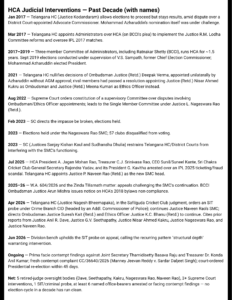
What is even more surprising is the BCCI’s stoic silence. The box item accompanying this article should make the point starkly: how many times must the judiciary intervene before the cricket establishment accepts that something is fundamentally wrong? From alleged financial irregularities surrounding stadium construction to the selection process and the infamous ‘pay-to-play’ culture, the HCA has witnessed allegations and controversies involving power brokers who, by all accounts, have wielded enormous influence over decision-making. The consequences are there for everyone to see—the near-ruin of one of the country’s historically important cricket associations.
Having said that, in my view, Justice P. Naveen Rao, appointed by the Telangana High Court as the Single Member Committee with a mandate to clean up the HCA, represents perhaps the last serious opportunity to restore credibility and discipline to the institution. If even this exercise fails in the coming months, one has to seriously ask what purpose repeated judicial interventions have ultimately served. There is a real danger that cricket administration could become nothing more than a revolving door of committees, court-appointed officials and highly paid functionaries, while those responsible for the mess continue to find ways to remain relevant.
And if the BCCI continues to look the other way while court cases multiply and drag on for years, the parent body cannot escape responsibility for that inaction. If a child in a family repeatedly misbehaves, who is expected to discipline him if not the parent? The same principle applies to the BCCI and its state associations. The BCCI cannot claim to be merely an interested spectator when one of its affiliated bodies is repeatedly dragged before the courts.
If it genuinely wishes to promote and protect cricket, it must also show greater magnanimity towards legitimate stakeholders in Telangana. Giving serious consideration to the Telangana Cricket Association’s request for Associate Membership could provide at least some relief to aspiring cricketers, particularly those from rural Telangana, who should not have to pay the price for an administrative battle in which they have no role.
Otherwise, one day, cricket administrators may discover that they still possess the titles, the offices and the letterheads—but the actual authority to run the game has already moved elsewhere.
That would be a disastrous outcome—not for the judges, but for Indian sport.