
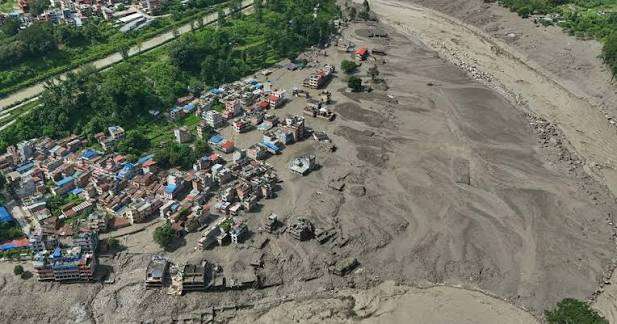
Kathmandu: Seventeen people were killed and nearly 500 others, including 105 Indians, are missing after a massive flash flood originating in Tibet swept through central Nepal districts, causing devastation in towns and villages, washing away bridges and damaging at least a dozen hydropower projects on Wednesday.
The flood surged through the Bhote Koshi River at around 9 am (local time), affecting Rasuwa and Dhading districts bordering Tibet, officials said. It then spread to Dhading, Nuwakot and Chitawan districts, damaging at least four permanent bridges and few temporary ones.
According to preliminary study reports on the basis of analysis of satellite pictures, the flash flood occurred due to a rock slide caused by an unstable mountain rock mass lying near the Nepal-Tibet border, 20 kms northeast of the Tibet-Rasuwagadhi border area.
The Bhotekoshi River flooded around 9 a.m. local time Wednesday, destroying several villages as well as roads and hydropower projects, officials said. They issued warnings to residents in several of Nepal’s districts and asked them to stay away from the banks of the Bhotekoshi, Trishuli and Narayani rivers.
“We have asked both India and China to help us with the rescue efforts,” said Sasmit Pokharel, a spokesperson for the Nepali government.
The worst affected area, Rasuwa district, witnessed similar flash floods to those in August last year, when a glacial lake in neighbouring Tibet overflowed. Nine people lost their lives then.
Security footage captured on the Chinese side of the Nepal-Tibet border showed many people fleeing before a wall of rock, mud and water destroyed buildings and vehicles, with the people disappearing from view.
At least 384 travellers were missing from the region, Nepal’s tourism authority said. While the nationalities of many still unaccounted for were not clear, the authority said the list included 105 Indians, 93 Nepalis, 17 Malaysian citizens, 12 British nationals and three U.S. citizens.
Climate experts at the Kathmandu-based International Centre for Integrated Mountain Development say an avalanche from a glacier likely caused Wednesday’s flash flood.
The Lhende Khola River, a tributary of the Bhotekoshi River, witnessed maximum flooding Wednesday, they said.
“The Lhende Khola has flooded twice in 14 months, this time triggered by an ice rock avalanche from a glacier on the Nepal side that blocked the river and released a sudden surge downstream,” said Saswata Sanyal, a disaster risk reduction specialist at the climate research group.
“In a warming Himalaya, early warning is the first line of adaptation,” he added.
The Himalayan region, which crosses Nepal and several nearby countries including India, is especially vulnerable to heavy rains, floods and landslides because the area is warming up faster than the rest of the world due to human-caused climate change.
Research has shown that extreme weather events including heat waves, heavy rains and melting glaciers have become more frequent in the region.
Researchers at the Kathmandu research group found earlier this year that glaciers across the Hindu Kush Himalaya region are melting at an accelerating rate, with ice loss rates doubling since 2000, primarily due to rising global temperatures and climate change.