



There is nothing more reassuring to Bharat than the sight of an ISRO rocket climbing into the sky. It represents scientific excellence, institutional discipline and, above all, national capability. That is precisely why a series of recent developments surrounding the Indian Space Research Organisation deserve far more scrutiny than they have received.
Let us be clear at the outset: there is no publicly established evidence of sabotage, espionage or a security breach inside ISRO. Nor is there any basis to declare that scientists leaving the organisation have been “purged”. But there are enough unusual dots to connect to justify a very uncomfortable question: has something more serious been happening inside Bharat’s space establishment than the public has been told?
Consider the chronology.
On May 18, 2025, PSLV-C61 carrying EOS-09 failed after an anomaly during the third stage. ISRO subsequently constituted a national-level committee to determine the root cause and recommend corrective measures. The organisation’s own annual report says the committee submitted its findings and recommendations, following which a modified third-stage motor was developed and successfully subjected to two static tests.
Then, on January 12, 2026, PSLV-C62 carrying EOS-N1 encountered another anomaly, this time towards the end of the PS3 stage. ISRO again ordered a detailed analysis. Its official mission record confirms that the launch was unsuccessful.
Two PSLV failures involving the third stage in less than eight months would naturally trigger a technical investigation. That is not suspicious; it is precisely what a serious space programme should do.
But then came something that demands attention.
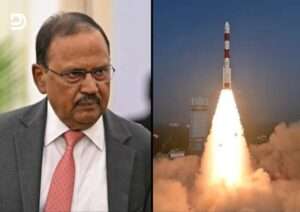
Reports said National Security Adviser Ajit Doval made a discreet visit to the Vikram Sarabhai Space Centre in Thiruvananthapuram on January 22-23, meeting senior officials and scientists behind closed doors. The reported visit has never been publicly explained in detail.
That does not automatically mean an intelligence operation was underway. Doval could have been examining broader strategic, technological or security issues. But when the NSA personally visits a premier space facility soon after two launch anomalies, Bharatiyas are entitled to ask what exactly prompted the visit.
And the questions become more compelling when placed alongside another development.
In July, the Department of Space effectively tightened the exit door for scientists working on Gaganyaan and other critical national missions. Its July 14 memorandum said there had been a “spate” of resignations and voluntary-retirement requests among Group ‘A’ scientific and technical personnel, including those associated with Gaganyaan and other important projects, and warned that this was severely affecting projects of national importance. Such exits would henceforth require higher-level scrutiny rather than routine approval at individual centres.
Reports put the number of departures at around 100 or more, with roughly 80 reportedly from URSC and at least 20 from VSSC. Some departures reportedly involved scientists associated with major programmes. The obvious explanation is the rapidly expanding private space sector, which offers higher salaries and more attractive career opportunities. That explanation is entirely plausible.
Yet the government’s response is what makes this story interesting.
If this were merely routine attrition, why substantially tighten the approval mechanism for scientists working on the country’s most sensitive missions?
Perhaps the answer is simply institutional continuity. Perhaps ISRO is trying to ensure that critical projects do not suddenly lose key expertise. ISRO Chairman V Narayanan himself has indicated that departures occur and that responsibilities can be redistributed.
But national security is rarely about one isolated event. It is about patterns.
Two failures. Both involving the third stage. A discreet NSA visit to VSSC. Additional scrutiny. A significant scientist exodus. And, months later, Delhi taking the unusual step of tightening the exit mechanism for personnel attached to strategic missions.
Coincidence? Quite possibly. But coincidence is not an explanation.
There have also been reports alleging that recommendations following an earlier failure were subsequently altered by a senior-level scientist. Such allegations must be treated as allegations until independently established. It would be reckless journalism to convert an unverified claim into a conclusion about institutional manipulation, financial interests or espionage.
But it would be equally reckless to dismiss every uncomfortable question simply because ISRO is a national icon.
If there is nothing beyond technical failures and talent attrition, the government should have no difficulty saying so. If there are security concerns, the public may not be told everything—and understandably so. Intelligence work cannot be conducted through press conferences.
The real issue, therefore, is not whether Ajit Doval “discovered” a mole inside ISRO. There is no public evidence to make that claim.
The real question is more fundamental: what did the national-security establishment see that made it necessary to look beyond the conventional technical explanation?
Bharat’s space programme is too strategically important to leave such questions hanging indefinitely. Rockets can fail. Scientists can resign. Institutions can correct themselves. But if there was ever a deliberate attempt to compromise Bharat’s space capabilities, the nation needs to know that the system detected it—and dealt with it.
ISRO will continue to fly. And it must.
But when the next rocket rises from Sriharikota, Bharatiyas should remember that the most important battles in a modern space programme are not always fought above the atmosphere.
Some may be fought quietly, behind closed doors, on the ground.

