



The Supreme Court’s decision not to pass any interim order on the petitions alleging serious differences within the Election Commission of India is, constitutionally speaking, the more appropriate course. The Bench headed by Chief Justice Surya Kant has issued notices to the Centre and the Election Commission. That is normal judicial procedure. A notice seeks a response; it is not a finding of guilt. More importantly, a constitutional court cannot convert allegations appearing in a newspaper report into established facts and then proceed as though another constitutional institution has already been found wanting.
This distinction matters enormously in a constitutional democracy.
Article 324 vests the “superintendence, direction and control” of elections in the Election Commission. The Constitution deliberately created the Commission as an independent constitutional authority, precisely because the conduct of elections cannot be left to the changing political convenience of governments. The CEC and Election Commissioners may therefore be subjected to judicial review where there is a demonstrable violation of law, constitutional rights or statutory duty. But judicial review is not the same thing as judicial administration of another constitutional institution.
The Constitution also provides a special removal mechanism. Under Article 324(5), the Chief Election Commissioner cannot be removed from office except in the manner and on the grounds applicable to a Judge of the Supreme Court. Other Election Commissioners cannot be removed except on the recommendation of the CEC. The underlying principle is unmistakable: Parliament and the constitutional process, rather than an ordinary judicial direction, have been entrusted with the question of removal of the CEC.
That does not place the Election Commission above the Constitution or beyond judicial scrutiny. It does, however, place clear constitutional boundaries around the manner in which such scrutiny can be exercised.
The present controversy reportedly revolves around claims that the three Election Commissioners differed on several issues and that certain decisions were allegedly taken without unanimity. If the allegations are correct, the Commission must explain itself. If they are incorrect, the Commissioners must be allowed to say so. Constitutional adjudication cannot begin by presuming either version to be true.
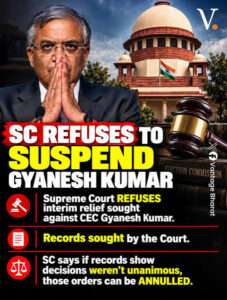
Indeed, what happens if the three Election Commissioners categorically tell the Supreme Court that no decision was taken unilaterally by the CEC? The controversy would then acquire an entirely different complexion. The burden of the allegation would necessarily fall back upon its source. Conversely, if the Commissioners acknowledge that certain decisions were taken contrary to established procedure, the Court would naturally have to examine the legal consequences.
That is precisely why the CJI’s reported observation that a judgment cannot be based merely on one newspaper report assumes significance. A newspaper report can trigger questions; it cannot, by itself, become evidence sufficient to pronounce a constitutional institution guilty.
There is another important safeguard that deserves public attention. Section 16 of the Chief Election Commissioner and Other Election Commissioners Act, 2023 provides statutory protection concerning acts done in the discharge of official duties, subject to the terms of the provision. The validity and scope of this immunity are themselves under challenge before the Supreme Court in separate proceedings. Therefore, it would be premature to treat the provision either as an absolute shield or as something that can simply be ignored.
The larger constitutional principle is therefore straightforward: one constitutional institution cannot casually be permitted to undermine another, just as no constitutional institution can claim absolute immunity from accountability.
The Supreme Court is the final interpreter of the Constitution, but that does not make every allegation placed before it a constitutional fact. Likewise, the Election Commission is a constitutional authority, but Article 324 does not make its decisions immune from lawful judicial review.
The appropriate course is therefore neither judicial overreach nor institutional defiance. Let the Election Commission respond. Let the petitioners establish their allegations. Let the Court examine the Constitution, the statute and the evidence—not newspaper narratives.
If the allegations are proved, the law must take its course. If they are disproved, however, the reputational damage caused to an independent constitutional institution cannot simply be brushed aside.
Constitutional democracy survives not when one institution triumphs over another, but when every institution respects the constitutional limits imposed upon itself. Article 324 entrusts the Election Commission with constitutional responsibility over the electoral process, while judicial review remains subject to the constitutional framework governing the respective powers of the institutions. The Supreme Court itself has recognised the Election Commission as a constitutional authority exercising powers under Article 324.
Having said that, the real question now is for the Congress-led Opposition and other political formations that have demanded the resignation of CEC Gyanesh Kumar: will they continue demanding his resignation even if the allegations on which their campaign is based are not judicially established? If so, on what constitutional or legal basis?
That would expose the deeper contradiction in the entire controversy. Political rhetoric cannot become a substitute for constitutional adjudication, just as allegations cannot automatically become established facts. The oft-repeated narrative that the “Constitution is in danger” loses its force when the same constitutional system provides clearly defined Lakshman Rekhas for the Legislature, Executive and Judiciary—and expects each to remain within them.
The Constitution does not require one institution to surrender to another. It requires every institution to function within its assigned sphere, subject to accountability under law.
And perhaps the final irony is this: the media is often described as the “fourth pillar” of democracy, but the Constitution does not create any such constitutional pillar. The real pillars are the institutions created and empowered by the Constitution itself. Their strength lies not in shouting down one another, but in respecting the constitutional boundaries that hold the Republic together.
Feel it’s high time we have a law ,which should charge a heavy penalty equilent to the time SC is invoveled deposit before it acts may be 50,0000 this may stop everyone going and filing