



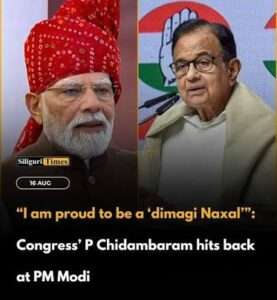
Former Union Home Minister and senior Congress leader P. Chidambaram’s response to Prime Minister Narendra Modi’s reference to “dimagi naxals” is being projected as a political retort. But it could well become something more significant—a revealing window into the mindset of a political generation that presided over the long and bloody battle against Left-Wing Extremism.
Chidambaram has said he is “proud” to be called a dimagi naxal. That may have been intended as sarcasm. Yet it raises an uncomfortable question: why would a former Home Minister, who once occupied the very office responsible for fighting Left-Wing Extremism, choose to embrace a term associated with ideological support for a movement that openly sought to overthrow Bharat’s constitutional democracy through violence?
The distinction is important. Armed Naxalism and ideological sympathy for Naxalism are not the same thing. Criticism of a government cannot automatically be equated with extremism. But neither can ideological justification of violence, romanticisation of Maoist politics or attempts to provide intellectual legitimacy to an armed insurgency be dismissed as ordinary dissent.
This is where Chidambaram’s intervention deserves scrutiny.
Left-Wing Extremism did not emerge overnight. The Naxalite movement took root in West Bengal in the late 1960s and subsequently spread to Andhra Pradesh and several other States. By the 1980s, violence had become a serious internal-security challenge. Naxal groups claimed to speak for the poor and landless, but their declared objective was not merely land reform—it was the overthrow of the elected constitutional order through armed struggle.
The Congress governments of those years cannot escape responsibility for the fact that the menace was allowed to grow into a major security challenge. At the same time, it would be unfair to claim that the Congress did nothing. The Centre did fund counter-Naxal operations through the Security Related Expenditure (SRE) mechanism, which dates back to 1996. Parliament records show that the Centre released substantial assistance to affected States, and the UPA years too witnessed a sharp escalation as the menace intensified.
Indeed, Union Home Minister Amit Shah pointed out in 2024 that approximately ₹1,180 crore was spent under SRE during 2004-14, compared with ₹3,006 crore during 2014-24—almost three times as much. The comparison is significant, though SRE alone cannot represent the entire national expenditure on counter-Naxal operations, because it excludes or does not fully capture the cost of CAPF deployments, intelligence, policing, infrastructure and other security and development interventions.
That is precisely why the argument should not be reduced to a mere accounting exercise.
The real difference after 2014 was the emergence of a more integrated strategy—security operations combined with roads, mobile connectivity, fortified police stations, intelligence coordination and development. Official figures show that SRE releases since 2014-15 have crossed ₹3,700 crore, while thousands of crores more have gone into special central assistance, infrastructure and police strengthening. The number of districts affected by LWE violence fell from 96 in 2010 to 45 in 2022, while incidents and resultant deaths declined by 77% and 90% respectively between 2010 and 2022.
And Andhra Pradesh provides an instructive chapter. The late Dr Y.S. Rajasekhara Reddy’s government attempted talks with Left-Wing extremists in 2004. When negotiations failed, the State increasingly relied on determined policing, intelligence and specialised counter-insurgency capabilities. The role of committed police and intelligence leadership in weakening the Naxal network should not be underestimated.
But today the larger story is unmistakable. The “Red Corridor” has shrunk dramatically. The Centre has built hundreds of fortified police stations, expanded roads and communications and strengthened State forces. The Government’s own data records more than ₹3,331 crore released under SRE over the preceding 11 years, a 155% increase over the previous decade.
Therefore, Chidambaram’s “dimagi naxal” remark should not be celebrated as clever political repartee. It deserves to be examined as a troubling political statement.
If dimagi naxal means someone who supports constitutional dissent, then the phrase should have no place in democratic politics. But if it refers to those who intellectually justify an armed ideology that seeks to destroy constitutional democracy, Chidambaram should explain why he appears comfortable with such a label. And if intellectually rationalising or defending such an ideology is not an “urban Naxal” mindset, then what is?
The Congress need not answer for every Naxalite. But it certainly has to answer for its own record.
And after decades of bloodshed, sacrifice and expenditure, Bharat has every right to ask one blunt question: will political parties fight Naxalism—or merely debate the semantics of those who defend its ideology?
The armed Naxal may be nearing extinction. The greater challenge now is ensuring that the ideology does not find respectable political shelter.
That is the real meaning of Naxalism-mukt Bharat. And perhaps, for the Congress, the more uncomfortable question is whether Bharat is also moving towards a politics that is increasingly Congress-mukt.


