U Lakshmanrao
This article was written in response to the Editor’s thoughtful appeal to develop a theme around the cultural renaissance of Bharat, rooted in the timeless virtues of our ancient heritage. I consider it a particularly inspiring suggestion, as it encouraged me to look beyond the visible dimensions of independence and explore the deeper transformation of the Bhatar’s spirit.
The theme offered an opportunity to reflect on how the values, wisdom, traditions, and ethical principles inherited from our ancient civilisation have evolved through the decades since Independence. It also led me to examine the journey from political freedom to intellectual awakening, cultural confidence, moral responsibility, and spiritual growth.
The article therefore attempts to connect our civilisational heritage with the aspirations of a new Bharat—a Bharat that respects its ancient wisdom while embracing modern knowledge, innovation, rational thought, and progressive values. The true significance of a cultural renaissance, in my view, lies not merely in looking back at our glorious past, but in drawing strength from it to shape a more enlightened, confident, compassionate, and purposeful future.
I am grateful to the Editor for this finest suggestion, which guided me to explore these dimensions more deeply and to consider how the virtues of our past can become a source of strength and direction for generations to come.
When Bharatvarsha attained independence in 1947, it inherited far more than the responsibilities of political freedom. It inherited the profound task of rediscovering its civilisational soul. After centuries of foreign rule, the nation emerged with economic deprivation, social divisions and a lingering psychological uncertainty about its own identity. Yet beneath these visible wounds endured an ancient spiritual consciousness—nurtured by the Upanishads, the Bhagavad Gita, Buddhism, Jainism, the Bhakti and Sufi traditions, and the countless cultural streams that had flowed through the subcontinent for millennia. The journey since independence has therefore been more than a passage from poverty to prosperity; it has been a gradual awakening of Bharatvarsha to the strength, dignity and wisdom of its own civilisational inheritance.

The first decades after independence were devoted principally to nation-building. Democratic institutions had to be established, constitutional values strengthened, education expanded and a remarkably diverse population woven into a common national purpose. Yet the spiritual foundations of Bharatvarsha never disappeared. They continued to live quietly in homes and villages, in temples and monasteries, in literature and music, in festivals and customs, and in the moral imagination of ordinary people. The ancient vision of Vasudhaiva Kutumbakam—the world as one family—remained a quiet philosophical undercurrent even while the nation concentrated upon industrialisation, scientific development and economic reconstruction.
With the passage of time, a deeper psychological transformation began. A civilisation that had long been compelled to see itself through the eyes of its former rulers slowly recovered its confidence. Scientific achievements, agricultural progress, industrialisation, democratic continuity, educational expansion and technological advancement demonstrated that Bharatvarsha possessed not merely the capacity to survive, but the ability to create, innovate and lead. Economic confidence gradually became cultural confidence. The old assumption that modernity required the abandonment of tradition began to lose its force. Science and spirituality, technology and philosophy, innovation and heritage increasingly came to be understood not as opposing forces, but as complementary dimensions of a mature civilisation.
The most remarkable expression of this transformation can be seen in the younger generation. Each generation inherited a Bharatvarsha different from the one known by its predecessors. The first generation after independence helped build institutions and strengthen the foundations of democracy. Later generations entered the expanding worlds of science, engineering, medicine, education, management and public administration. Economic liberalisation opened new horizons, while the digital revolution placed the knowledge of the world within immediate reach. The young citizen of today can celebrate Diwali, practise yoga, study artificial intelligence, build a global enterprise, explore space technology and engage with distant cultures without necessarily seeing any contradiction between these pursuits.
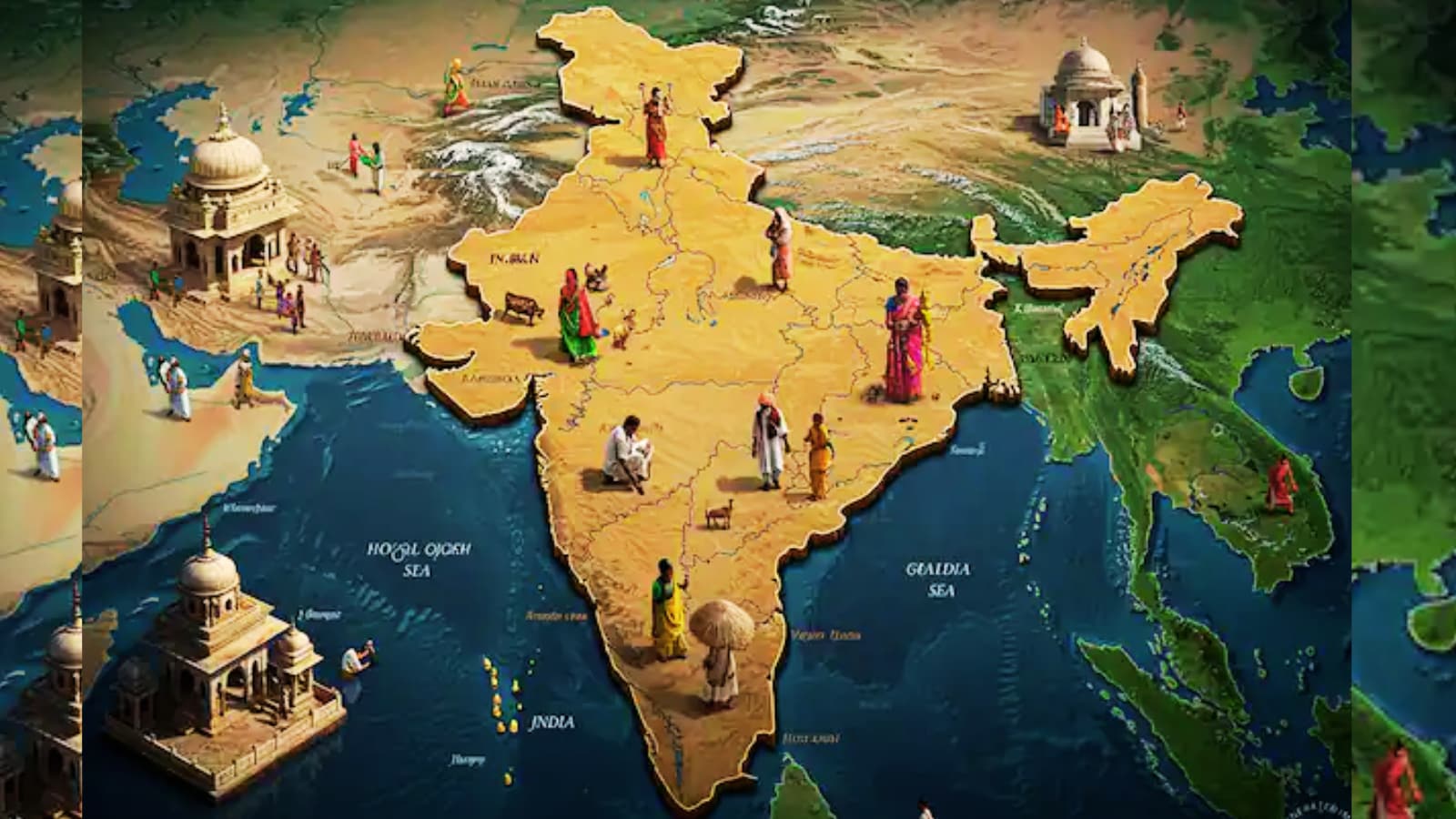
This is perhaps the finest transformation of all: a name and identity once weakened by historical circumstances have increasingly been reclaimed through the deeper civilisational consciousness of Bharatvarsha. The rediscovery of Bharat is not merely a change of nomenclature; at its finest, it represents a return to an ancient rootstock while remaining fully engaged with the modern world. It is the recovery of an inner continuity—a recognition that the civilisation which produced profound philosophical inquiry, scientific curiosity, artistic excellence and ethical thought need not stand outside modernity in order to preserve its identity.
The revival of cultural consciousness has consequently assumed many forms. Yoga, meditation, Ayurveda, Indian philosophy, classical music and dance, traditional knowledge, literature, architecture, crafts and cuisine have found renewed appreciation both within Bharatvarsha and across the world. Their significance, however, lies not merely in preservation. Heritage becomes truly powerful when it inspires contemporary creativity. Young artists, scientists, entrepreneurs, writers, designers and innovators are demonstrating that tradition need not remain confined to memory. When joined with imagination, it becomes a living force capable of creating something new.
The spiritual renaissance of Bharatvarsha is equally significant. The essence of its ancient dharma was never confined to ritual alone. It embraced righteousness, responsibility, self-discipline, compassion, truth, balance and the pursuit of inner knowledge. The wisdom of the Bhagavad Gita, for instance, speaks of action without bondage to its fruits; the Upanishadic tradition turns the mind towards the discovery of the Self; Buddhism and Jainism emphasise compassion, restraint and freedom from attachment; Bhakti traditions place devotion at the heart of human experience. These principles possess a remarkable relevance in an age increasingly burdened by anxiety, comparison, material excess and information overload.
For the younger generation, therefore, spirituality need not mean withdrawal from the world. Properly understood, it can provide the inner discipline necessary to engage with the world more intelligently. It can become a source of clarity rather than dogma, courage rather than fear, compassion rather than division, and ethical action rather than mere ritual. The great challenge is to communicate these timeless principles in a language that speaks naturally to modern minds.
The psychological meaning of freedom has also undergone a profound change. For the generation that witnessed independence, freedom meant liberation from foreign rule. For a self-confident civilisation, freedom acquires a deeper dimension: freedom from intellectual insecurity, cultural inferiority and inherited limitations of imagination. The contemporary youth increasingly seeks a fuller definition of success—professional accomplishment, financial independence, personal wellbeing, social responsibility and pride in the nation’s civilisational heritage. Yet this generation also faces unprecedented pressures: relentless competition, social-media comparison, consumerism, loneliness, uncertainty about careers and confusion regarding values. Material progress without inner equilibrium can easily become another form of bondage.
The future of Bharatvarsha will therefore depend upon the ability of its youth to harmonise three great forces—technological advancement, economic aspiration and moral responsibility. Artificial intelligence, biotechnology, space exploration, renewable energy and digital infrastructure will reshape the material conditions of human life. But technology by itself cannot decide what kind of civilisation emerges from these achievements. The character of citizens, the integrity of institutions and the values that guide power will determine whether progress produces merely greater wealth or a deeper form of human development.
The true promise of Bharatvarsha lies in synthesis. It need not choose between ancient wisdom and modern science, between national consciousness and global citizenship, or between economic prosperity and spiritual depth. Its civilisational genius has always been its capacity to absorb, question, reinterpret and renew. The finest future would therefore not be a return to the past, but a creative continuation of its deepest principles in circumstances unknown to earlier generations.
The young generation stands at the centre of this great possibility. Nearly forty crore young minds represent not merely a demographic strength but an extraordinary civilisational opportunity. They are inheritors of an ancient legacy and architects of an entirely new future. Their responsibility is neither to become prisoners of the past nor to become detached from it, but to understand its wisdom and give it contemporary expression. If they can unite knowledge with wisdom, ambition with responsibility, freedom with discipline and prosperity with compassion, they can carry forward the unfinished work of national renewal.
The independence of Bharatvarsha thus promised more than political sovereignty. It opened the possibility of recovering an ancient civilisational confidence and allowing that inheritance to grow dynamically in the modern world. The enduring strength of dharma lies precisely in its ability to respond to changing circumstances without surrendering its essential principles. It does not merely resist the challenges and menaces of an age; at its best, it meets them with wisdom, balance, courage and compassion.
The noblest spirit of the modern world may therefore emerge not from the rejection of ancient roots, but from a deeper understanding of them. The values that once guided sages, philosophers, seekers and ordinary communities can acquire renewed meaning when carried by educated, confident and compassionate young citizens. In that union of ancient wisdom and contemporary imagination lies the possibility of a new civilisation—not a civilisation that merely remembers its greatness, but one that transforms its inheritance into a gift for humanity.
From independence to the present, the most consequential transformation of Bharatvarsha has therefore occurred beneath the surface of statistics, institutions and technology. It has been the quiet restoration of self-belief, cultural consciousness and spiritual confidence. The next chapter will be written not simply by the power of its economy or the brilliance of its technology, but by the depth of its character. If Bharatvarsha succeeds in preserving the wisdom of its ancient rootstock while giving it new life through science, creativity and ethical action, its renaissance will belong not merely to a nation, but to a civilisation—and its legacy may become a source of light for the wider human family.