It is with considerable restraint that I chose the subject for this column, following a request from the Editor to express my views on how I assess Bharat’s achievements as we celebrate its 80th Independence Day. Much has already been said by Prime Minister Narendra Modi about the nation’s journey, achievements and aspirations. Yet, as a citizen and someone who has closely watched Indian politics, I felt compelled to depart from the usual celebratory narrative and express my displeasure at the manner in which the political discourse is being steadily degraded.
The present NDA government, whatever one’s political preferences, has repeatedly asserted its commitment to constitutional institutions and parliamentary democracy. Its supporters would argue that, unlike the Congress era—when the political misuse of investigative and constitutional institutions has been a recurring subject of historical debate—the Modi government has not followed a systematic policy of eliminating political opponents. Whatever the political arguments, much of the conduct of governments and political parties remains in the public domain and is open to scrutiny.
That is precisely why the conduct of Rahul Ghandy, the dynast and Leader of the Opposition in the Lok Sabha, becomes so disappointing. After the Congress secured 99 seats in the 2024 Lok Sabha election, giving the party its strongest showing in a decade but still leaving it far short of a parliamentary majority, Rahul Ghandy occupies an important constitutional and political position. The Leader of the Opposition is not merely another political campaigner. The office carries responsibility, visibility and, above all, a duty to question the government seriously.
Instead, Rahul Ghandy increasingly appears to be auditioning for a new role in Indian politics—that of a stand-up comedian.
The difference, however, is that professional comedians work hard to make people laugh. Rahul Ghandy increasingly appears to work hard to make people wonder whether they should laugh, wince or simply switch off.
His repeated attempts to reduce Prime Minister Narendra Modi’s foreign policy to “hug diplomacy” are a case in point. A serious Leader of the Opposition could have questioned the government’s diplomatic priorities, challenged its strategic partnerships, examined the outcomes of foreign visits or demanded greater transparency on international agreements. There is nothing wrong with robust criticism. That is what democracy requires.
But reducing international diplomacy to jokes about hugs is hardly the level of political argument expected from the Leader of the Opposition.
And this is where the contrast becomes particularly striking. Bharat’s foreign policy under Modi, with the experience of External Affairs Minister S. Jaishankar, has undergone a visible transformation. Bharat today simultaneously engages with the United States, Russia, Europe, Japan, the Gulf, Africa and the wider Global South while maintaining strategic autonomy. It has expanded partnerships, strengthened its diplomatic footprint and increasingly insisted that terrorism, particularly terrorism emanating from Pakistan, cannot be treated as merely a bilateral irritant.
Pakistan, once accustomed to portraying every India-related issue as a bilateral dispute, has found itself increasingly isolated diplomatically over its record of supporting cross-border terrorism. Following the Pahalgam terror attack and Operation Sindoor, Bharat made it clear that terrorism would have consequences and took the issue directly to the international community.
That is foreign policy.
A hug is merely a photograph.
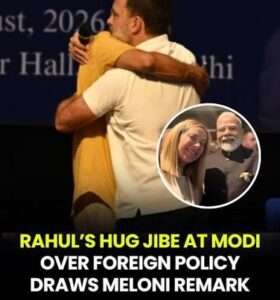
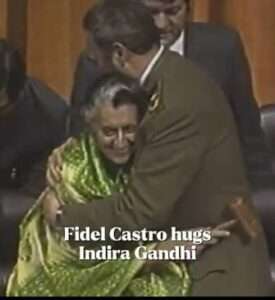
Even more amusing is Rahul Ghandy’s apparent discovery that physical gestures between world leaders are somehow a new invention of Modi diplomacy. If an embrace is sufficient evidence of foreign-policy incompetence, perhaps he should revisit the history of his own family. Indira Gandhi, too, met, embraced and cultivated relationships with numerous world leaders. Was every such gesture also “hug diplomacy”?
The real question, therefore, is not who hugged whom. It is what Bharat gained from those relationships.
Under Modi, Bharat has emerged as one of the world’s fastest-growing major economies, is seeking to become a global manufacturing and technology hub, is expanding its defence capabilities and has cultivated relationships across geopolitical camps. Modi has also received the highest civilian honours of numerous countries—an indication, at the very least, of the recognition Bharat’s diplomatic outreach has received internationally.
So, what exactly is Rahul Ghandy mocking?
As someone who comes from a hardcore Congress family and is a qualified engineer, I say this with genuine sadness rather than political malice. I would have expected the Leader of the Opposition to provide a credible alternative vision for Bharat at 80—not turn serious questions of national interest into political comedy.
Opposition is indispensable to democracy. But opposition without substance becomes theatre; ridicule without argument becomes comedy.
And if Rahul Ghandy is determined to become Indian politics’ first full-time stand-up comedian, perhaps he should at least leave foreign policy to the diplomats.
Bharat has grown up. It is time its political discourse did too.