Vinay Rao
I was rather delighted when the Editor of OrangeNews9 asked me to share my experiences as a citizen and responsible journalist, and reflect on how I view Independent India’s eight-decade journey, even though I am relatively young and in my mid-forties. Yet, I saw it as an opportunity to take a break from sports writing and revisit some of my fondest childhood memories—of how enthusiastically we celebrated Independence Day and, years later, the profound emotion of witnessing the tricolour Indian flag flutter at Lal Chowk in once terror-torn Jammu and Kashmir.
Yes, I must have been in school when my August 15 ritual was set: the flag hoisting at seven, the national anthem, a few dutiful lines about freedom fighters—and then the packet. An assortment of sweets, some mixture, perhaps a biscuit or two, handed out as we filed past. In the India of the late 1980s, when such things were still a small luxury, that packet was the day’s real headline for a child. We would not have missed it for anything.
Patriotism, at that age, tasted faintly of laddoo and namkeen, and I do not think any less of it for that. Every nation’s idea of itself has to start somewhere, and for many of us, it started in a schoolyard queue.
College brought a different rhythm. The flag hoisting remained the opening formality, but what we actually waited for was the cricket match that followed—bragging rights among departments, a ball that inevitably landed on someone’s terrace, and an afternoon that felt more like ours than the nation’s. Somewhere in those years, without anyone quite deciding it, August 15 had quietly become routine. Flag up, anthem sung, an event or two, flag down. Important, certainly—but not urgent. Not something that pressed upon you.
That changed, gradually and then unmistakably, in the years that followed. Independence Day stopped being a fixed, unchanging ritual and began acquiring new layers almost every year—campaigns, symbols, commemorations and new ways of participating that had not existed before. It became less a date to observe and more an occasion to be part of.
I remember, too, the period when playing the national anthem in cinema halls became a matter of national debate. In 2016, the Supreme Court directed that the anthem be played before feature films and that audiences stand; the order was subsequently modified in 2018. People debated and contested the issue, as they should in a democracy. Yet there was no mistaking the larger phenomenon: the symbols of the Republic were no longer confined to official ceremonies. They had entered everyday public life and, inevitably, our arguments about what patriotism should mean.
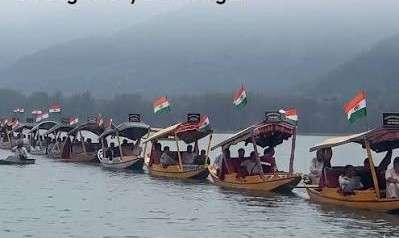
And then came images from Kashmir that, for someone of my generation, would have seemed difficult to imagine not too many years earlier: the Tricolour being displayed and hoisted openly in Srinagar and around Dal Lake, amid the kind of civic participation we normally associate with any other Indian town or city.
Whatever one’s view of the politics, policies or events that brought about this change, the sheer visual remains powerful. The most striking thing about such an image is not the flag itself but the possibility of its becoming ordinary. A symbol becomes truly powerful when it no longer appears extraordinary. When the Tricolour can fly over a place once associated in the national imagination primarily with conflict and uncertainty, and when citizens can celebrate Independence Day in an atmosphere of normalcy, that visual carries a significance of its own.
I set down these memories not as a verdict on any particular government or era, but because I think they trace something true about the country itself. We have moved from a nation that often treated freedom as a settled, slightly sleepy inheritance—hoist the flag, eat the sweets and get on with the day—to one that keeps asking itself, sometimes noisily and sometimes clumsily, what that freedom is actually for.
That is not a small shift. Nor is it without its costs, contradictions and critics. A republic that stops questioning itself stops growing. But a republic that forgets what made its freedom possible risks something even more fundamental: taking that freedom for granted.
Beneath the sweets, the ceremony, the campaigns, the symbols and the endless debates lies something we too easily forget to feel: this day exists because of sacrifices too numerous to count. We take freedom much as we take the air we breathe—without thinking about it—until something reminds us that neither was ever guaranteed.
Someone, somewhere, once gave his or her life for a freedom that they themselves would never live to experience. That is not merely a fact to be read in a textbook and filed away. It is something to be felt quietly, in the heart, if we are to remain connected to those who made our freedom possible. No pageantry, however grand, can substitute for that private moment of gratitude.
Each of us carries a private ledger of what August 15 meant at different ages: a packet of sweets, a cricket match, a flag over Srinagar, and now, perhaps, a quiet debt of gratitude finally understood.
Add up enough of those private ledgers, and you get something close to the real history of a nation—not merely the history recorded in official documents, but the history lived by its people.
Eighty years on, Bharat is still being written. It is being written in our memories, in our arguments, in our aspirations and, above all, in the freedoms we choose to value and preserve.
For me, August 15 began with a packet of sweets.
It has ended up as something much larger: a quiet thank-you to a nation, and to those who made it free.