



The successful user-trial of the Agni-IV ballistic missile marks yet another milestone in Bharat’s steady march towards strategic self-reliance and credible deterrence. In an increasingly volatile Asian security environment, where two nuclear-armed neighbours continue to modernise their military capabilities, the latest validation of Agni-IV sends a clear message: Bharat possesses both the technological capability and the political resolve to safeguard its sovereignty.
Developed indigenously by the Defence Research and Development Organisation (DRDO) and inducted into the Strategic Forces Command (SFC), the Agni-IV is far more than another missile in the country’s arsenal. It represents decades of indigenous research, engineering excellence and technological perseverance that have steadily transformed Bharat from a defence importer into a nation capable of designing and manufacturing sophisticated strategic weapon systems.
With an operational strike range of approximately 3,500 to 4,000 kilometres, the road-mobile Agni-IV places critical strategic targets well within reach while offering exceptional operational flexibility. Its mobility enables rapid deployment across different theatres—from the northern front to the eastern seaboard—making it significantly harder for any adversary to locate or neutralise before launch. Equipped with a two-stage solid-fuel propulsion system, state-of-the-art navigation, ring-laser gyroscope-based inertial guidance and high terminal accuracy, the missile can deliver either a conventional or a nuclear payload of up to one tonne with remarkable precision.
Equally significant is the fact that the latest launch was conducted as a routine user-training exercise by the Strategic Forces Command rather than as a developmental test. Such trials validate not merely the missile’s design but also the operational readiness of the country’s nuclear deterrent. A weapon acquires strategic value only when it can be deployed reliably under real-world conditions. Regular user trials therefore reinforce confidence in both the platform and the personnel responsible for operating it.
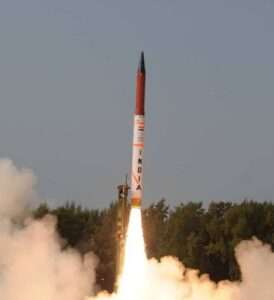
The journey to this stage has been neither short nor easy. Initial developmental setbacks more than a decade ago were followed by a series of successful tests that progressively demonstrated longer ranges, greater accuracy and improved reliability. Today, Agni-IV stands as one of the most dependable pillars of Bharat’s strategic missile force, reflecting the maturity achieved by DRDO’s indigenous missile programme.
More importantly, Agni-IV forms part of a much broader transformation underway in India’s defence ecosystem. Under the vision of Atmanirbhar Bharat, indigenous defence manufacturing has moved beyond licensed production to original design and development. From missile systems and artillery to fighter aircraft, warships, drones and air defence platforms, the country is increasingly reducing dependence on foreign suppliers. This strategic autonomy is indispensable in an era where global supply chains can be disrupted by geopolitical conflicts and sanctions.
Nor does the journey end with Agni-IV. Bharat has already demonstrated the significantly longer-range Agni-V, capable of reaching well beyond 5,000 kilometres, while the successful testing of Multiple Independently Targetable Re-entry Vehicle (MIRV) technology under Mission Divyastra has showcased another leap in strategic capability. Together, these developments strengthen India’s doctrine of credible minimum deterrence while remaining fully consistent with its long-standing policy of No First Use.
Unlike nations that indulge in nuclear brinkmanship or coercive rhetoric, Bharat’s strategic programme has always been defensive in nature. Its objective is not aggression but deterrence—to convince any potential adversary that the costs of military adventurism would be unacceptable. Peace is best preserved when deterrence is unquestionable.
The successful validation of Agni-IV is therefore not merely another defence headline. It is a testament to the vision of India’s scientists, engineers, armed forces and policymakers who have patiently built indigenous capabilities over decades. As Bharat aspires to emerge as a leading global power, strategic autonomy will remain inseparable from technological self-reliance. Agni-IV is not just a missile; it is a powerful symbol of an Atmanirbhar Bharat that is capable of defending its interests with confidence, credibility and indigenous strength.

