



The greatest strength of democracy is that the public has the right to question the government. This right keeps democracy alive. When shortcomings are discovered in a government system, when irregularities occur in an examination, when the future of youth is questioned, protest is not only natural but also necessary. But this very power of democracy begins to weaken when the focus of a real issue gradually shifts to political competition, ideological polarization, and power struggles. Then the original question is left behind, and the calculus of political gains and losses takes the forefront.
The alleged paper leak and other irregularities in the NEET exam shocked the entire nation. Millions of students worked hard for years, and families spent beyond their financial means to prepare their children for competitive exams. However, when the fairness of the examination process was questioned, the confidence of students and parents naturally wavered. In such a situation, it is entirely justified to demand answers from the government, demand strict action against the culprits, and demand reforms to the examination system. The primary responsibility of any democratic government is to ensure transparency and accountability in matters concerning the future of its citizens, especially the youth.
It is equally true that any paper leak cannot be dismissed as merely an administrative lapse. This is not merely the theft of a question paper, but a betrayal of millions of dreams. Fair investigations and swift punishment of individuals, gangs, or officials involved in such crimes are essential. If there are shortcomings in the system, it is the government’s responsibility to address them. Making the examination system more technologically secure, increasing digital monitoring, establishing accountability, and ensuring timely justice are no longer just options, but a necessity.
But another aspect of this entire incident also emerged. As the protests grew, political debates increasingly overtook the core issue in many places. Various political parties, social organizations, and ideological groups began presenting the issue from their own perspectives. The question of student welfare gradually became a medium for political accusations and counter-accusations. Some platforms criticized government policies, while others questioned the entire democratic structure. At times, even the limits of language were violated. This naturally raises the question: was the movement’s goal to secure justice for students or to gain political advantage?
The role of the opposition is crucial in a democracy. The opposition questions the government, reviews policies, and brings the public’s voice to Parliament and the streets. Similarly, the ruling party’s responsibility is not only to list its achievements but also to answer the public’s concerns. Democracy remains healthy when both parties respect their constitutional roles. However, if every issue is weighed solely on the scale of political gains and losses, the common citizen suffers the most.
India’s democracy has gone through many difficult periods. After independence, the country witnessed political instability and periods like the Emergency, when civil liberties were severely restricted. That history also taught us that democracy is protected not only by the Constitution but also by informed citizens. Today, the situation is different. Social media has given every citizen a platform to express their views. Governments are criticized more openly than ever before. This is a testament to the strength of democracy. However, it is equally important to maintain the distinction between freedom of expression and indecency. Dissent is a democratic right, but personal insults, hatred, and propaganda weaken any healthy society.
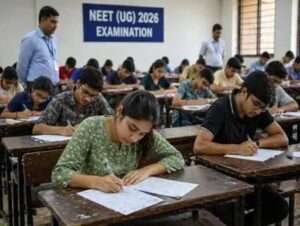
Today, social media has simplified communication as much as it has complicated it. Unverified information, half-baked videos, emotional posts, and political propaganda reach millions of people within minutes. As a result, issues are often decided based more on emotions than facts. During the NEET controversy, a wide variety of information and claims emerged. At such times, the responsibility of citizens, the media, and political parties—all of them—increases to express their views based only on verified facts.
There are varying opinions in the country about Prime Minister Narendra Modi’s leadership. His supporters consider his achievements to include infrastructure expansion, digital governance, India’s growing role on international platforms, and numerous welfare schemes. His critics, meanwhile, raise serious questions about unemployment, inflation, social tensions, and some administrative decisions. The maturity of democracy lies in ensuring that both sides have the right to express their views. A leader should be judged not solely by his popularity, but by his decisions, results, and accountability.
It must also be kept in mind that elections are not the final stage of democracy, but rather a crucial one. The public chooses from available options based on their discretion. This does not mean that the elected government is above criticism. Similarly, it is not appropriate to dismiss every government decision without supporting it with facts. The balance of democracy lies in acknowledging achievements while also clearly questioning shortcomings.
The NEET controversy has exposed a deeper problem in the education system. Competitive exams in India are no longer just tests, but have become the foundation of the social and economic aspirations of millions of families. In such a scenario, any irregularity becomes not just an administrative failure but a crisis of social trust. Therefore, it is essential to transform the examination system into an opportunity for institutional reform rather than making it a permanent subject of political debate.
Political parties should also introspect. If a student movement is led through political platforms, the public will naturally question its impartiality. Similarly, if the government simply dismisses opposition criticism as political, public trust will also diminish. The solution lies not in confrontation, but in dialogue. In a democracy, dialogue is the only means by which even disagreement can be channeled positively.
In a vast democracy like India, it is the responsibility of every citizen to support or oppose any movement based on facts. Spreading hatred against any religion, caste, language, or region is contrary to the spirit of any democratic movement. If a genuine issue is used as a means of social division, it ultimately harms the very purpose for which the movement was started.
The need today is not just to fix blame, but to secure the future. The use of modern technology in the examination system, improved standards for question paper security, transparent investigations, timely justice, strict punishment for those guilty, and effective support systems for students’ mental health—all these reforms are the need of the hour. If implemented seriously, such incidents can be prevented in the future.
The success of democracy isn’t measured solely by changes in power. Its true test is the trust citizens have in their institutions. As important as government accountability is, so too is public responsibility. Protest is necessary, but its purpose should be solutions, not anarchy. Criticism is essential, but it should be based on facts, not prejudice. Support is also essential, but it should be based on rational belief, not blind imitation.
Ultimately, the question isn’t just about NEET. It’s about the system on which the future of millions of our country’s youth depends. It’s also about democracy, which gives every citizen the right to express their views. If we succeed in maintaining the dignity of both, that will be the greatest achievement of this entire controversy. Students should get justice, the guilty should be punished, institutions should be strengthened, and political parties should put student interests above party interests—this is the hallmark of any sensitive democracy. Because democracy is strongest when the ultimate goal of every struggle is not power, but the trust of society and the future of the nation.


The core areas of any countries development,
* Education
* Health
* Telecommunication
* Power
* Housing
Must be independent of Politics and political interference in their functioning.
These areas must be run by bodies directly under the President of India as entities with clear business agenda and performance evaluation