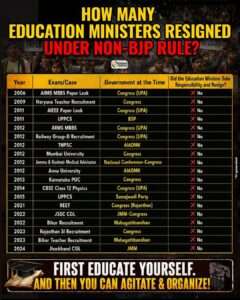
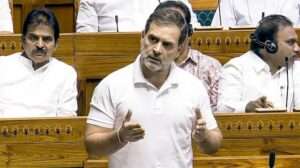
Nothing exposes political hypocrisy better than refusing to debate an issue after spending weeks demanding one. The Congress-led Opposition’s conduct over the NEET question paper leak issue and the events at Jantar Mantar has done precisely that. Its hidden agenda is no longer difficult to decipher – it was never merely about the students, but about ensuring that Parliament does not function and that political capital continues to be extracted from a national concern. The Narendra Modi government has categorically stated that it is willing to debate the issue in Parliament. Parliamentary Affairs Minister Kiren Rijiju made the government’s position unambiguously clear in the Lok Sabha. Prime Minister Narendra Modi has assured the nation that stringent legislation would be brought in to deal mercilessly with question paper leaks and exemplary punishment would await those found guilty of destroying the future of lakhs of students. The Union Cabinet has been actively engaged in finalising measures to plug every possible loophole in the examination system. If the government is willing to debate, willing to legislate and willing to accept constructive suggestions from the Opposition, what then is preventing Parliament from functioning? The answer perhaps lies in the Congress party’s conduct itself. Rahul Gandhi’s declaration that the Opposition would agree for a debate only if three preconditions were fulfilled – the resignation of Education Minister Dharmendra Pradhan, action against the policemen involved in the alleged excesses and an apology from the Prime Minister – speaks volumes about the Opposition’s political arrogance. Parliamentary debate is not a favour that the Opposition extends to the nation. It is its constitutional obligation. The Opposition cannot hold Parliament hostage until its political demands are first conceded. One is tempted to ask: if resignations and apologies are prerequisites, what exactly remains to be debated in Parliament? Ironically, the biggest setback to the Congress party’s political narrative came not from the Treasury Benches, but from Sonam Wangchuk himself. The Ladakh leader, who spearheaded the agitation, chose dialogue over confrontation. After receiving firm assurances from the government through Union Ministers J.P. Nadda and Jitendra Singh, Wangchuk ended his fast, making it abundantly clear that his primary concern was safeguarding the future of India’s students and not indulging in partisan politics.
That decision seems to have upset the Opposition more than it pleased them. The speed with which sections of the Congress ecosystem and their allies began questioning Wangchuk’s intentions and describing him as “sold out” is both unfortunate and revealing. Does accepting the government’s assurances amount to betrayal? Has dialogue become a political crime in contemporary opposition politics? Or is every agitation expected to continue indefinitely until it culminates in the political embarrassment of the Narendra Modi government? The answers are self-evident. The Congress-led Opposition appears to have forgotten that agitations cannot become permanent political projects. Their purpose is to secure solutions. When solutions are offered, democratic maturity demands engagement, not endless confrontation. The government’s decision to order investigations into the violence witnessed during the protests, which reportedly left over a hundred police personnel injured, has perhaps made certain political actors uncomfortable. Questions are now being asked about who mobilised the crowds, who financed the agitation, and whether vested interests had infiltrated what was projected as a students’ movement. These are legitimate questions that deserve answers through due process of law. More importantly, crucial legislation awaits Parliament’s approval. National interest cannot become collateral damage in the Opposition’s pursuit of political theatre. Parliamentary democracy survives on debate, disagreement and accountability – not disruption for disruption’s sake. The Congress party must realise that being in Opposition does not mean opposing governance itself. It certainly does not mean reducing Parliament into a battlefield of ultimatums. Students deserve justice. The guilty deserve punishment. Parliament deserves to function. The Congress party and its allies would do well to remember that they are the Opposition in Parliament, not the Parliament itself. They do not possess the privilege of deciding when the House should function and when democracy must pause for their political convenience. Their duty is to question, criticise and challenge the government from the floor of the House—not to reduce Parliament into an instrument of political blackmail. If they have facts, let them debate. If they have evidence, let them expose the government. If they have better ideas, let them persuade the nation. But if they merely have ultimatums, they have no moral right to hold the country’s legislative business hostage. Bharat’s students deserve justice, Parliament deserves dignity and democracy deserves better than an arrogant Opposition.