Lakshmanrao Upadhyayula
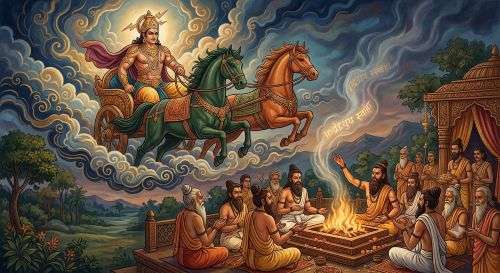
In the sacred current of the Ṛigvedic revelation, the illustrious sage Sounaka Grutsamada stood among those enlightened seers whose consciousness moved between the visible and the invisible realms. With profound spiritual perception, he invoked Indra through the majestic cadence of the Tristubh chandas, the powerful metrical form employed in hymns of heroism, cosmic struggle, and divine illumination. These hymns were not merely poetic compositions but living vibrations, born from states of heightened awareness wherein the sages perceived the forces governing nature, consciousness, and cosmic order. In the Vedic understanding, sound itself was creative power, and the utterance of mantra became a bridge between the mortal and the eternal.
Indra, celebrated as the luminous sovereign of the Devas, emerged in the Vedic vision not merely as a tribal war-god but as the embodiment of awakened force, intelligence, courage, and celestial authority. By divine birth and incomparable prowess, he became the crest-jewel among the gods and the foremost among beings endowed with heroic energy. The hymns portray him as the power before whom both earth and heaven tremble in reverence. His strength was not only physical might but also the irresistible momentum of cosmic order overcoming chaos. As commander of the celestial hosts, he represented the victorious emergence of light over obscurity, consciousness over ignorance, and harmony over destructive disorder.
The sages declared that when the earth sank into instability and the mountains themselves seemed seized by violent unrest, it was Indra who restored equilibrium. In symbolic and scientific temperament alike, these hymns reveal an ancient intuition regarding the balancing forces of nature. The Vedic seers perceived the universe as dynamic rather than static, sustained through opposing energies held in cosmic rhythm. Thus Indra was praised as the power that stabilized the trembling earth, restrained the fury of the mountains, and established the radiant mid-region between heaven and earth. The “shining space” created by him may be understood both spiritually as the illumined realm of consciousness and scientifically as an intuitive perception of atmospheric order emerging from primordial turbulence.
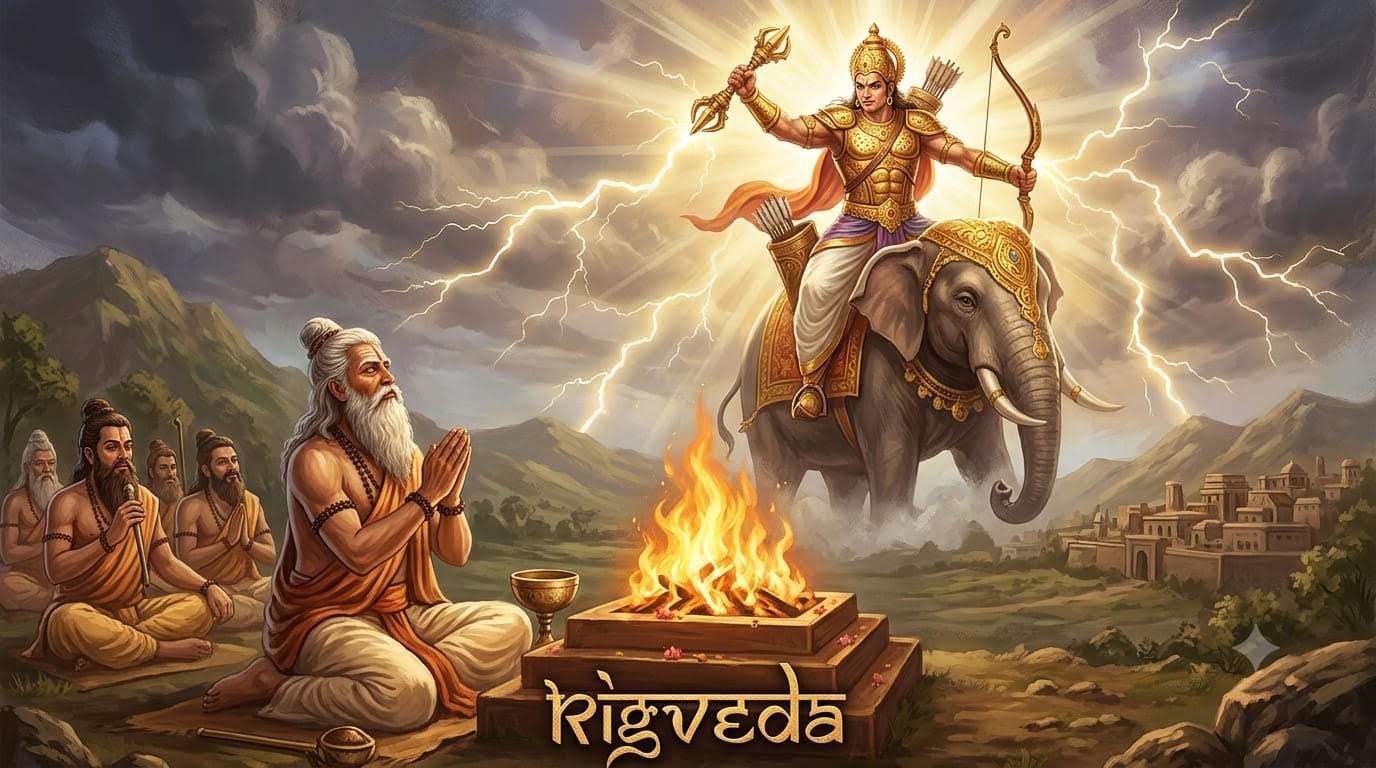
The slaying of the serpent-demon Vṛtra forms one of the grandest symbols in Vedic literature. Vṛtra represented obstruction, inertia, drought, and the imprisoning forces that hinder the free movement of life. When Indra shattered Vṛtra with the thunderbolt, the rivers and oceans were released to flow once more across the world. Spiritually, this signifies the breaking of ignorance and the liberation of the currents of consciousness within the human being. Scientifically, the imagery reflects an early observation of monsoon phenomena, thunderstorms, and the release of rain-bearing waters after atmospheric tension. The Vedic sages transformed natural events into metaphysical insight, perceiving divine intelligence operating through the processes of nature.
Likewise, the hymn speaks of Indra liberating the cows imprisoned by the demon Bala. In the Vedic idiom, cows symbolized rays of illumination, wisdom, abundance, and the nourishing powers of life. Their captivity represented the concealment of truth beneath darkness and confusion. Indra’s recovery of the cows therefore symbolized the restoration of divine knowledge to humanity. The fire generated between two clouds, described as Agni arising in the heavens, reflects a strikingly observant vision of lightning emerging from electrical tension in storm clouds. Such imagery reveals that the Vedic mind united spiritual symbolism with keen observation of natural phenomena, seeing no division between sacred truth and cosmic process.
The hymns further proclaim that the entire universe stands established through the ordering power of Indra. He drove the hostile Dasyus into hidden and inferior regions, symbolizing the subjugation of forces opposed to truth and harmony. These Dasyus were not merely external enemies but also representations of inner ignorance, greed, falsehood, and spiritual blindness. Indra’s arrows piercing the enemies and seizing their riches signify the triumph of awakened consciousness over the hidden energies that obstruct human evolution. In the Vedic world-view, the outer battle and inner battle were reflections of one another, and every cosmic struggle mirrored the ethical and spiritual struggle within the human heart.
The sages observed that human beings often questioned which divine power was truly supreme, fierce, and all-pervading. Yet in moments of danger, uncertainty, and warfare, the mind instinctively turned toward Indra, the lord capable of laying his hand upon all treasures and powers. The hymns reveal an enduring psychological truth: humanity seeks a principle of assurance amid the unpredictability of existence. Indra thus became the archetype of confidence, resilience, and victorious will. The exhortation to trust his power was simultaneously a call to awaken courage within oneself, for the Vedic gods also represented forces latent in human consciousness.
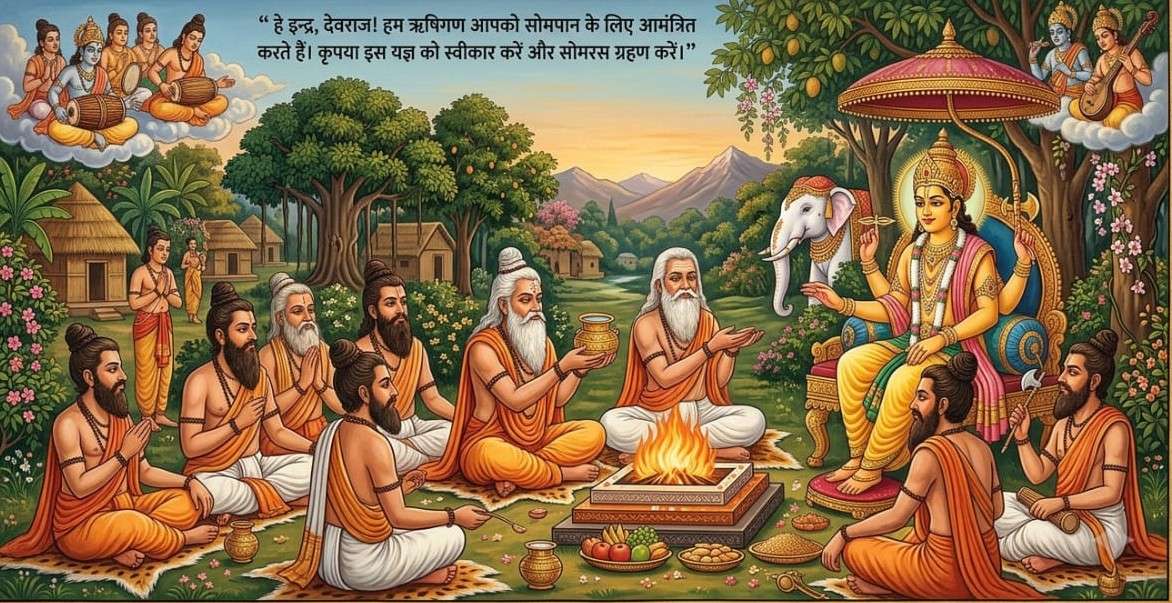
Indra was praised as the giver of wealth, not merely material riches but also strength, vitality, insight, and spiritual prosperity. He uplifted the needy and protected those who purified Soma, the sacred elixir central to Vedic sacrifice. Soma symbolized both a ritual offering and an exalted state of divine ecstasy attained through spiritual discipline. The protector of Soma was therefore the guardian of sacred knowledge itself. The hymns imply that divine grace descends where purity, dedication, and inner aspiration are present. Thus Indra stood as the sustaining force behind sacrifice, devotion, and the quest for immortality.
All living prosperity—horses, cattle, villages, fertile lands, and chariots—was believed to flourish under his sovereign influence. He stirred the waters, awakened the dawn, and released the brilliance of Uṣas across the horizon. These poetic descriptions reveal an astonishing intimacy with the cycles of nature. Dawn, rainfall, rivers, fertility, and celestial movement were not viewed as accidental mechanisms but as manifestations of a cosmic intelligence that nourished life. The hymns thereby cultivated reverence toward nature while simultaneously encouraging observation of its rhythms and laws.
Whenever armies assembled upon the battlefield and warriors stood facing one another in uncertainty, Indra was invoked as the decisive power of victory. Even rival warriors upon similar chariots prayed to the same deity, revealing the Vedic understanding that divine power transcends tribal divisions. Indra was present wherever courage, discipline, and heroic striving arose. Yet the deeper battle described in these hymns was always the battle between illumination and ignorance, between disciplined consciousness and destructive impulse.
The hymns extol him as the slayer of sinful and destructive forces through the thunderbolt known as Vajra. The Vajra symbolized concentrated energy, irresistible truth, and the penetrating force of awakened intellect. In spiritual interpretation, the Vajra destroys illusion and fragmentation within the human mind. In natural symbolism, it evokes the tremendous power of lightning that rends the sky during storms. Thus, the Vedic imagination transformed atmospheric electricity into a symbol of divine consciousness descending into the world.
One remarkable episode describes Indra pursuing the demon Śambara through the caves of mountains for forty years before finally destroying him. This prolonged struggle symbolized the persistence required to overcome deeply rooted ignorance and hidden obstruction. The sleeping serpent Ahi, also slain by Indra, represented dormant but dangerous forces concealed within existence. The Vedic sages recognized that darkness often survives not through open confrontation alone but through concealment, inertia, and unconsciousness. Hence the divine hero must possess patience as well as strength.
The hymn then celebrates the many-hued manifestations of Indra—Varāha, Swapatha, Vidyut, Mahah, Dhoopi, Swapi, Gruhamedha, and Rasmimanth—forms radiant with cosmic symbolism. These names suggest powers connected with lightning, radiance, pathways of energy, illumination, sacrifice, and celestial brilliance. The “seven rivers” or Saptasindhu released by Indra were both geographical realities and symbols of seven streams of spiritual consciousness flowing through existence. The mountains trembling before his force and the heavens saluting him reveal the immeasurable scale attributed to divine power by the Vedic seers. Empowered through Soma and bearing the Vajra in his hand, Indra stood as the majestic embodiment of inexhaustible energy.
At the close of the hymn, the sage turns from cosmic vision toward intimate devotion. Indra is invoked as protector of the patron who prepares and purifies Soma with reverence. The hymns themselves are described as nourishment and nectar of immortality. The sages pray not merely for wealth or victory but for flourishing generations, righteous continuity, and the privilege of serving truth through the chanting of Vedic hymns. This reveals the deeply civilizational character of Vedic spirituality, wherein sacred knowledge was preserved through disciplined oral tradition and transmitted across generations as the foundation of cultural continuity.
A profound legend surrounds these hymns. Once the sage Sounaka Grutsamada entered the sacrificial hall where Indra himself was believed to be present. Through severe penance and spiritual attainment, the sage had acquired a radiance and form closely resembling the divine king. The powerful Dasyus, Dhuni and Chumuri, mistook the sage for Indra and sought to capture him. Grutsamada calmly declared that he was not Indra and began describing the immeasurable qualities of the deity. In narrating the attributes of Indra, the sage revealed the distinction between divine essence and outward appearance. Spiritual resemblance to divinity does not mean identity with the Absolute; rather, it signifies the transformation of human consciousness through tapas, wisdom, and devotion.
This episode carries profound philosophical significance. The Vedic tradition teaches that through austerity, purity, and realization, the human being may reflect divine attributes. Yet the true divine principle remains infinite, transcending all forms. Grutsamada’s humility amidst confusion illustrates the highest wisdom: the enlightened sage does not claim divinity for himself but becomes a transparent instrument through which divine truth shines. The Dasyus, blinded by superficial perception, could not distinguish spiritual radiance from the cosmic source itself. Thus the narrative becomes an allegory of humanity’s tendency to mistake appearance for essence, while the sage redirects attention toward the eternal qualities of truth, courage, illumination, and cosmic order embodied by Indra.
Through these ancient hymns, the Vedic sages bequeathed to humanity a vision where spirituality, psychology, cosmology, ethics, and observation of nature exist in harmonious unity. The figure of Indra stands not only as a deity of thunder and victory but also as the eternal symbol of awakened consciousness conquering the forces that bind the universe and the human soul.