K.S. Nagarajan
Bharat’s civilisational foundation rests on Sanatan Dharma—a way of life that evolved over millennia on the principles of Dharma, duty, virtue and social responsibility. At the heart of this philosophy was the concept of an interdependent society, where knowledge, governance, commerce and skilled occupations complemented one another for the collective welfare of society.
The Hindu Undivided Family (HUF) system was not merely an economic arrangement. It was a social institution that fostered shared responsibility across generations. It nurtured values, preserved traditional skills and ensured that wealth, knowledge and duty were passed on within families and communities.
Ancient Vedic thought considered the Sun as the source of all life and the Earth as the universal mother. Our epics and Puranas symbolically convey these truths. The story of Kunti and Karna in the Mahabharata, for instance, illustrates profound philosophical ideas relating to creation, destiny, social norms and Dharma.
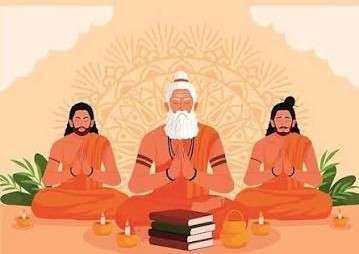
The traditional Gurukulam system was designed to impart not only knowledge but also virtues. Education was never viewed merely as a means of earning a livelihood. Its primary objective was character-building and preparing individuals to discharge their responsibilities towards society.
In this virtue-based social framework, different sections of society specialised in different functions. Those who pursued Vedic learning guided society in matters of Dharma. Kshatriyas were trained in governance and defence. Vaishyas contributed through trade and commerce, while artisans and skilled communities excelled in their respective disciplines. Every role carried both responsibility and social obligation.
The underlying principle was not the accumulation of power or wealth, but Lokakshemartham—the welfare of society.
The ancient education system recognised that teaching depended upon the competence of the teacher and the receptivity of the student. Knowledge was transmitted through experience, discipline and continuous learning. Kings sought guidance from learned scholars and experts across disciplines before taking important decisions.
Unfortunately, successive invasions and colonial influences disrupted many of these institutions. Social divisions widened and traditional systems of education and family structures weakened over time. The caste system, which in practice became rigid and discriminatory in many places, also contributed to social fragmentation, distancing society from the original ideals of duty and virtue envisioned in Sanatan Dharma.
The decline of the Hindu Undivided Family system and the shift towards excessive individualism have had far-reaching consequences. Traditional family enterprises and community-based industries that once flourished across Bharat have steadily declined.
Tamil Nadu offers numerous examples of successful skill-based ecosystems built around families and communities—Kancheepuram silk weaving, Arani silk looms, Tiruppur’s textile industry and Sivakasi’s match and fireworks industries. These enterprises thrived because of interdependence, knowledge transfer and collective responsibility.
Modern education, however, increasingly emphasises examinations and rote learning rather than conceptual understanding, ethics and skill development. Education has become heavily commercialised, often producing degree-holders rather than socially responsible and skilled individuals.
My conviction is that Bharat must revive the strengths of its traditional virtue-based education system while integrating modern scientific and technological advancements. The objective is not to reject modernity but to harmonise it with the timeless principles of Karma Yoga—selfless action performed with responsibility and discipline.
A society built upon virtue-based education, entrepreneurship and family-supported skill development can generate sustainable employment and social harmony. The Hindu Undivided Family concept and the Gurukulam spirit continue to offer valuable lessons in collective well-being and social responsibility.
On July 20, 2026, I submitted a report on my innovative machine concept and its prototype proposal to IIT Madras. The idea seeks to promote clusters of MSMEs that complement one another in a manner similar to traditional Indian family enterprises and community-based industries.
Today, when Bharat faces numerous political, economic and cultural challenges, it is imperative that future generations understand the philosophical foundations of our civilisation. Peace and prosperity cannot be sustained merely through economic growth. They require ethical values, social responsibility and a deeper understanding of Dharma.
Sanatan Dharma’s greatest contribution lies in teaching humanity that progress must be guided by virtue. The Karma Yogi way of life remains as relevant today as it was thousands of years ago.