Lakshmanrao Upadhyayula
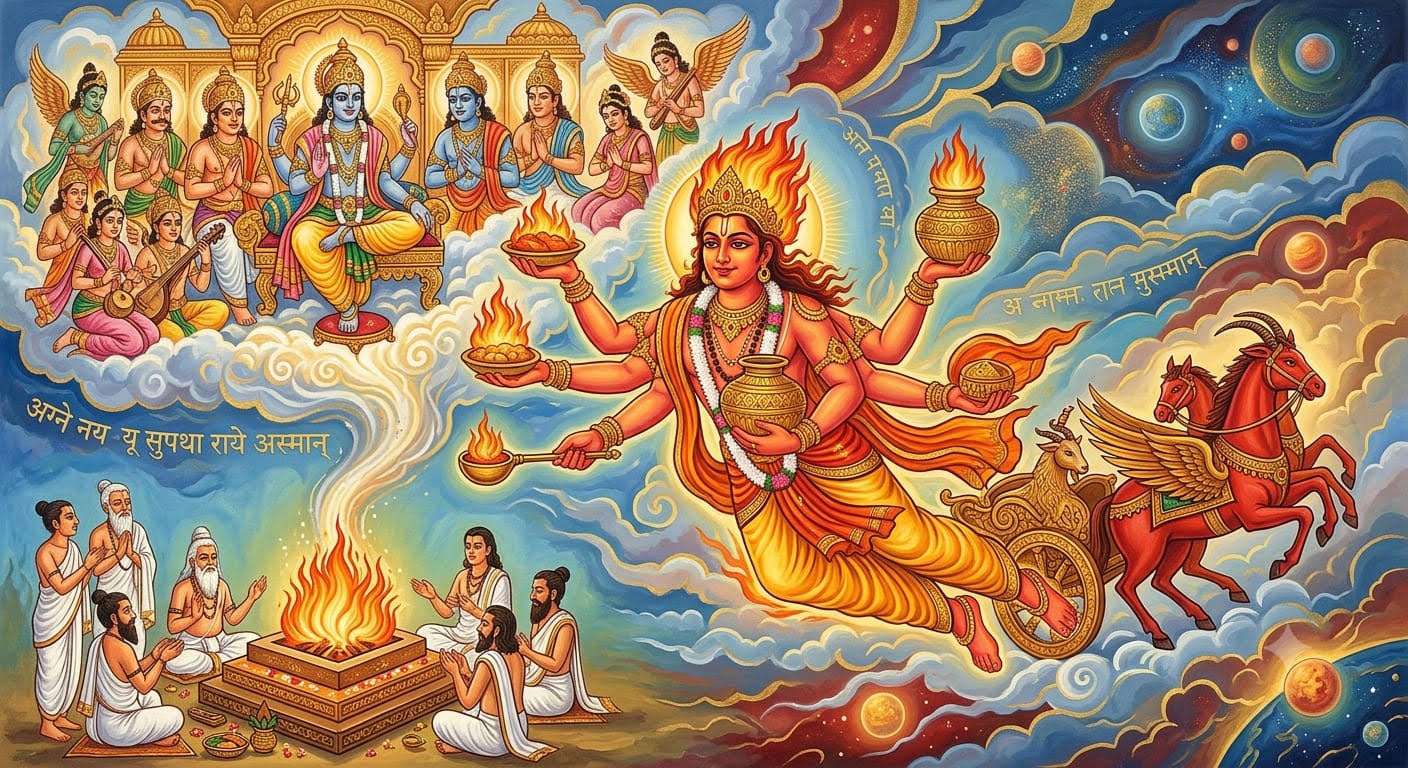
The sage Bhargava Somahuti, invoking Agni in the sacred cadence of the Gayatri metre of the Rigveda, offers not merely words of praise but a profound alignment of human intention with cosmic order. Agni, as the receiver of twigs and oblations, becomes the living altar upon which the visible and invisible realms converge. Each offering placed into the fire is not an act of destruction, but of transformation; matter is refined into energy, and the finite rises toward the infinite. Thus, the sage calls upon Agni to hear the resonance of Vedic hymns, for sound itself, structured through metre and devotion, becomes a vehicle of transmission between human consciousness and divine intelligence.
Agni is addressed as the son of might, vast in presence and supreme performer of yajna, the sacred ritual that sustains the rhythm of existence. In Vedic understanding, yajna is not confined to ritual fire alone but extends to the very processes of nature—cycles of exchange, renewal, and interdependence. The sage’s declaration of offering and service reflects a deeper principle: that human life attains meaning through participation in this cosmic reciprocity. Agni, born of great origin, is both immanent in the ritual flame and transcendent as the universal principle of energy, governing transformation from the gross to the subtle.
With reverence, the sage expresses devotion through hymns, seeking to please Agni, who is described as wealthy, praiseworthy, and ever inclined toward sacrifice. This wealth is not merely material abundance but the richness of vitality, knowledge, and illumination. Agni’s longing for yajna signifies the inherent drive within the cosmos toward order and harmony. By identifying themselves as servants of this divine force, the worshippers acknowledge their role within a larger system governed by laws both spiritual and natural. Agni, as the wise and discerning presence, is entreated to arise and dispel adversities, both internal and external, symbolising ignorance, conflict, and imbalance.
The hymn further invokes Agni as the bringer of rain, linking the sacrificial fire to atmospheric cycles. This reflects a remarkable intuitive grasp of natural processes: the transformation of offerings into subtle elements mirrors the evaporation and condensation that sustain life through rainfall. Agni thus becomes a mediator not only between humans and gods but also between earth and sky, embodying an early scientific awareness encoded in symbolic language. The request for strength and incomparable riches underscores the Vedic aspiration for both physical vitality and spiritual prosperity, unified rather than opposed.
Agni is then contemplated as youthful yet venerable, ever fresh yet ancient, embodying continuity within change. The sage seeks refuge in this luminous force, recognising in Agni the knower of human minds and the witness of both dimensions of existence—the material and the spiritual. Such insight reveals a psychological depth: Agni represents awareness itself, the inner fire of cognition that perceives, interprets, and guides. To ask Agni to fulfil the desires of the mind is to seek alignment between personal will and universal order, ensuring that aspiration is guided by wisdom.
The narrative continues with Agni as the active conductor of yajna, orchestrating the offerings toward the divine in a progressive and ordered manner. This reflects an understanding of process and system, where each act contributes to a larger outcome governed by precision and intent. Agni’s youthful nature, associated with the lineage of Bharata, signifies continuity of cultural and spiritual heritage, ever renewing itself through practice and remembrance. As luminous and widely desired, Agni becomes the centre of collective aspiration, the axis around which community, ritual, and knowledge revolve.
Protection from enemies is sought not merely in a physical sense but as safeguarding against forces that disrupt harmony. The imagery of crossing over enemies as one crosses a pool of water suggests transcendence rather than confrontation, an overcoming through clarity and guidance. Agni, purified and holy, receives offerings through clarified butter, intensifying in brilliance. This act symbolises refinement—just as ghee is purified butter, so must human intention be purified before it is offered into the fire of transformation.
Agni is further identified intimately with the people, invoked by all conditions of life—barren cow, pregnant cow, and bull—indicating inclusivity and universality. Every state of existence finds representation in the ritual, affirming that the sacred is not distant but embedded in the totality of life. As the consumer of sacrifice and companion of the priest, Agni stands as both participant and witness, ancient yet ever-present, the eternal performer of homa and bestower of boons.
In its essence, this hymn reveals Agni as the principle of transformation that unites spirituality with an early scientific temperament. Fire becomes the metaphor and mechanism through which matter changes state, energy flows, and connections are established across realms. The beauty of the narrative lies in its seamless blending of devotion, observation, and philosophical insight, where the sacred fire is at once a ritual presence, a natural force, and a symbol of inner awakening.