



Jagruteshwar Shiva Temple is located in Navi Mumbai, on the serene banks of Thane Creek. Surrounded by lush greenery and a tranquil lake, the temple offers a peaceful spiritual retreat amidst the bustling city. The temple is one of the oldest and most revered Shiva temples in Navi Mumbai and continues to attract thousands of devotees throughout the year.
The temple is believed to be over 250 years old, predating the establishment of Navi Mumbai by nearly two centuries. The original shrine was built by the local villagers after the discovery of the sacred Swayambhu Shiva Linga. Although the temple has undergone several renovations over the years, including a major reconstruction completed in 2015, the original Shiva Linga remains enshrined at its sacred location.
The presiding deity is Lord Jagruteshwar Mahadev, worshipped in the form of a Swayambhu (self-manifested) Shiva Linga that naturally emerged from the earth. The sanctum is uniquely located about six to seven feet below ground level, where devotees descend by steps to have darshan of the sacred Linga. A large monolithic Nandi faces the sanctum, while shrines dedicated to Lord Ganesha, Vasoba, Lord Vitthal-Rukmini, Lord Rama, Radha-Krishna, Mari Aai, Sheetala Devi, Lord Dattatreya, Shani Dev, Swami Samarth, Sai Baba and other deities are located within the temple complex.
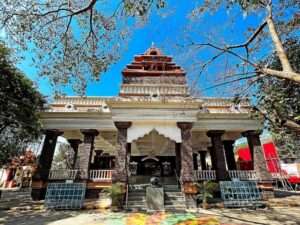
Spread across nearly 2.5 acres, the temple features a spacious courtyard, landscaped gardens and a traditional Nagara-style Shikhara. The complex consists of a Mukha Mandapa, Sabha Mandapa, Antarala and a unique underground Garbhagriha where the Swayambhu Shiva Linga is enshrined. A centuries-old Peepal tree with an ancient Naga idol near the entrance further enhances the temple’s spiritual ambience.
Jagruteshwar Shiva Temple is one of the oldest surviving temples of Vashi, predating the development of Navi Mumbai by nearly two centuries. Long before Vashi became a planned township, the area was a small coastal village inhabited by the Agri and Koli communities, who regarded Lord Jagruteshwar as their principal deity. The temple served as the spiritual centre of the village and became an integral part of the community’s religious life.
When the Government of Maharashtra initiated the development of Navi Mumbai in 1966 gradually transformed into the first major node of the new city. Despite rapid urbanisation following the opening of the Thane Creek Bridge in 1973, the ancient temple was carefully preserved. The original tiled-roof shrine underwent renovations over the years while retaining the sacred Swayambhu Shiva Linga in its original position. A major reconstruction began on 10 November 2007, and the renovated temple was ceremonially consecrated on 25 March 2015. Today, the temple continues to be one of Navi Mumbai’s most revered centres of Shaiva worship.
According to the sacred tradition preserved by the temple authorities and the original residents of Vashi, nearly 250 years ago, villagers noticed a stone emerging naturally from the ground on the banks of Thane Creek. On closer examination, it resembled a Shiva Linga. Curious to know its full size, they began excavating around it. However, the deeper they dug, the deeper the Linga appeared to extend into the earth, revealing no visible end. Realising that it was not an ordinary stone but a divine manifestation of Lord Shiva, the villagers immediately stopped digging and accepted it as a Swayambhu Shiva Linga. They built a shrine around the sacred spot without disturbing its natural position, and the deity has been worshipped there ever since.
Over the centuries, devotees witnessed another remarkable phenomenon associated with the temple. Although the shrine stands close to Thane Creek and has experienced numerous monsoons, floods and exceptionally high tides, local tradition maintains that seawater has never entered the sacred precincts. This strengthened the belief that Lord Jagruteshwar himself protects the village and its people from calamities. The temple also preserves the worship of Vasoba, the ancient guardian deity of the village, and local tradition holds that the name “Vashi” originated from this deity. Because devotees believe that Lord Shiva here is ever awake, listens to sincere prayers and grants the wishes of those who worship him with devotion, He came to be revered as Jagruteshwar Mahadev, meaning “The Ever-Awake Lord Shiva.”
Mahashivaratri is the temple’s grandest festival and is celebrated with special Abhishekam, Rudrabhishekam, Bhajans, Kirtans, Annadanam and a large gathering of devotees.
Other important festivals celebrated at the temple include Shravan Mondays, Gokulashtami, Akhanda Harinam Saptah, Mari Aai–Sheetala Devi Jatra, Rama Navami, Hanuman Jayanti and Tukaram Beej, all observed with special poojas and devotional programmes.


