



Dharmaraja, weighed down by immeasurable grief at the fall of the youthful hero Abhimanyu, sat immersed in sorrow, his heart trembling under the burden of loss. The Kaurava host, fortified by the mastery of Dronacharya, Kripacharya, and a multitude of valiant kings and princes, had stood unconquerable; yet into that formidable array the boy had entered alone, like a wild tiger plunging into herds of cattle, scattering and subduing all before him. To appease the fire of vengeance and uphold the honor of his lineage, he fought with unmatched fury, felling warriors and shattering the fourfold army as though it were but tender grass beneath the storm. Even the proud Dussasana, driven by envy and wrath, was humbled before him. Such valor, Dharmaraja reflected, could belong only to the son of Arjuna.
Yet this remembrance brought no solace. “When Arjuna,” he thought, “returns and asks, ‘Where is my son, whom I long to behold?’ what answer shall I give?” His mind recoiled in anguish, for he deemed himself the cause of grief not only to Arjuna but also to Krishna and to Subhadra, the tender mother. He lamented that Abhimanyu, delicate in form and radiant in beauty, untested in the full fury of war, had been sent into the most perilous of formations by his own command. His hope, veiling his judgment, had disguised a grave error as a noble challenge. “Children,” he mused bitterly, “are meant for joy, for adornment, for gentle pleasures—not for the cruel theatre of war. Only one steeped in folly could consign such a boy to such a fate.”
He reproached himself further, imagining that had he accompanied the youth into battle, he might at least have shared his destiny or shielded him from the cruel end. His thoughts turned to Arjuna, the conqueror of celestial hosts, the subduer of mighty demons, whose prowess had once preserved even the lord of heaven. How then could such a hero endure the humiliation of losing his son in so unjust a manner? The grief of a father, he reflected, cannot be assuaged by all the wealth of earth or heaven; the innocent smile of a child outweighs all treasures. Thus his lament grew boundless, like an ocean without shore.
At that moment, the sage Vyasa, perceiving all through divine insight, arrived at the camp. Dharmaraja rose at once, prostrated before him, and with folded hands circumambulated the venerable seer. Having offered due reverence, he spoke with a voice choked by sorrow, recounting how he had sent Abhimanyu to break the enemy formation, how he himself had been restrained by Saindhava, and how the boy, surrounded unjustly by many warriors, had been slain in violation of the code of war. “He was but a tender youth,” he cried, “yet I offered him to the arrows of the enemy. Who could live after committing such a deed, save one as accursed as I? I am lost in an ocean of grief, bereft of reason, and know not what path remains.”
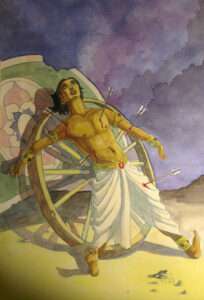
Vyasa, calm and radiant in wisdom, replied with gentle firmness: “Abhimanyu was no mere child, but a warrior of supreme strength and skill, who single-handedly overcame kings and princes. In battle, enemies do not greet one with garlands; they release volleys of arrows without mercy. Those who understand the nature of life do not succumb to agitation in times of peril. Death remains a mystery that none—be they birds, serpents, celestials, or demons—can escape. O king, you are foremost among the brave; it does not befit you to grieve thus. Compose yourself and regain your steadfastness.”
Dharmaraja, though consoled, spoke again with humility: “O sage of exalted wisdom, the mind does not easily remain steady at the thought of death. Even the brave falter for a moment. Yet your words illumine the truth that death is the law of nature, to be accepted by all.” Thereupon Vyasa began to recount an ancient tale, intending to cleanse the king’s sorrow by the example of those who had endured similar calamities.
“In former times,” said the sage, “there was a king named Akampana, who was plunged into despair at the death of his son. To restore his composure, the sage Narada instructed him with noble discourse. For it is the nature of men, when struck by misfortune, to believe that none have suffered as they do; yet the wise recall the trials of those before them and stand firm in duty.”
Vyasa then narrated how King Akampana had once been besieged and bound by his enemies, and how his son, the valiant prince Hari, had burst forth like blazing fire, vanquishing the foes and freeing his father. Not content with mere rescue, the prince advanced upon the enemy’s vast army, scattering them in terror. But the enraged warriors, uniting their strength, unleashed countless weapons and slew him. The king, consumed by wrath, retaliated like a raging conflagration, destroying the enemy forces and returning victorious amidst the thunder of drums, the blare of conches, and the triumphant cries that filled earth and sky.
Yet even in victory, his heart was hollow, for the loss of his son eclipsed all joy. In that state of grief, Narada appeared, and the king received him with honor. Sitting beside the sage, he spoke at length of his son’s virtues, lamenting that triumph itself had become tasteless in the absence of the one he loved. With reverence, he asked Narada to reveal the origin and nature of Death, the sovereign over all beings, seeking understanding to ease his sorrow.

