


The son of Dussasana, beholding Abhimanyu who had shattered his chariot, slain his guide, and laid low his steeds with the fierce sweep of a mace, was seized with both admiration and wrath, and, taking up his own mace, advanced into single combat; thus the two young kinsmen, equal in ardour and skill, encountered one another in a duel wherein the purpose was unmistakable, for each strove to slay while neither desired to yield his life, and this paradox of the warrior’s spirit, wherein death is defied yet inflicted, lent to their contest a grandeur that drew even the celestials into watchful wonder, as the maces, striking with dreadful force, scattered fiery sparks and sent forth thunderous reverberations that echoed across the trembling field.
Their forms, once radiant with youthful vigour, became stained with blood, their limbs shattered within though still upheld by indomitable will, their flesh seeming as though moulded anew under the crushing blows, and yet the battle endured; exhausted, reeling, and scarcely able to stand, they appeared like beings enveloped within a single sphere of fire, wherein life itself struggled to abide under the relentless weight of their fury, until at last, as though bound by a common destiny, life departed from both at the selfsame moment, and their bodies fell to the earth, reduced to lifeless masses, bereft of all motion and splendour.
Then spoke Sanjaya to the blind king Dhritarashtra, describing how Abhimanyu, like a wild elephant sporting in a lake, had been surrounded by hunters devoid of fear or compassion, hemmed in on all sides by thy sons and their allies, driven to exhaustion and helplessness, and slain in a manner devoid of honour; yet his departing soul, radiant as the sun that illumines the worlds, ascended towards the heavens, sinking beyond the western mountains like the setting orb, while his glory resembled a blazing conflagration that consumes a forest to ashes, or like the mighty tides of the ocean that rise to touch the heavens only to vanish suddenly, or like the moon that, straying from its ordained path, seems to fall helplessly to the earth, and though his body perished under adverse fate, his heroic essence shone with a brilliance too intense for mortal sight.
The earth, drenched in blood, assumed the hue of a crimson sky, and amidst that dread spectacle Abhimanyu seemed as the moon amidst the firmament, while the scattered fragments of shattered weapons gleamed like stars; the battlefield itself resembled a vast and terrible ocean, wherein the bodies of elephants stood like mountains, fallen horses like lurking crocodiles, swords and spears like writhing serpents, blood-soaked arrows like coral reefs, heaps of entrails like foaming froth, streams of blood like surging waters, and broken ornaments like shifting sands, and within this dreadful ocean of war, the splendour of Abhimanyu, akin to the divine repose of Vishnu, appeared matched only by the ineffable aura of Krishna.
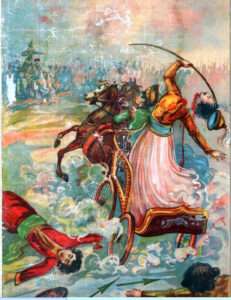
The youthful hero, fallen upon the ground with his turban still adorning him, resembled the full moon cast down from the heavens, and the Kaurava soldiers, raising cries of triumph with trumpets, bells, and shrill exultations, rejoiced in what they deemed a victory, whispering that the backbone of the Pandavas was broken; yet on the other side, the sons of Kunti were overcome with grief, their spirits shaken, while even the beasts of war—elephants and horses—uttered strange and mournful sounds, as though lamenting the fall of that noble youth, and it seemed that the voices of men and creatures alike merged into a single cry of the earth itself grieving for a fallen hero.
Then, to the astonishment of all, the very elements of nature appeared to roar in protest against the violation of righteous conduct, condemning the slaughter of one warrior by many through deceit, and that terrible sound, reverberating across the field, was heard alike by the Kauravas and the Pandavas, filling hearts with dread; the Pandava warriors, struck with anguish and confusion at this turn of fate, stood silent, until Dharmaraja, mastering his sorrow, addressed them with words of resolve, declaring that grief was unworthy in the face of such valour, for Abhimanyu had penetrated the enemy ranks, slain countless warriors, beasts, and princes, subdued even the great preceptor Drona, and thereby earned an exalted place among the immortals, and thus he urged them to cast aside despair, to crush the pride of their foes, and to uphold their honour until the day’s end.
Thus inspired, their courage rekindled, they stood firm, while the sun descended into the west, casting a red glow upon the desolate field that seemed steeped in blood; as twilight deepened, the scene grew ever more dreadful, with spirits and unseen beings imagined to revel amidst the carnage, birds of prey shrieking fiercely as they contended for their grisly share, and wild creatures emerging with eerie cries to feast upon the fallen, so that both sight and sound became unbearable, and the soldiers of either side withdrew to their camps, their hearts laden with thoughts of fate and the uncertain morrow.
Sanjaya, concluding his narration, declared that the sons of Dhritarashtra were filled with exultation at their ill-gained triumph, while the sons of Kunti were plunged into sorrow and reflection, and thus ended that day of terrible conflict, marked forever by the fall of Abhimanyu, whose death, though wrought in injustice, became a beacon of undying glory.

