
Upadhyayula Lakshman Rao
In the sacred cadence of the Tristubh metre, the seer Agastya raises a profound inquiry that echoes through the corridors of Vedic wisdom: between Heaven and Earth, who indeed was born first, and who followed after? This question is not merely of temporal origin but of metaphysical depth, for it reveals the limits of human understanding when confronted with the eternal. The hymn does not hasten to resolve this mystery; rather, it invites contemplation, acknowledging that such knowledge rests beyond the grasp of ordinary perception.
Heaven and Earth, known as Dyava and Prithvi, are envisioned as the primordial pair whose unity sustains the universe. Bound together in a sacred interdependence, they uphold the vast cosmic order, bearing the worlds as a mother and father would cradle their child. The revolving cycle of day and night moves through their divine ordinance, yet they themselves remain unmoving, without feet, beyond the need for motion. In contrast, all living beings traverse the earth with feet, sustained and sheltered by this cosmic pair who nurture life with boundless care.
Like compassionate parents, they hold all beings upon their lap, protecting them from harm and guiding them through the moral fabric of existence. The sage implores them to guard humanity from grievous sin, to grant a life free from violence, and to bestow nourishment that is pure, sufficient, and enduring. In this prayer, the yearning is not merely for material sustenance but for a state of harmony where existence aligns with righteousness and inner peace.
The hymn further extends its invocation to Aditi, the boundless mother of all, seeking from her a wealth that mirrors the abundance of Heaven itself—limitless, untainted, and life-sustaining. The luminous alternation of day and night is invoked as a dual blessing, a rhythm that enriches life with both activity and rest, illuminating the path of existence with balance and continuity.
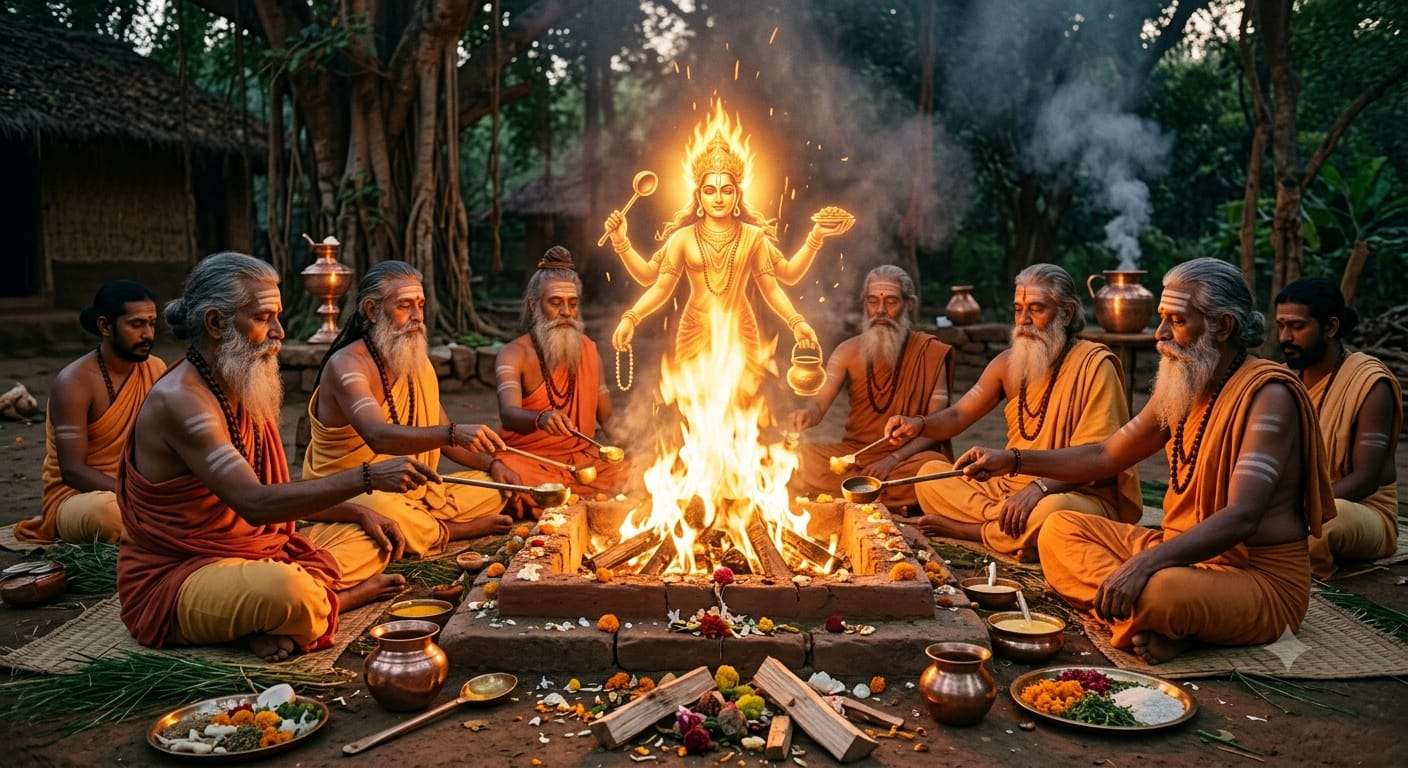
Described as ever-youthful, closely united, and equal in their vastness, Heaven and Earth are likened to sisters, companions, and kin. They are adorned with waters, the vital essence likened to the navel of life, from which all nourishment flows. Their forms are manifold, their hues diverse, yet their purpose remains singular—to sustain and protect the cosmic order. The sage, with reverence and humility, invites them into the sanctified space of the yajna, offering hymns as an expression of devotion and alignment with divine law.
In a moment of introspective honesty, the poet confesses human fallibility—errors committed in relation to the divine, to kin, and within the social fabric. The yajna is thus not only an act of praise but also a means of purification, a sacred endeavor seeking forgiveness and restoration. Through this ritual, the devotee aspires to transcend imperfections and reestablish harmony with the divine forces.
The hymn culminates in a heartfelt surrender to Heaven and Earth, recognizing them as the eternal parents of all existence. They are invoked to remain ever-present, to grant shelter, sustenance, strength, and longevity. The poet, identifying as a sacred composer of hymns, offers this composition as a testament to enduring devotion, aspiring for its resonance to spread in all directions and across generations.
Thus, in the sanctified stillness of the ritual ground, the voice of the seer rises, calling upon the cosmic माता and पिता to hear his hymn from near, to accept his offering, and to bless humanity with a life rooted in nourishment, righteousness, and divine protection.