MS Sparsha
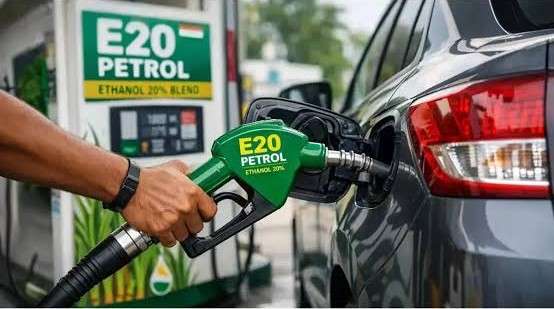
As India steadily moves towards cleaner fuels through its Ethanol Blended Petrol (EBP) programme, the introduction of E20 petrol has triggered an equally vigorous debate. Social media posts, rumours and anecdotal accounts have fuelled fears that E20 could severely damage vehicle engines. But what do the available facts actually suggest?
The first point often overlooked is that India is not importing ethanol from the United States because domestic production has failed. The imported ethanol is primarily meant for industrial, pharmaceutical and chemical applications. This enables domestically produced ethanol—derived mainly from sugarcane and food grains—to be channelled towards the government’s ambitious Ethanol Blended Petrol programme.
The long-term objective remains clear: fuel ethanol should increasingly come from domestic production, thereby reducing India’s dependence on imported crude oil while providing an additional revenue stream for farmers.
The more contentious issue, however, revolves around the impact of E20 petrol on automobiles.
Contrary to alarmist claims, there is no scientific evidence to suggest that E20 damages the engine block itself. The cast iron or aluminium engine remains unaffected. The concerns are largely limited to certain components of the fuel delivery system, particularly in older vehicles that were not originally designed for higher ethanol blends.
Rubber hoses, seals, plastic fuel lines, connectors, fuel pumps, injectors and, in some cases, older metal fuel tanks and fuel lines are considered more susceptible to wear or corrosion. Yet experts point out that these very components naturally deteriorate with age, heat, vibration, contaminants and prolonged use—even in vehicles that have never consumed ethanol-blended fuel.
The distinction is important because normal wear and tear should not automatically be attributed to ethanol.
Even more significant is the absence of conclusive scientific evidence from India linking E20 to widespread engine failures. There are currently no large-scale peer-reviewed studies establishing that E20 causes systemic engine damage. Equally, there is no long-term study proving zero impact across every category of older vehicle. The scientific evidence, therefore, remains inconclusive rather than condemnatory.
The Automotive Research Association of India (ARAI), one of the country’s leading automotive testing agencies, has stated that it has found no evidence of widespread vehicle damage attributable to E20 fuel.
India’s automobile manufacturers have echoed similar conclusions.
Maruti Suzuki says it has serviced over 15 million older vehicles without identifying ethanol-related engine failures. Hero MotoCorp, Toyota Kirloskar and several other manufacturers have likewise reported no evidence of systemic engine damage caused by E20. What they do acknowledge is a modest reduction in fuel efficiency—typically around 3 to 3.5 per cent—owing to ethanol’s lower energy content compared to conventional petrol.
Reduced mileage, however, is a very different issue from engine failure.
International experience also offers a valuable perspective. Brazil, often cited as the global benchmark for ethanol blending, has been using high-ethanol fuels for several decades. Today, most Brazilian vehicles are flex-fuel and specifically engineered to run on high ethanol blends.
During Brazil’s transition in the late 1970s and early 1980s, some older vehicles did experience deterioration of rubber seals, hoses and certain metallic components because they had not been designed for ethanol-rich fuels. However, there were no reports of ethanol damaging the engine block itself.
India’s transition appears to be following a similar trajectory, with newer vehicles increasingly designed to be E20 compatible while older vehicles may require closer monitoring of fuel-system components during routine maintenance.
The debate over E20 should therefore be driven by engineering evidence rather than speculation. No fuel is entirely without trade-offs. E20 may marginally reduce mileage and may accelerate wear in certain ageing fuel-system components, particularly in older vehicles. But the available evidence does not support sweeping claims that it destroys engines.
As India pursues cleaner mobility and greater energy security, public confidence will ultimately depend on transparent scientific research, continuous monitoring and clear communication—not fear-driven narratives unsupported by evidence.