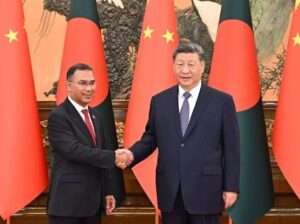
Diplomacy has many languages. Some are spoken through treaties. Others through trade agreements. And then there is the newest dialect perfected by Beijing—floating geopolitical balloons, hoping someone else mistakes them for policy. The sudden resurrection of the Bangladesh-China-India-Myanmar (BCIM) Economic Corridor falls squarely into that category. The BCIM is hardly a new idea. Conceived in 1999, it gradually lost relevance after Bharat distanced itself from the initiative when China subsumed it under the Belt and Road Initiative. Since then, BCIM has largely gathered dust in diplomatic archives. Yet, almost immediately after Bangladesh Prime Minister met with Chinese President Xi Jinping, BCIM miraculously returned to the headlines. Curiously, not because any treaty was signed or any joint communiqué announced its revival. It simply appeared—as if repeating an old slogan could make it a new strategy. One is tempted to ask: if the corridor exists nowhere on paper, why is Beijing so eager that it should exist in headlines? Perhaps because headlines are cheaper than highways. Timing, after all, is everything. Barely three weeks earlier, Myanmar’s military leader was accorded full honours in New Delhi. Prime Minister Narendra Modi and the visiting leader discussed bilateral cooperation, including security and the strategic importance of rare earth minerals. Bharat’s Foreign Secretary Vikram Misri publicly acknowledged that rare earths figured prominently in the discussions. That alone explains why Beijing may not be sleeping comfortably. Myanmar is no ordinary neighbour. Beneath its troubled terrain lie deposits of heavy rare earth elements such as dysprosium and terbium—the obscure metals without which modern missiles lose accuracy, electric vehicles lose efficiency and wind turbines lose purpose. Whoever secures reliable access to these resources gains leverage over tomorrow’s technologies. China has enjoyed an overwhelming dominance in refining these critical minerals for years. It has repeatedly demonstrated that supply chains can become strategic weapons as effectively as missiles. Naturally, any credible effort by another major power to diversify access would attract Beijing’s close attention.
Bharat, unlike China, has seldom advertised every strategic conversation it conducts. New Delhi understands Myanmar’s complicated realities. Political authority and territorial control are not always identical there. Any serious regional strategy must recognise facts on the ground rather than merely photographs from ceremonial meetings. Bharat appears to be doing exactly that—engaging officially where necessary while keeping its long-term strategic options open. Contrast that with Beijing’s sudden enthusiasm for reviving a corridor that even its latest diplomatic engagements stopped short of formally endorsing. It resembles a real estate developer unveiling glossy brochures for a township before acquiring the land. The irony is impossible to miss. For years, China lectured the world about infrastructure creating connectivity. Today, it appears increasingly interested in constructing narratives instead of roads. The BCIM mention serves less as an economic blueprint and more as psychological messaging directed at New Delhi. But Bharat has little reason to lose sleep over announcements unsupported by agreements, financing or political consensus. Serious nations distinguish between signals and substance. Bharat’s strategic calculus today extends beyond highways and ports. It is about securing resilient supply chains, reducing dependence on monopolies and ensuring that future industries are not held hostage by a single supplier. Critical minerals are becoming the new oil, and competition over them will shape global geopolitics for decades. If Beijing’s objective was to provoke anxiety in New Delhi, it may have misread its audience. After all, confidence does not require daily press conferences. Sometimes the loudest statement is silence backed by steady diplomacy. China may continue unveiling corridors that exist more vividly in press reports than on maps. Bharat, meanwhile, would do well to remain focused on something infinitely more valuable than headlines—strategic access, enduring partnerships and national interest. Because in geopolitics, imaginary corridors make news. Real leverage makes history.