



Water is not just a natural resource, but the foundation of life, civilization, economic development, food security, and environmental balance. Most of the great civilizations in human history developed along rivers, as water has been the fundamental source of life and prosperity. However, in the twenty-first century, increasing pressure on water resources has created a serious crisis for many countries around the world. India is emerging as a prime example of this crisis. While bearing approximately 18 percent of the world’s population, India possesses only approximately 4 percent of the world’s freshwater resources. Rising population, rapid urbanization, industrialization, excessive water exploitation in agriculture, water pollution, climate change, and structural deficiencies in water management have pushed the country into a situation where merely talking about a water crisis is no longer sufficient. Many experts believe that if current trends continue, India could go beyond a water crisis to a state of water bankruptcy. Water insolvency is a condition when available water resources are exhausted due to over-exploitation beyond the capacity of natural recharge, the quality of water deteriorates so much that its use becomes difficult and it becomes impossible to meet the needs of society, agriculture, industry and ecology.
India’s annual per capita water availability, which was over five thousand cubic meters in the early years of independence, has steadily declined, reaching the water stress threshold. Many metropolitan cities have periodically faced drinking water crises. Groundwater levels in rural areas are steadily declining. Pollution is turning many rivers from life-giving sources into pollutants. Rainfall uncertainty and climate change have further complicated the situation. This crisis is not solely caused by natural causes, but is also the result of long-term weaknesses in water management, policy imbalances, and social behaviors.
India’s biggest problem is its excessive dependence on groundwater. The country is the world’s largest user of groundwater. Millions of tube wells operate for irrigation, drinking water, and industrial use. Free or highly subsidized electricity in many states has further encouraged groundwater exploitation. Groundwater levels are rapidly declining due to significantly lower recharge than withdrawals. In many areas, wells and hand pumps have dried up, forcing farmers to drill deeper. This is increasing energy costs and pushing small farmers into financial crisis. In many places, public health is also being affected by increased levels of fluoride, arsenic, and nitrate in groundwater.
Another major weakness in water management is the lack of proper rainwater harvesting. Most of India’s rainfall occurs over a few months, but a significant portion of it flows into the ocean through rivers. Scientifically harvesting and recharging this water could significantly mitigate the groundwater crisis. Unfortunately, traditional water structures such as ponds, stepwells, johads, wells, and lakes have fallen victim to neglect, encroachment, and pollution. While rainwater harvesting has been made legally mandatory in urban areas, its effective implementation remains limited.
Water pollution is also a major factor driving the water crisis towards water bankruptcy. Most of the country’s rivers are affected by domestic sewage, industrial waste, plastic waste, and agricultural chemicals. Large quantities of untreated sewage are discharged into rivers every day. Many industries do not comply with environmental standards. As a result, the quality of available water is continuously deteriorating. No matter how much water is available, if it is not usable, the actual water availability automatically decreases. This situation poses a serious threat to health, agriculture, fisheries, and biodiversity.
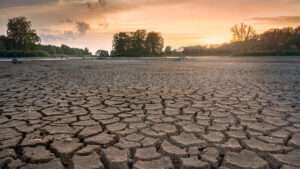
Excessive and inefficient water use in agriculture is also a significant cause of the current crisis. Nearly 80 percent of India’s freshwater is used for agriculture, but irrigation efficiency remains low. Most areas employ traditional flood irrigation, which wastes large amounts of water. Minimum support prices and government procurement policies have encouraged the cultivation of water-intensive crops like paddy and sugarcane in many states, even though water availability in those areas is not conducive. This puts additional pressure on groundwater and impacts long-term agricultural sustainability.
Urban water management also suffers from serious deficiencies. Rapidly growing cities experience significant water loss through pipelines. Non-revenue water is excessive in many cities. Treated wastewater is rarely reused. Encroachment on lakes and ponds is destroying the natural storage of rainwater. Ironically, while cities face waterlogging during the monsoon season, they face water shortages during the summer. This demonstrates that our water management system has not evolved in accordance with the natural water cycle.
Another structural weakness in water management is institutional fragmentation. Water-related functions are divided among numerous ministries, departments, and agencies. Irrigation, drinking water, groundwater, river conservation, urban water supply, and environmental protection are under separate institutions. Lack of coordination among these agencies hinders the formulation and effective implementation of an integrated water policy. Water management is conducted based on administrative boundaries rather than river basin-based planning, which prevents scientific use of resources.
Climate change has exacerbated this crisis. Monsoon vagaries, short periods of excessive rainfall, long dry spells, melting Himalayan glaciers, and rising temperatures have all impacted the water cycle, increasing the frequency and intensity of both floods and droughts. Planning water resources based on past climate patterns will not be able to meet future needs.
Due to all these challenges, the water crisis is no longer just a resource issue, but has become a broader question involving food security, energy security, public health, economic development, social stability, and national security. Water scarcity will impact agricultural production, adversely affecting food security. Industrial productivity may decline. The spread of waterborne diseases may increase. Water disputes between states and regions may intensify. The possibility of large-scale migration from rural areas may also increase. Therefore, making water security a central priority of national development is the need of the hour.
This challenge cannot be addressed simply by building new dams or extracting more groundwater. This requires a complete transformation of water management thinking. First, water must be recognized as a limited and valuable natural resource. Water resources should be managed using an integrated river basin-based approach, simultaneously considering surface water, groundwater, rainwater, and ecological needs. Scientific water budgets should be developed for each river basin, and water use planning should be done accordingly.
Groundwater conservation should be given top priority. Scientific assessments of groundwater withdrawals and recharge should be conducted in every region. Groundwater governance should be developed based on aquifer mapping, digital monitoring, and community participation. Where groundwater levels have fallen significantly, effective controls on withdrawals should be implemented and artificial recharge schemes should be widely implemented.
Rainwater harvesting should be made a national mass movement. Rainwater harvesting systems should be effectively implemented in every building, school, industry, and government institution. Village ponds, johads, stepwells, and other traditional water sources should be revived. Local communities should be given the responsibility for their conservation and maintenance so that water conservation becomes part of social culture, not just a government program.
Increasing water use efficiency in agriculture is crucial. Micro-irrigation systems such as drip and sprinkler irrigation should be expanded. Water-efficient crops should be encouraged and crop diversification should be promoted. Minimum support prices and agricultural incentives should be rebalanced to reflect water conservation. Irrigation needs can be reduced by improving soil health, promoting natural farming, and water-conserving agricultural practices.
Wastewater treatment and recycling should be made mandatory in urban areas. Treated water should be used in industries, construction, gardens, and other non-potable uses to reduce the pressure on clean water. Water savings can also be achieved by reducing pipeline leakage, adopting smart metering, and modernizing water distribution systems.
River conservation should not be limited to cleanup campaigns, but should encompass the protection of the entire river ecosystem. Strict controls should be put in place on the flow of untreated sewage and industrial waste. Wetlands, floodplains, and natural drainage channels should be protected, as these are key sources of water recharge and biodiversity.
Technological innovations should also be widely utilized. Developing water monitoring systems based on remote sensing, geospatial information systems, artificial intelligence, the Internet of Things, and smart sensors can enable real-time monitoring of water use. Water accounting, water audits, and data-driven policymaking will enable more scientific resource use.
Additionally, it is essential to link water conservation with public participation. Active participation of schools, universities, panchayats, voluntary organizations, religious institutions, and local communities can transform water conservation into a social movement. Citizens must develop a sense of responsibility to future generations by conserving every drop of water.
The water crisis facing India is truly a test of the development model. If the shortcomings of current water management are not addressed, the water crisis could soon turn into water bankruptcy, with widespread and long-term consequences. However, if scientific planning, effective governance, technological innovation, traditional knowledge, community participation, and a culture of water conservation are integrated, India can turn this crisis into an opportunity. Water security is not just the government’s responsibility, but a shared responsibility of every citizen, farmer, industry, local bodies, and policymakers. The future of sustainable development belongs to a society that considers water not merely a commodity for consumption but a shared natural heritage and conserves it judiciously. This approach can lead India out of the water crisis and towards long-term water security and inclusive development.

