



In India, the monsoon is not just a season, but the fulcrum of the country’s economy, agriculture, water resources, and livelihoods. For centuries, the monsoon has been considered life-giving because its rains nourish fields, fill rivers and reservoirs, and provide relief from the scorching heat. However, in recent years, the nature of the monsoon has been rapidly changing. Now, it brings not only relief but also numerous risks. In some places, sudden cloudbursts occur, strong winds and thunderstorms disrupt life, and in others, lightning strikes claim lives. In an era of changing weather and climate change, the risks associated with the monsoon have become more serious and widespread than ever before. This is why weather-related risks have become not only a subject of scientific study but also a matter of social, economic, and humanitarian concern.
Currently, it is clearly visible that the traditional nature of weather is changing. While rainfall used to be relatively regular and balanced, now prolonged droughts are followed by sudden bursts of excessive rainfall. Similarly, the incidence of thunderstorms and lightning is also increasing. Meteorologists believe that the Earth’s rising temperatures have affected the structure and behavior of the atmosphere. With more energy and moisture available in the atmosphere, weather events are becoming more intense and unpredictable. This is directly impacting human life, agriculture, infrastructure, and natural resources.
Lightning is one of the natural phenomena that affects thousands of people every year. In India, the number of deaths due to lightning strikes is higher than that of many other natural disasters. Of particular concern is that most of the victims are from rural areas, where a large number of people work in the open. Farmers, agricultural laborers, livestock herders, and construction workers are more vulnerable to these weather hazards. When clouds suddenly gather and thunderstorms begin, many people do not understand the severity of the danger and remain in open spaces. As a result, many people lose their lives due to lightning strikes.
Scientifically, lightning results from complex processes in the atmosphere. When the surface becomes extremely hot and the air above it is relatively cold, the warm, moist air begins to rise rapidly. This process is called convection. The rising air cools, condenses, and forms clouds. If the atmosphere is sufficiently humid and energetic, these clouds form large cumulonimbus clouds. Collisions between water droplets, ice particles, and hailstones within these clouds generate electrical charges. When the charge imbalance becomes too great, lightning strikes, resulting in an electrical discharge between the ground and the clouds.
During the monsoon, moist winds from the oceans reach much of the Indian subcontinent. These winds carry large amounts of water vapor, essential for cloud formation and rainfall. But this moisture, when combined with an extremely warm atmosphere, can also create powerful storms. This combination of moisture and temperature increases weather instability. This is why thunderstorms and lightning are more frequent during the monsoon months. Weather experts believe that as global temperatures rise, the atmosphere will hold more moisture, increasing the likelihood of such events.
Climate change is the most important aspect of this entire scenario. Industrialization, excessive use of fossil fuels, deforestation, and uncontrolled urbanization have increased the amount of greenhouse gases in the atmosphere. As a result, the Earth’s average temperature is continuously increasing. This increase in temperature is not limited to increasing heat, but is affecting the entire weather system. A warmer atmosphere holds more moisture, which increases the likelihood of intense rainfall and thunderstorms. This is why today’s weather appears more unpredictable and extreme than before.
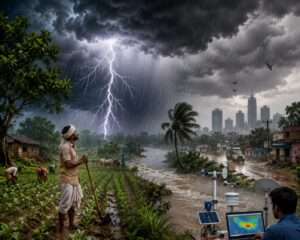
Urbanization is also playing a significant role in increasing weather risks. The abundance of concrete, asphalt, and buildings in large cities creates a heat island effect. This causes temperatures in cities to be higher than in surrounding rural areas. Hotter surfaces cause air to rise faster, which can increase the likelihood of local cloud formation and storms. Additionally, inadequate drainage systems in urban areas can lead to waterlogging and flooding during heavy rainfall.
India’s geographical diversity also influences weather events. In the Himalayan region, mountains cause air to rise rapidly, leading to increased cloud formation. In Northeast India, high humidity and mountainous terrain combine to create conditions for intense rainfall. In Central India and the Gangetic Plain, the combination of heat and humidity gives rise to thunderstorms. In coastal areas, the interaction between sea breezes and land heat influences weather patterns. Thus, each region of India faces different risks due to its geographical and climatic factors.
Weather hazards have the greatest impact on vulnerable sections of society. People living in rural areas often lack safe shelter and timely information. Even when warnings are issued for lightning or severe storms, the information doesn’t reach the last person. Furthermore, economic limitations also force people to take risks. Farmers and laborers often continue working despite bad weather because their livelihoods depend on it. In such circumstances, natural hazards transform into social and economic risks.
Technical solutions alone are not enough to reduce the damage caused by weather-related disasters. Increasing public awareness and weather literacy is also essential. People need to be made aware of the importance of moving away from open spaces when they hear thunder, the dangers of standing under tall trees, and the precautions to take during lightning. Schools, municipal councils, NGOs, and the media all have a crucial role to play in this regard. If society understands weather risks, many lives can be saved.
Meteorology has made remarkable progress today. Satellites, Doppler radar, automated weather stations, and advanced computer models are making weather forecasts more accurate. In many cases, the likelihood of thunderstorms and lightning can now be predicted in advance. The India Meteorological Department and other agencies regularly issue warnings. But the challenge is to effectively communicate these warnings to the public and motivate them to take action. Merely providing information is not enough; it is also essential to ensure that people understand and act on that information.
Governments must integrate weather risk management into their development plans. Special safety measures can be implemented by identifying areas prone to lightning strikes. Safe community shelters can be built in rural areas. Weather-based advisory systems for agricultural operations can be strengthened. Disaster management training can be made mandatory in schools and public institutions. Additionally, timely warning messages can be sent using mobile technology and digital communications.
Long-term efforts are also essential to mitigate the impacts of climate change. Forest conservation, the expansion of green energy, carbon emissions reduction, and sustainable development policies can help mitigate future risks. If global warming is not controlled, both the intensity and frequency of extreme weather events could increase. Therefore, addressing climate change is not only an environmental imperative, but also a human security and sustainable development imperative.
In this era of changing climate, it is crucial to understand that natural events are no longer the same. Events like monsoon rains, thunderstorms, storms, and lightning are becoming more complex and risky. The most effective means of protection against them are scientific understanding, timely warnings, public awareness, and community preparedness. If we simply leave the weather to fate or natural destiny, the risks will continue to grow. But if we combine science, policy, and social participation, the impact of these hazards can be significantly reduced.
The monsoon is India’s lifeline and will continue to be so. We need to understand its changing nature and adapt our policies, systems, and behavior accordingly. Only a society aware of weather risks can meet future challenges. In this era of changing climate, preparedness is the key to safety, and understanding is the best defense.

