

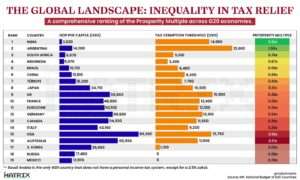
At a time when many advanced and emerging economies are grappling with slowing growth, stagnant wages, and rising tax burdens on ordinary citizens, Bharat has quietly crafted a taxation framework that stands out among G20 nations. The numbers tell a compelling story. While most countries begin taxing citizens at or near their average income levels, Bharat allows individuals to earn more than five times the national per capita income before becoming liable for income tax. With a Prosperity Multiple of 5.32 times, India ranks first among G20 economies on this measure. This is not merely a statistical achievement. It reflects a conscious policy choice that places household prosperity, consumption-led growth, and economic aspiration at the centre of national development. The transformation has been remarkable. In 2013, an individual earning more than ₹2 lakh annually became liable to pay income tax. Today, under the revised tax structure, that threshold has effectively risen to ₹12 lakh. This six-fold increase over little more than a decade demonstrates a clear recognition that economic growth becomes meaningful only when citizens are allowed to retain a greater share of their earnings. Critics often focus exclusively on government revenue while evaluating tax policies. However, taxation is not merely about collection; it is equally about enabling economic activity. Every rupee left in the hands of a salaried employee, small entrepreneur, or young professional becomes potential consumption, savings, investment, or education expenditure. These expenditures, in turn, stimulate economic growth, generate employment, and expand the tax base organically. The Indian economy’s resilience in recent years owes much to strong domestic demand. Unlike several economies that depend heavily on exports or government spending,
Bharat’s growth has increasingly been powered by a confident and aspirational middle class. Lower direct tax burdens strengthen this foundation by enhancing disposable incomes and encouraging spending across sectors ranging from housing and automobiles to consumer goods and services. The benefits extend beyond consumption. Higher disposable incomes encourage savings and investments, strengthening financial inclusion and capital formation. Millions of Indians are now participating in mutual funds, insurance schemes, pension plans, and equity markets. Such participation creates long-term wealth and reduces dependence on government support, fostering genuine economic empowerment. Equally important is the psychological impact of the policy. Taxpayers often perceive excessive taxation as a penalty on ambition and hard work. By raising exemption limits and simplifying tax structures, the government sends a different message: growth and prosperity should be rewarded, not punished. This strengthens compliance, reduces tax evasion incentives, and promotes a healthier relationship between citizens and the state. Of course, sustaining such a model requires fiscal discipline. Governments cannot indefinitely reduce tax burdens without ensuring robust revenue generation through economic expansion, improved compliance, indirect taxes, and efficient administration. The success of India’s approach therefore rests on continued economic growth and widening formalisation of the economy. Nevertheless, the broader philosophy deserves recognition. At a time when several countries are compelled to squeeze taxpayers to sustain welfare commitments and mounting public debt, Bharat has chosen to trust its citizens with greater financial freedom. The result is a tax structure that encourages aspiration, rewards enterprise, and strengthens household prosperity. Among the G20 economies, this approach makes Bharat an outlier—but in the best possible sense. It reflects a development model that understands a simple truth: a nation’s prosperity ultimately begins with the prosperity of its people.