Upadhyayula Lakshman Rao
In the measured cadence of the Trishtubh metre, the seer Dirghatamas lifts his consciousness toward the radiant mystery of the Aswa, the divine horse, whose birth he proclaims as resplendent and universally adored. This is no ordinary creature of flesh and motion, but a symbol that gathers within itself the energies of heaven, earth, and the intermediate realms. Its thunderous neigh is not merely sound, but a deliberate vibration, a call that awakens attention, much like the resonant forces of nature that draw awareness to the unseen workings of existence. In this vision, the horse becomes a living hymn, its very being an invocation that bridges the mortal and the divine.
The sage beholds in the Aswa a synthesis of supreme attributes: wings like the eagle that signify elevation and far-seeing vision, and hooves like the deer that denote swiftness and grace upon the earth. These are not poetic exaggerations but symbolic expressions of natural principles, where velocity, balance, and adaptability converge. The origins of the horse are traced to divine agencies—Yama and Agni—indicating its connection with both transformation and mortality. Its harnessing by Vayu, and its ascent by Indra, reflects a profound understanding that motion, energy, and control are interlinked forces governing both ritual and cosmos. The Gandharvas and the essence of Soma holding its bridle further suggest that harmony and consciousness guide this immense power.
The horse is then revealed as a manifestation of cosmic structure itself. Fashioned by the Vasus from the brilliance of Surya, it becomes a radiant embodiment of solar energy. The seer identifies it with Aditya and even with the Lord of Death, not as contradictions but as complementary truths: for that which gives life also governs its cessation. The Aswa thus emerges as a principle of continuity, the eternal cycle of creation, sustenance, and dissolution. Its identity as a vow within ritual underscores its role as a binding force, a disciplined channel through which cosmic energies are invoked and stabilized.
In a striking vision of structured reality, the sage speaks of the horse as bound in threefold domains. In the luminous realm, its bonds are associated with the Vasus, the Sun, and the radiant heavens, signifying energy, light, and transcendence. Upon the earth, these bonds become nourishment, seed, and soil—the triad that sustains life through cycles of growth and regeneration. In the atmospheric expanse, they manifest as cloud, lightning, and thunder, revealing an early intuitive grasp of natural processes that govern weather and electricity. This tripartite division is not merely symbolic but reflects an observational understanding of the interconnected systems that sustain existence.
The ancient seers, through their insight, fixed the birthplaces of this cosmic horse, not in a single location but across the fabric of reality itself. Every realm becomes a limb, every process an organ of its vast being. The horse moves through sacrificial grounds, and its footprints mark not mere physical space but sanctified zones where human intention meets cosmic order. When it partakes of the sacrificial offering, it symbolizes the transformation of matter into energy, echoing a principle that modern thought recognizes in the conservation and conversion of energy.
The sage’s vision extends beyond ritual into experiential awareness. He perceives the horse moving through distant regions, both in the skies and upon the earth, its presence spanning the visible and the invisible. Its head, pure and unblemished, rises along even and harmonious paths, suggesting a motion governed by natural laws rather than chaos. Its grazing upon fertile lands reflects the sustaining rhythm of life, while humanity approaches it with offerings, recognizing its central place in both survival and spirituality.
Behind the horse follows a procession that is both symbolic and social: men walk in reverence, women’s prosperity is said to follow it, and other horses accompany it in companionship. This imagery conveys the idea that the forces represented by the Aswa are not isolated but influence collective human existence—prosperity, continuity, and cooperation. The gods themselves are said to applaud its valor, indicating that the harmonious functioning of natural forces is itself a divine act worthy of reverence.
Its form is described with elements of brilliance and strength: a golden head that reflects radiance and consciousness, and iron hooves that denote resilience and grounding. Its speed surpasses even that of Indra, emphasizing the boundless nature of cosmic motion. As it journeys toward the heavens, its form becomes refined and subtle, suggesting transformation from the gross to the ethereal. The imagery of celestial horses moving like swans in graceful clusters evokes patterns observed in nature, where collective motion follows unseen laws of coordination.
The sage perceives in the horse not only physical swiftness but the velocity of thought itself. Its mind moves with an immediacy that transcends distance, and the shimmering hues of its mane create illusions of movement within stillness, hinting at perceptual phenomena where motion and light interplay. This reveals an early sensitivity to how human perception interprets natural patterns, blending observation with metaphysical reflection.
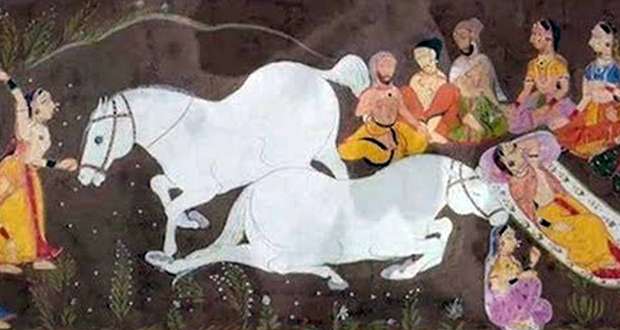
As the sacrificial journey unfolds, the horse advances with solemn purpose. A goat precedes it, symbolizing companionship and preparatory offering, while priests follow with hymns that align human intention with cosmic rhythm. The horse moves toward its divine origin, not as a loss but as a return, carrying with it the aspirations and offerings of humanity. In this culmination, the Aswa becomes a mediator, bestowing wealth and prosperity upon those who participate in the sacred exchange.
Thus, the hymn of Dirghatamas reveals the Aswa as a profound synthesis of spirituality and observation. It is at once a ritual symbol, a cosmic principle, and a reflection of natural laws. Through poetic insight, the sage articulates a worldview where the physical and the metaphysical are inseparably intertwined, and where every movement of nature is both a scientific phenomenon and a sacred act.