Upadhyayula Lakshman Rao
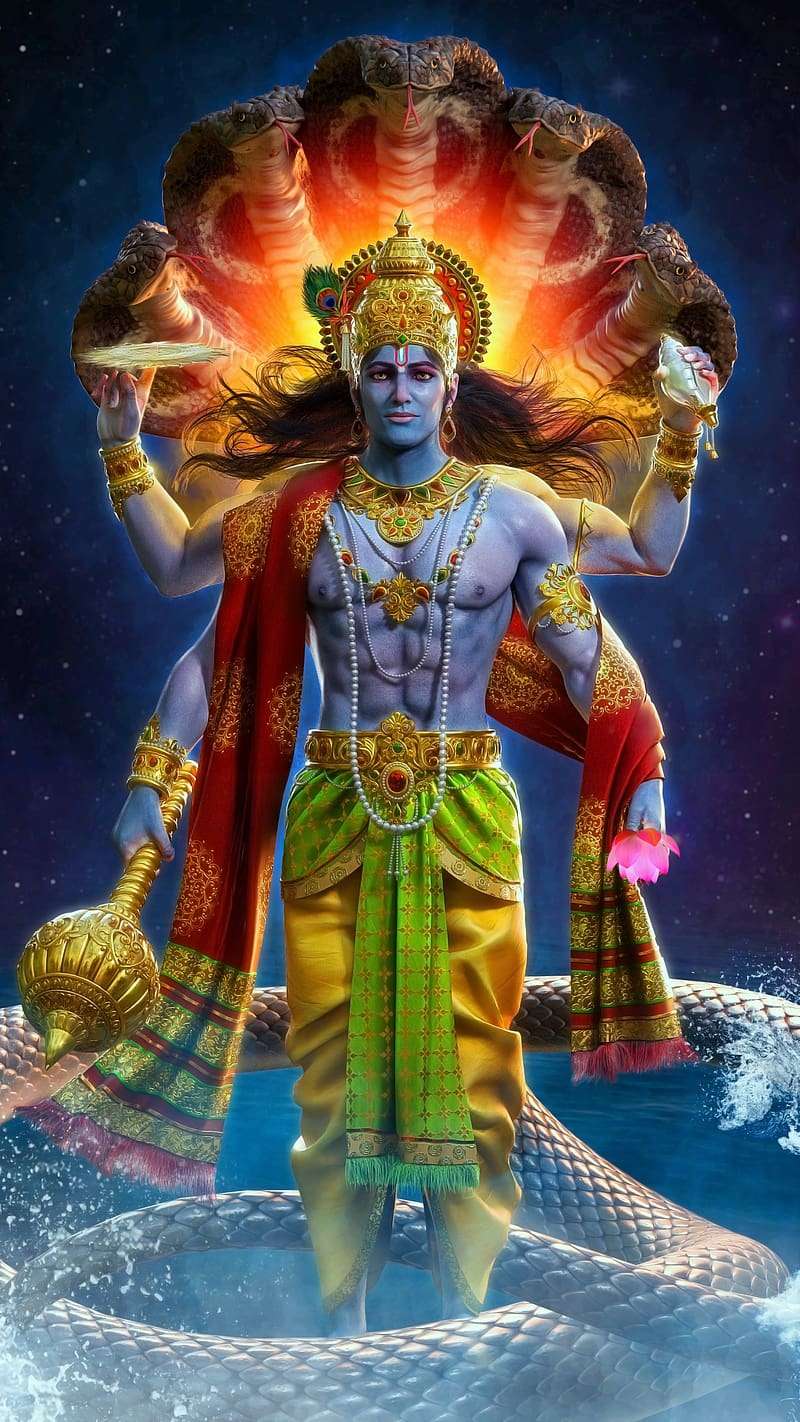
In the sacred cadence of the Tristubh and Jagati metres, the venerable sage Deerghatama raises his voice in luminous praise of Vishnu, the all-pervading principle who embodies both cosmic vastness and subtle order. The hymn unfolds not merely as devotion, but as a profound inquiry into existence itself, where spirituality and observation unite. Vishnu is not only adored as the creator of the three worlds, but also understood as the intelligence that sustains their harmony. His act of establishing the higher realm signifies the ascent of consciousness, while the formation of worlds in three distinct characteristics reflects an early intuition of structured reality—perhaps akin to layers of existence perceived through matter, energy, and awareness.
The imagery of Vishnu’s three strides carries immense philosophical weight. These steps are not merely mythic measures of space, but symbolic expansions of the universe itself. In one interpretation, they represent the observable, the conceivable, and the transcendent—domains that extend beyond ordinary perception. The entire cosmos, it is said, is contained within these three strides, suggesting a remarkable compression of infinity into intelligible form. Such an idea resonates with scientific temperament, where vastness is often expressed through elegant simplicity, and where the universe, though immeasurable, obeys underlying principles.
The hymn speaks of a distant and formidable presence, likened to a mysterious beast dwelling in the mountains of Asama, known to all by reputation though rarely seen. In the same way, the deeds of Vishnu are universally acknowledged, though their full depth eludes comprehension. His realm is described as radiant, filled with unending streams of light and life-giving rain, evoking both the physical sustenance of nature and the spiritual nourishment of truth. The desire to reach this realm reflects humanity’s enduring aspiration toward higher states of being, where clarity, joy, and equilibrium prevail.
Vishnu’s feet, described as pleasant and complete, symbolize stability and foundation. The reverence offered to these steps by all beings signifies recognition of the laws that uphold existence. The third step, however, remains beyond the grasp of the human mind, hinting at dimensions of reality that transcend empirical understanding. Even the swiftest forces—wind and winged creatures—cannot reach it, suggesting limits to both physical movement and intellectual pursuit. This acknowledgment of the unknown reflects a mature scientific humility, where the boundaries of knowledge are respected even as they are explored.
The hymn further presents Vishnu as the essence of time itself, a concept articulated through a detailed enumeration of temporal cycles—year, solstices, seasons, months, fortnights, days, and divisions of time. The totality of ninety-four movements signifies a structured perception of temporal flow, revealing an early attempt to quantify and comprehend the rhythm of existence. Time here is not merely duration, but a living force, embodied in Vishnu, who moves, turns, and cycles through creation with majestic continuity.
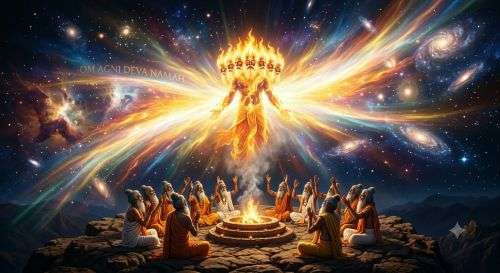
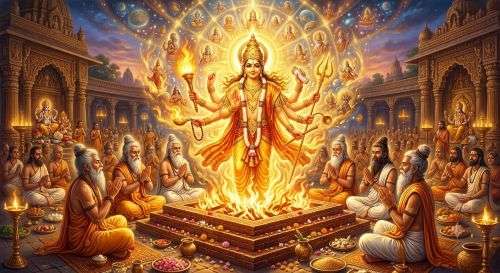
In union with Indra, Vishnu participates in the dynamic processes of nature. Together, they command the clouds, release the rains, and sustain life upon earth. Their swift movement and control over natural forces reflect an understanding of causality and interdependence. The preparation of soma by the priests symbolizes the human effort to align with these cosmic forces, to participate in the grand cycle through ritual, intention, and knowledge. The offerings, transformed through fire, represent the conversion of material into subtle essence, mirroring processes observed in both nature and science.
Vishnu is portrayed as the origin of all elements—earth, water, and brilliance—suggesting a foundational unity from which diversity emerges. He is the kin of all beings, the silent witness and active sustainer. Those who perform sacred acts with sincerity are said to reach his realm, not merely as a reward, but as a natural consequence of alignment with universal order. This reflects a principle akin to resonance, where harmony with the system leads to elevation within it.
The narrative culminates in a vision of Vishnu as perpetual, ever-renewing, and complete in the form of yajna itself. He is both the process and the purpose, the offering and the receiver. His presence in shining space, his role as the giver of merit, and his responsiveness to sincere invocation all point to a cosmos that is not indifferent, but deeply interconnected. The patron, guided by knowledge and supported by the learned Ritvijas, seeks not only material prosperity but a deeper union with this sustaining principle.
Thus, the hymn stands as a bridge between devotion and discernment, where poetic expression meets observational insight. It invites the seeker to contemplate not only the grandeur of Vishnu but also the intricate order of the universe he embodies. In praising him with purity of thought and clarity of understanding, one participates in the very rhythm that sustains all existence, moving closer to that radiant realm where the finite touches the infinite.