Upadhyayula Lakshman Rao
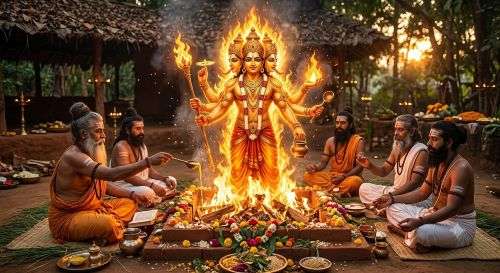
The sage Puruchhepa, with a mind disciplined by sacred insight, raises his invocation to Vāyu and Indra in the measured cadence of Antyeṣṭi and Aṣṭi metres, weaving devotion with precision. The sanctified ground of yajña is prepared with utmost care, and the Soma elixir, purified through ritual discipline, stands ready in its luminous clarity. With humility and reverence, the sage invites Vāyu, the swift-moving lord of life-breath, to arrive borne by countless vigorous horses, whose गति reflects the ceaseless motion of the cosmos. The Soma, potent and invigorating, awaits to gladden the divine senses, embodying both spiritual ecstasy and the subtle essence of nature’s vitality.
The priests, custodians of sacred order, present the Soma with devotion, its fragrance rising like a hymn unspoken, its clarity resembling the distilled purity of truth itself. Filtered through ritual processes, it shines with crystalline brilliance, symbolizing both physical refinement and metaphysical illumination. Vāyu is addressed with intimacy and awareness, for the offering is not merely material but attuned to the divine disposition, harmonizing with his subtle nature. This Soma, shared among mortals yet consecrated for the gods, becomes a bridge between realms, linking human aspiration with celestial grace.
As dawn unfolds, the Soma glows with equal radiance, reflecting the balance of nature’s cycles and the constancy of cosmic law. The priests, holding the Soma creepers, crush and press them rhythmically, their chants resonating with vibrational precision, akin to the ordered frequencies that govern the universe. This act, both ritualistic and symbolic, mirrors processes of transformation—where raw essence becomes refined energy. Vāyu is called to partake in his rightful share, urged to hasten with his swift steeds, whose motion signifies the invisible currents of air and life-force permeating all existence.
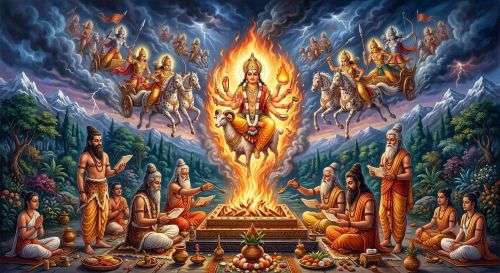
Indra and Vāyu, often invoked together, are invited to partake of the Soma before all other celestial hosts, a testament to their dynamic synergy. Indra, the force of strength and decisive action, and Vāyu, the principle of movement and vitality, together represent the interplay of शक्ति and प्राण. Their chariot, drawn by designated steeds, symbolizes controlled energy directed with purpose. They are entreated to join the ritual assembly, partake in the joy of sacred communion, and thereafter return gracefully to the heavens, carrying with them the essence of the offering.
The Soma, pressed and purified, is presented again with renewed devotion, held in vessels prepared with care, free from all impurity. The priests, through their disciplined actions, embody a proto-scientific temperament—observing, refining, and presenting the offering with precision. The ritual itself reflects an understanding of transformation, where matter is elevated through process and intention. Indra and Vāyu are invoked to receive this offering, to partake of its essence, and in return, to bestow nourishment, prosperity, and protection upon the devotees.
The sacred space resounds with the rhythm of pressing stones and the resonance of Vedic chants, creating an atmosphere charged with both spiritual intensity and harmonic order. Vāyu is invited to traverse even the realms of stillness, to pass beyond the inertia of the unawakened, and arrive at the vibrant केंद्र of ritual energy. Indra is called to accompany him, for their संयुक्त presence ensures the completeness of the offering. The horses that draw them are not merely physical beings but representations of गति, ऊर्जा, and दिशा—forces that sustain the cosmos.
The patrons of the yajña, engaged in the collection and preparation of Soma, uphold the continuity of tradition and the discipline of sacred science. Their efforts ensure that the offering remains pure, potent, and worthy of divine acceptance. The cows, symbols of abundance and sustenance, yield their milk without hindrance, reflecting a state of harmony where प्रकृति supports the sacred endeavor. The cakes and oblations, prepared from barley and paddy, signify the transformation of earth’s bounty into offerings of higher purpose.
Vāyu’s horses are described as strong, youthful, and tireless, embodying the principles of ऊर्जा and निरंतरता. They sustain his presence between the earthly and the celestial, moving effortlessly across the vast expanse, much like the unseen forces that govern atmospheric motion and cosmic flow. Their गति, likened to the rays of the sun, illustrates the impossibility of स्थिरता in a dynamic universe. Thus, the hymn culminates in a vision where ritual, nature, and cosmic law converge, revealing a profound unity between spiritual aspiration and the scientific rhythm of existence.