


Sanjaya spoke to King Dhritarashtra, describing the dreadful stage of the war when the conflict had grown turbulent and unrestrained. Both armies fought with the grim determination to destroy the supporting pillars of each other’s warcraft. The grandsons of the Pandavas unleashed relentless volleys of shafts that pierced their enemies, leaving many warriors bleeding and sinking into distress.
At that moment, the valiant King Neela of Anupa, a trusted ally and close confidant of Bhima, advanced to confront Ashwatthama. His challenge angered Ashwatthama greatly. Determined to preserve his supremacy, Ashwatthama rained blood-drawing arrows upon Neela and drove him to the verge of fainting.
Witnessing this, the mighty demon warrior Ghatotkacha could not tolerate Ashwatthama gaining the upper hand. With terrible vigour and ferocity, he attacked him. Immediately, the venerable preceptor Drona rushed to the aid of his son and showered the demon hero with countless arrows, weakening him for a moment.
Yet Ghatotkacha, guided by his innate demonic prowess, turned to the mysterious art of illusion to overcome his temporary weakness. Before the eyes of the Kaurava warriors, he created a terrifying phantom vision. In that illusion, the mighty heroes Drona, Kripa, Ashwatthama, Chitrasena, Bruhadbala, Bahlika and the lord of Avanti appeared struck down, bleeding, and lying unconscious upon the ground, as though slain.
The Kaurava soldiers, beholding this dreadful spectacle, were seized with panic and fled in all directions. Their ranks dissolved in terror. Then the grandsire Bhishma halted them and cried aloud that it was but a demonic illusion and not the truth. Yet fear had already mastered the soldiers, and they continued to run from the battlefield in desperation.
Seeing the miserable state of his army, Duryodhana approached Bhishma in agitation. Addressing him with reverence, he said that the grandsire was unconquerable even to gods and demons, the supreme master of archery and invincible among warriors. Yet despite such heroes fighting for him, he could see no decisive advantage over the enemy. Therefore, he declared that he would personally lead the army, either to victory or to death, for he could no longer endure the uncertain sway of the war.
Bhishma listened attentively and smiled with calm authority. He replied that to conquer the Pandavas one must be equal to them in power and virtue, and that for a king of Duryodhana’s disposition, victory was difficult even to imagine. Yet he reminded him that the Kauravas were assembled to fight an almost impossible war and must therefore abandon despair and malice.
Turning then toward the mighty king Bhagadatta, Bhishma declared that demonic illusions would have no power over him and that he alone could subdue those forces. Encouraged by the confidence of the commander of the Kaurava host, Bhagadatta roared like a lion among warriors. Mounting his colossal elephant, he advanced boldly to the forefront of battle, and the Kaurava army surged forward behind him.
Soon, the battle became so fierce that the lines between the two armies vanished. Soldiers, horses, and elephants clashed in confused combat where man and beast alike struggled for survival. Sanjaya told Dhritarashtra that the sun had already passed midday and blazed fiercely over the field of war.
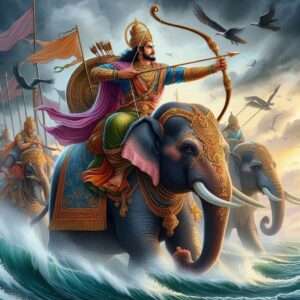
Then the gigantic Ghatotkacha appeared mounted upon an enormous elephant resembling a moving mountain. Surrounded by powerful demon warriors, he advanced to confront Bhagadatta. At his side fought Bhima, the youthful hero Abhimanyu, and the sons of Draupadi, all determined to support the demon prince.
The Pandava allies surrounded Bhagadatta’s mighty elephant and attacked it with spears, pestles, and maces. Blood flowed from its wounds like red streams descending from hills into the plains, while the cries of warriors and animals filled the air. Ghatotkacha, terrible as the lord of death, hurled a blazing trident toward Bhagadatta, but the latter shattered the weapon in midair with astonishing skill.
Bhagadatta then struck fiercely, smashing the steeds and chariot of Bhima. Filled with pride in his strength he harassed Abhimanyu and the other Pandava warriors. Though wounded, his elephant quickly recovered and trampled chariots, horses, and soldiers beneath its dreadful feet. That elephant, named Supratika, rushed upon the enemy ranks like a raging tempest, stirring the opposing forces just as Mount Mandara once churned the great ocean.
At that time the king of Dasarna, Sudharma, a warrior renowned for strength equal to Bhima, advanced on his own war elephant to challenge Bhagadatta. Yet he was compelled to withdraw before the overwhelming and almost demonic force of his opponent.
Bhagadatta, the son of Narakasura and the ruler of Pragjyotishapura, possessed immense strength and profound mastery of warfare. Bound by ancient enmity toward Krishna, he fought with relentless resolve for the Kauravas and was ready to lay down his life in their cause.
Delighted by Bhagadatta’s terrible onslaught, Duryodhana himself rushed into the Pandava ranks, accompanied by Drona and Kripa. Their advance spread fear and confusion among the enemy forces. The Pandava army momentarily plunged into chaos, and a great uproar echoed across the battlefield.
Observing this turmoil, Yudhishthira, King Drupada, and the mighty Arjuna came forward to the front lines. With pride in their strength and skill they stood firm against the advancing Kauravas. Arjuna twanged the string of his bow and blew his conch, its sound reverberating through the heavens and the earth. Then he released a storm of arrows that shattered the enemy formations and restored confidence among the Pandava warriors.
Thus, O King Dhritarashtra, the fortunes of war continued to swing like a restless tide, with victory and despair passing from one side to the other while the terrible struggle raged without pause.

