Upadhyayula Lakshman Rao
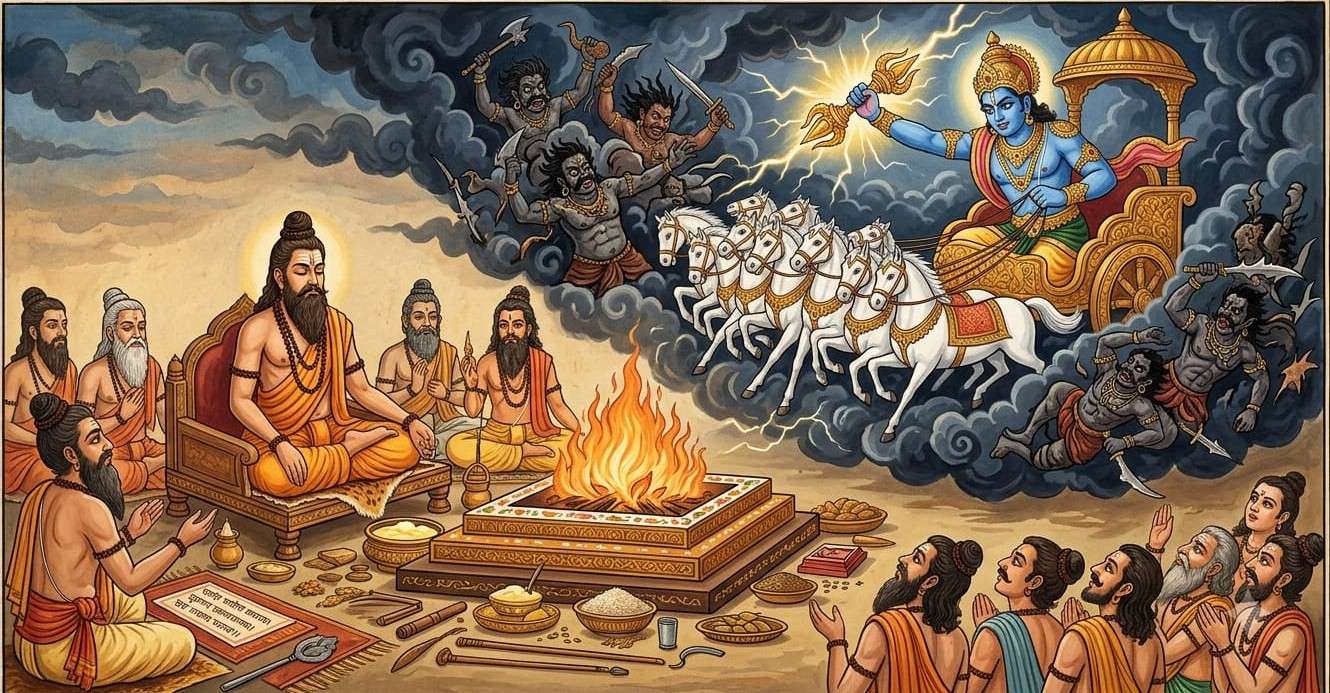
The sage Puruchhepa, steeped in the sacred vision of the Rigveda, raises his voice in solemn praise to Vayu through the Antyeṣṭi chandas, a metre resonant with depth and finality. In the sanctified precincts of the yajña, where the earthly and the celestial converge, he invokes Vāyu, the swift-moving lord of life-breath, beseeching him to arrive before all others, borne by his fleet and faithful horses. These steeds, embodiments of गति (motion) and प्राण (vital force), are not mere carriers but symbols of the unseen energies that pervade the cosmos, hastening to the altar where truth and righteousness sanctify every uttered word.
The sage proclaims that the path to divine communion lies through the purification of speech and intent, for only that which is aligned with सत्य (truth) and ऋत (cosmic order) can truly invite the gods. The chariot of Vāyu, drawn by radiant steeds of red and variegated hues, signifies the dynamic interplay of natural forces, harmonized and directed toward the sacred. Just as a preceptor awakens his pupils to knowledge, so does Vāyu stir the patron from spiritual inertia, ushering in awareness, while the dawn—Ushas—unfolds her luminous veil across the heavens, adorning the universe in garments of subtle and manifold colors.
The Soma, carefully prepared and purified, rests in vessels of reverence, exuding a fragrance that symbolizes both sensory delight and transcendental essence. This elixir, offered with devotion, represents not only a ritual substance but also the distilled aspiration of the human spirit seeking union with the divine. Vāyu, as the first recipient of Soma in Vedic tradition, is invoked to partake of it, for his acceptance signifies the activation of life’s energies within the sacrificer. The horses that serve him move in perfect accord with necessity, reflecting a principle akin to natural law, where every force operates with precision, purpose, and harmony.
As the winds guided by Vāyu traverse the worlds, they carry moisture that becomes rain, nourishing the पृथ्वी (earth) and sustaining all forms of life. The rivers, enlivened by these currents, flow with renewed vigor, embodying the cyclical movement of energy and matter. The cows, sacred providers of milk, butter, and ghee, symbolize abundance and the transformation of natural resources into offerings that sustain both ritual and life. In this interplay, one perceives an early scientific temperament, where observation of natural phenomena—wind, rain, and sustenance—is interwoven with spiritual understanding, forming a unified vision of existence.
The patrons, purified through vows and austerities, invoke Vāyu not merely as a deity but as a protector against forces that disrupt harmony—those metaphorical demons and obstructions that hinder both ritual and inner discipline. Their fasting and devotion refine their consciousness, aligning it with the subtle vibrations of the cosmos. Vāyu, seated upon the exalted place prepared for him, is acknowledged as the remover of impurities, the bearer of vitality, and the sustainer of all beings. His presence affirms that life itself is sustained by an invisible yet perceptible force, one that moves through breath, wind, and space alike.
Thus, the hymn of Puruchhepa becomes not only an act of devotion but also a profound reflection on the unity of natural law and spiritual insight. The ritual ground transforms into a microcosm of the universe, where every element—wind, light, water, and life—participates in a grand harmony. In invoking Vāyu, the sage reveals an enduring truth: that the forces governing the cosmos are not separate from the inner life of man, and that through reverence, discipline, and understanding, one may attune oneself to the