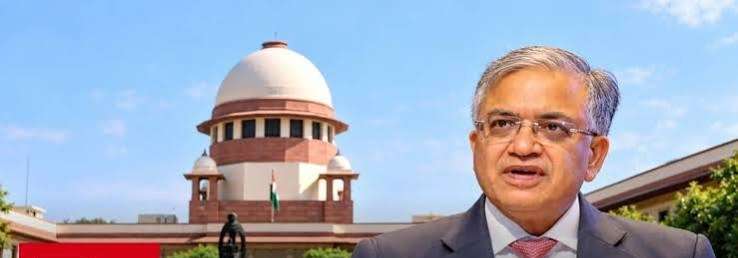
New Delhi: The New Delhi: The Supreme Court on Wednesday took suo motu cognisance of the contents of Class 8 NCERT textbook referring to the corruption in the judiciary and termed it a matter of “grave concern.”
A bench comprising Chief Justice Surya Kant and Justices Joymalya Bagchi and Vipul M Pancholi was urged by senior advocate Kapil Sibal that “children of class 8 are taught about corruption in the judiciary. This is a matter of grave concern.”
The CJI said, “I will not allow anybody to defame the institution. Law will take its course.”
“Since you have mentioned, I am informing you that I have already passed an order and am taking the matter suo motu. I will not allow anyone on earth to taint the integrity of the institution and defame the institution. At any cost, I will not permit it. Whosoever high it may be, the law will take its course. I know how to deal with it,” CJI Kant said.
The other judge in the Bench of the top court, Justice Joymalya Bagchi, while criticising the move, said it was against the basic structure.
It is to be noted that the National Council of Educational Research and Training (NCERT) has withdrawn its revised Class 8 Socience Science textbook from being sold a day after its release, following the controversy over a section on ‘corruption in the judiciary’.
The book, introduced recently, was even unavailable at NCERT’s office, the next day, following instructions from the Sales Division to pull it out from circulation.
The chapter titled “The Role of the Judiciary in Our Society” included a section on judicial accountability that triggered the row.
It stated that judges are bound by a code of conduct, including the Bangalore Principles of Judicial Conduct, which require them to remain fair, impartial and maintain integrity in both personal and professional life.
It further noted that when these standards are not upheld, the judiciary has internal mechanisms to ensure accountability.
“Complaints can be filed through the Centralised Public Grievance Redressal and Monitoring System (CPGRAMS), with over 1,600 judiciar related complaints recorded between 2017 and 2021,” it read.
Notably, the text also mentioned that in serious cases, judges can be removed by Parliament through impeachment.