Special Correspondent
Should a person named as an accused in a corruption case be allowed to vote in Hyderabad Cricket Association elections?
Should he be permitted to contest those elections — and even win?
And, having won, should he be allowed to occupy a position of authority in an institution whose own constitution contains a specific provision intended to prevent precisely such a situation?
These are not theoretical questions. They go to the heart of the continuing governance crisis in the Hyderabad Cricket Association.
The HCA’s Supreme Court-approved 2018 constitution appears to provide a clear answer.
Rule 6(6)(g) disqualifies a person from becoming an Office Bearer if he “has been charged by a Court of Law for having committed any criminal offence, i.e. an order framing charges has been passed by a court of law having competent jurisdiction.”
Rule 14(3)(g) provides an identical bar in respect of Councillors on the Apex Council.
There is nothing vague about this language.
It does not say that a person is disqualified merely because somebody makes an allegation against him. Nor does it say that a conviction must first take place.
Instead, it identifies a specific judicial event — an order framing charges by a competent court — as the point at which disqualification operates.
That is the rule.
That is the line.
That is the safeguard.
So why has that safeguard apparently remained dormant for years?
Three chargesheets. One extraordinary coincidence.
According to the records referred to in the Supreme Court-appointed Supervisory Committee’s progress report in SLP(C) 6779/2021, three criminal cases — CC 27/2017, CC 17/2016 and CC 26/2020 — involve allegations against a number of HCA office-bearers and former office-bearers, including former Test stars who served as Secretary and President, active politicians-cum-industrialists, power brokers and private academy promoters. (Although this newspaper possesses the charge sheets naming those accused, it is deliberately withholding their names, even though every stakeholder in the system knows who they are.)
The allegations are serious.
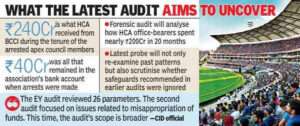
They arise from Anti-Corruption Bureau investigations and include alleged irregularities in the purchase of stadium chairs, alleged inflation of construction costs by as much as 400 per cent, the award of a canopy contract valued at around Rs 21 crore to a firm alleged to have had no prior experience in roofing work, and the purchase of gold coins worth nearly Rs 50 lakh from association funds.
These are not matters that can simply be dismissed as election-time allegations.
At the same time, an essential principle must be made absolutely clear: a charge is not a conviction. The accused are presumed innocent until proved guilty by a competent court.
That principle must be respected without exception.
But there is another principle that must also be respected — HCA’s own constitution.
And this is where the story becomes deeply troubling.
The Supervisory Committee’s report indicates that the three cases remain at the stage where chargesheets have been filed but orders framing charges have not been passed.
In at least two cases — CC 17/2016 and CC 27/2017 — the trial courts have passed discharge orders, while those orders are subject to further proceedings and stays before the High Court.
Thus, after years of criminal litigation, the cases have apparently not crossed the precise procedural threshold upon which HCA’s constitution places such importance.
Read that again.
Chargesheets have been filed.
Criminal proceedings have continued.
Years have passed.
But the constitutional trigger remains untouched: an order framing charges.
That raises a question HCA owes not merely to its members but to every cricketer who comes through its system.
Is this simply an unfortunate consequence of the criminal justice process?
Or has the extraordinary length of these proceedings created a situation in which the very rule intended to protect HCA’s governance can never effectively operate?
Nobody should prejudge the answer.
But nobody should be afraid to ask the question.
A rule with a finish line — but nobody seems to reach it
Rule 6(6)(g) was not drafted as a vague statement of good intentions.
It establishes an objective test.
Had the constitution said that an office-bearer would be disqualified merely because somebody accused him of wrongdoing, such a provision would obviously be vulnerable to abuse. Anyone could make an allegation and attempt to destroy an opponent’s eligibility.
HCA’s rule does something different.
It places the decisive event in the hands of a court.
Not a rival.
Not an election candidate.
Not a faction.
Not the media.
A court.
Only when a competent court passes an order framing criminal charges does the constitutional disqualification apparently arise.
That is about as objective as an association’s eligibility rule can get.
Which makes the prolonged absence of such an order all the more consequential.
A decade is not a trivial period in the life of a sporting institution.
A decade is long enough for generations of cricketers to come and go.
It is long enough for administrators to contest multiple elections.
It is long enough for office-bearers to acquire influence, consolidate positions and shape the institution’s future.
It is long enough for an entire generation of players to ask why the administration controlling their cricket appears permanently trapped in litigation.
And yet these criminal proceedings remain caught before the very procedural milestone upon which HCA’s constitution places such importance.
That is an extraordinary situation.
At the very least, it demands a transparent explanation.
The danger of turning procedure into protection
The issue here is not whether accused persons should receive due process.
Of course they should.
The issue is whether procedural delay can, in practice, become a substitute for constitutional compliance.
There is a fundamental difference between saying:
“These men are guilty.”
and saying:
“HCA must explain how its own constitutional eligibility rules are being applied.”
The first would prejudge a criminal case.
The second is a legitimate question of institutional governance.
And it is precisely the second question that HCA cannot escape.
If Rule 6(6)(g) is binding, who is responsible for determining whether a candidate is disqualified?
What scrutiny is undertaken before elections?
Who examines the status of criminal cases?
Who verifies whether an order framing charges has been passed?
What happens when an accused person contests an election?
Who certifies his eligibility?
Are all candidates treated identically?
Are the same standards applied to every faction and every individual?
Most importantly, where is the transparent record showing how these provisions have been applied?
If there is a legitimate legal explanation for the continued eligibility of the individuals concerned, HCA should have no difficulty placing it before its members.
Silence only deepens suspicion.
And that brings us to the second and perhaps even more disturbing part of this story.
Because the question of whether HCA’s accountability mechanisms are merely weak or are being actively frustrated is not based solely on the criminal cases.
There is another episode — involving the association’s own Ombudsman — that deserves close examination.
That is where the story moves from the question of criminal proceedings to the larger question of institutional accountability. (To be concluded)