


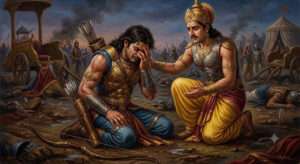
Overwhelmed by a grief too fierce to be contained, Arjuna, the son of a noble warrior lineage, gave way to bitter lamentation, his voice trembling with anguish as he cried that it was neither just nor fitting for his beloved son to depart alone into the unknown realm, especially when his maternal uncle, Lord Krishna, had come seeking him with affection; in that storm of sorrow, he seemed to call out as though Abhimanyu yet lived, urging him to return, to console Uttara with tender words, and to dispel the darkness gathering around their hearts, but the silence that followed only deepened his despair, while the sight of Dharmaraja’s downcast and pallid face stirred within him a restless inquiry, for he noticed the absence of Bhima and wondered if he had been sent elsewhere, and whether Satyaki had not entered the field of battle, and where King Virata had stood amidst the tumult, and whether the tide of war had grown so formidable that even such protectors had failed in their duty, yet even in that hour of torment, Arjuna did not yield to blame, for he knew well the prowess of his elder brother, who could stand unshaken even against hosts divine, and thus, restraining his grief within the bounds of discipline, his mind sought not accusation but understanding, probing the cause of Abhimanyu’s fall as a warrior seeking knowledge for the shaping of future strategy.
With a voice softened by respect yet sharpened by urgency, he addressed Dharmaraja, asking how the valiant youth had met his end, carefully framing his words so as to absolve his brother of fault, affirming his trust in him as both guardian and king, and he imagined that the boy must have fought with unmatched courage, striking down countless foes and troubling the mightiest among the enemy ranks, questioning whether he had stood firm without faltering, refusing to beg for mercy, and whether his valor had been duly recognized upon the battlefield, yet his thoughts, weaving between emotion and reason, wandered into tender speculation, wondering if, when surrounded by a storm of arrows, spears, and swords, bereft of aid, the young warrior had, even for a fleeting moment, remembered his father and silently called for rescue, though he rebuked himself at once, declaring that such weakness could not belong to the son of Arjuna, nor to the nephew of Krishna, for surely Abhimanyu would not retreat even if the heavens themselves fell upon him, and thus, torn between pride and sorrow, he confessed that the radiant smile of his son haunted his mind, and marveled that his own heart had not shattered into fragments under the weight of such grief, concluding that it must indeed be made of stone to endure so cruel a burden.
As his lament deepened, he reflected that when the merciless enemy hosts closed in upon the boy, suffocating him with their treachery, why had he not turned his thoughts to Krishna, whose mere remembrance could have undone the wicked design, and he wondered aloud whether anyone had beheld the fallen hero, his body adorned with the crimson mantle of blood, vowing to seek him out, for he knew that wherever Abhimanyu lay, that place would shine with a brilliance like the moon rising from the earth itself, and his thoughts turned with dread to Subhadra, who would be shattered by the loss of her son, and to Draupadi, whose grief would demand solace beyond words, and thus, exhausted and broken, he continued to speak in fragments of sorrow, each memory piercing him anew, until he recalled the earlier tumult of battle, when, while he was engaged against a vast alliance of sworn warriors, he had heard the triumphant roars of the Kauravas and the cutting words of Yuyutsu, who condemned their act, declaring that many had united to slay a mere youth and that such hollow victory would soon turn into wailing, warning that those who dared harm the kin of Krishna and Arjuna would not escape destruction, for even divine protection would not shield them from the fruits of their sin, yet Arjuna admitted that he had dismissed those words at the time, trusting that Krishna, who had also heard them, would guide him, and thus he turned again to Dharmaraja, lamenting that had he been informed at once, he would have annihilated the cruel adversaries without delay, and once more his spirit sank into the abyss of despair.
At that critical juncture, Lord Krishna, who had thus far remained silent, gently took Arjuna by the hand and spoke with calm authority, reminding him that it was not fitting for a warrior to be consumed by sorrow, for death in battle, embraced with valor, was the highest destiny of the heroic, and that the duty of the kshatriya was to assemble forces, wield weapons as extensions of life itself, and confront the enemy without hesitation, and he declared that Abhimanyu, by his extraordinary courage and by striking down countless foes, had attained both earthly glory and celestial honor, which would forever adorn his name, and thus there was no cause for lamentation, and Krishna further exhorted Arjuna, addressing him as Partha, that one so versed in the deeper truths of existence should not grieve like an ignorant man, for his sorrow had unsettled the hearts of all present, and it was now his duty to restore their courage with steadfast resolve and words of strength.
Gradually regaining composure, though his voice still trembled with restrained emotion, Arjuna turned to his brothers and declared that he longed to hear once more the sweet and noble words of Abhimanyu, and that those who had caused his death would soon behold him in the heavens, for Arjuna himself would send them there without delay, and he demanded a full account of the battle as it had unfolded, for even as grief lingered within him, his mind had returned to its warrior’s discipline, blending sorrow with purpose, and thus Sanjaya, witnessing all these events, conveyed to Dhritarashtra the poignant scene within the Pandava camp, where grief and resolve intertwined, and where, through the guidance of Krishna, the flame of duty was rekindled amidst the ashes of loss.

