



The valour of Abhimanyu upon the battlefield, so nobly acknowledged by Dronacharya, stirred not admiration but concealed resentment in the heart of Duryodhana. Though his countenance bore a strained smile, its pallor betrayed the unrest within. Addressing the assembled warriors—Karna, Bhurisrava, and Shalya—he spoke with veiled scorn. He declared that Drona, preceptor to all who bore the bow, renowned for his mastery, had, in misplaced affection for Arjuna, praised an immature and unsteady youth. Though this boy had caused them grievous harm, Drona, he insinuated, would never consent to his destruction.
Thus did jealousy reveal its true nature in Duryodhana—narrow in vision, restless in spirit, and incapable of bearing the excellence of another. While Abhimanyu upheld the highest codes of warfare, guided by the counsel of Yudhishthira, the Kaurava king derided him as a reckless child intoxicated with arms. The untimely praise of the commander and the corrosive envy of the king together became twin snares tightening around the young hero.
Persisting in his malice, Duryodhana urged his warriors to encircle the boy, to deny him escape, and to overwhelm him with a concerted assault. He sought not merely victory, but the humiliation of his own preceptor by striking down the one whom Drona had commended. Thus, with dark intent disguised as strategy, he set the hosts in motion.
Then rose Dushasana, proclaiming with reckless pride that he alone would devour the youth as Rahu swallows the sun. He boasted that upon Abhimanyu’s fall, grief would consume both Krishna and Arjuna, and that with this single act the long-nursed hatred of the Kauravas would find its appeasement. Such words laid bare the crude arrogance and destructive impulse that marked the Kaurava princes.
Amidst this gathering darkness, Abhimanyu shone resplendent, like the sun amid storm-laden clouds. When Dushasana advanced with a fierce volley, the son of Subhadra answered with equal might, piercing him with sharp shafts. The combat that ensued was intense and evenly matched; their chariots wheeled and swayed as though animated by the very rhythm of war. Yet the balance broke when Abhimanyu shattered his opponent’s bow.
With righteous indignation, Abhimanyu addressed Dushasana, recalling his vile conduct in the Kaurava assembly and condemning his cruelty, arrogance, and moral blindness. He declared that the torment inflicted upon the righteous never fades but returns with multiplied force. In that solemn spirit, he released a powerful shaft that struck Dushasana deep in the chest, casting him senseless upon his chariot. His charioteer, perceiving the peril, bore him swiftly away to safety.
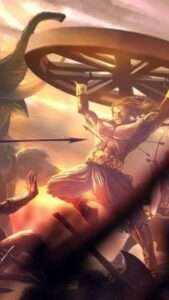
Meanwhile, the Pandavas, striving through heavy resistance to reach Abhimanyu, beheld from afar his extraordinary feats and rejoiced. Their hearts swelled with pride at the humiliation of Dushasana, even as they pressed forward to support the young warrior.
Observing his brother’s fall, Duryodhana turned to Karna and incited him to action. Karna advanced swiftly, yet Abhimanyu met him with unyielding force, slaying his guards and striking him with numerous arrows. Though Karna, the disciple of Parashurama, invoked celestial weapons, the youthful hero remained steadfast, embodying both skill and moral discipline. The fierce resistance of Abhimanyu wearied Karna, and when his brother joined the fray, the young warrior, in a surge of wrath, slew him with a well-aimed spear. Overcome by grief and shaken by the boy’s prowess, Karna withdrew from the field.
Then the Kaurava forces, uniting as a vast and turbulent ocean, surged upon Abhimanyu. Yet he moved among them like Mount Mandara churning the cosmic sea, scattering their ranks and instilling terror. Pursuing Karna, he drove him from the field, while his attendants too fled in disarray.
Witnessing this chaos, Dronacharya called out to the fleeing warriors—Karna, Kripa, Shakuni, and Bahlika—urging them to stand firm and rally their courage. He exhorted Duryodhana himself to gather his scattered forces and display his strength. Yet his words fell upon ears dulled by fear, and none returned to face the advancing hero.
Then Sanjaya spoke to Dhritarashtra, describing the devastation wrought by Abhimanyu. He likened the boy’s arrows to thunderbolts from the clouds of doom, shattering the Kaurava hosts. Like a lion’s cub roaring amidst prey, he ranged through the battlefield, reducing the fourfold army to ruin. Elephants lay fallen, chariots lay broken, warriors were scattered with shattered limbs, and the field itself appeared as a forest laid waste by tempest and fire.
Dhritarashtra, ever clouded by doubt, questioned why no great Pandava warrior came to aid the solitary youth. His inquiry, born not of compassion but of suspicion, sought to discern weakness or disunity among the sons of Pandu. Such was the reflection of his own inner fears and the flawed nature he shared with his sons.
Perceiving this, Sanjaya prepared to dispel the king’s misgivings and to reveal the deeper truth behind the unfolding events.

