


Bhishma, the deep taproot of the glory of the Kuru lineage, had fallen upon the field of Kurukshetra, and his fall drew forth waves of sympathy and sorrow from both the celestial worlds and the mortal realms. Lying upon the terrible bed of arrows, the grandsire spoke calmly as one who had mastered life itself. Addressing the unseen powers and celestial beings, he declared that he would hold his life within his body until the sacred season of Uttarayana, the second half of the solar year, when the sun begins its northward course. He reminded them that his father, Shantanu, had granted him two incomparable boons: that none could slay him against his will, and that he would depart from the world only when he himself chose the moment. “I have invited death,” he said with serene authority, “yet none can compel it upon me. My life force rests under my own command.” The gods themselves praised this supreme mastery. At the request of the river goddess Ganga, certain sages assumed the form of graceful swans and approached Bhishma; they perceived that he was fully aware that the present time belonged to the southern course of the sun, Dakshinayana, and that he patiently awaited the turning of the sun toward the north.
Meanwhile, Dushasana, acting under the command of Duryodhana, hurried to inform Drona of Bhishma’s fall. The venerable teacher fainted upon hearing the dreadful news, and after a brief interval, regained his consciousness. At the same time Sanjaya reported the events to the blind monarch Dhritarashtra. In the camp of the Pandavas, there arose an explosion of relief and triumph, for the mighty Bhishma had long stood as the impregnable wall protecting the Kauravas. Trumpets sounded, kettle-drums thundered, conches roared, and cries of victory echoed through the air. On the opposite side, grief overwhelmed the Kaurava host; princes and soldiers alike wept bitterly. The vast space between heaven and earth resounded with a strange mingling of jubilation and lamentation, so powerful that it seemed to dominate even the winds and waters. Many warriors stood motionless, their spirits paralyzed, gazing helplessly toward the victorious Pandavas and forgetting even the battle they had been waging. As the sun descended and darkness crept upon the field, the Kaurava camp seemed to sink into a river of sorrow.
Hearing these tidings, King Dhritarashtra spoke with anguish to Sanjaya, declaring that his heart must surely be forged of iron or carved from stone, for though every word struck him like an arrow, he yet remained alive to endure the pain. Sanjaya continued his narration: both armies, setting aside their weapons and armor, approached the fallen grandsire with reverence. Led by Yudhishthira, the princes and warriors from both sides gathered around Bhishma. Even Arjuna, holding his mighty bow Gandiva, came forward with tears in his eyes. In that solemn moment, hostility dissolved, and the field of war became a place of shared reverence for the heroic elder. Bhishma welcomed them with affection and permitted them to serve him. Requesting a pillow to support his head, he watched as the princes hurried to bring soft silken cushions; yet the grandsire merely smiled and turned his gaze toward Arjuna. Understanding the silent request, Arjuna laid aside his Gandiva and approached respectfully. Bhishma then asked him to fashion a pillow worthy of a warrior lying upon a bed of arrows. With Bhishma’s permission, Arjuna shot thirty arrows skillfully into the earth so that they upheld the grandsire’s head in firm and noble support.
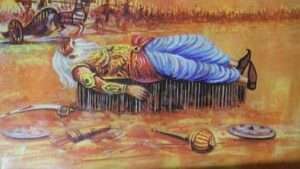
Bhishma then declared that he would remain upon that bed of shafts, meditating upon the radiant Sun, until the arrival of Uttarayana. He asked that security be arranged around him so that he might peacefully fulfill his vow. Obeying this request, both the Pandavas and the Kauravas constructed a protective enclosure and stationed devoted guards from both sides. Physicians approached with the intention of treating his wounds, but Bhishma gently declined their services, preferring to endure the suffering as part of his chosen destiny. Princes from the two camps arranged soft music of flute and Veena, and graceful dances to ease his mind from worldly anxieties. Yet the grandsire soon felt an intense thirst. Many refreshing juices and drinks were brought before him, but he refused them all, saying that the desired water was touched by the brilliance of the earth itself. The warriors were perplexed and helpless. Then Bhishma turned his gaze to Arjuna and said that his body burned under the arrows and that only Arjuna could relieve his thirst. Understanding the sacred hint, Arjuna circumambulated him, took up a shining arrow, and invoked the powers of Indra and Varuna through solemn prayer. When he shot the arrow into the earth, a sparkling fountain of cool water burst forth with natural fragrance and purity. The stream flowed directly to Bhishma’s lips, relieving his thirst and soothing his agony.
Greatly pleased, Bhishma praised Arjuna and revealed that he had heard from the sage Narada that Arjuna and Krishna were none other than the divine pair Nara and Narayana. Where those two stood united, he said, nothing was impossible. He lamented that Duryodhana had ignored his repeated counsel, for hostility toward the Pandavas was an invitation to self-destruction, and he foretold that Duryodhana would ultimately fall to Bhima. Addressing Duryodhana with compassion, Bhishma urged him to abandon pride and restore the kingdom of Indraprastha to the sons of Dharma, while ruling peacefully over the remaining half of the realm. If the war ended now, he said, at least some lives might yet be spared. Having spoken these wise words, the grandsire fell silent, and both armies saluted him reverently before returning to their camps.
As they departed, Krishna remarked to Yudhishthira that neither gods nor mighty demons could have defeated Bhishma, and that only through divine grace had such a miracle been accomplished. Yudhishthira humbly replied that it was solely through Krishna’s guidance and blessing that the Pandavas had been able to perform what seemed impossible. While these conversations unfolded, Karna approached Bhishma with deep humility and bowed before him. With folded hands, he requested the grandsire to set aside all anger and speak to him with fatherly affection. Bhishma beckoned him nearer, grasped his hand with tenderness, and asked the attendants to leave them alone. He then confessed that he had never harbored anger toward Karna; his only intention had been to restrain him so that unity might prevail among the children of Pandu and Dhritarashtra. Revealing a hidden truth, Bhishma told Karna that he was, in fact, the son of Kunti, not the son of Radha, and that this secret had been revealed to him long ago by Vyasa. From Karna’s radiant prowess, he had already suspected a divine origin. Since Karna was truly a son of the same lineage, Bhishma declared that he felt only affection for him and urged him to join the Pandavas in harmony, for they were destined to be invincible under the protection of Krishna.
Karna listened respectfully but replied with grave determination. Though he had learned of his birth from Kunti, he could not abandon the honor and generosity bestowed upon him by Duryodhana. To desert such loyalty, he said, would be unworthy of a warrior. He admitted that he had repeatedly insulted the Pandavas and widened the gulf between the two sides. Therefore, the war must continue until one party is crowned the victor. All events, he declared, moved according to divine will; action followed thought, and destiny unfolded its course. With unwavering resolve, he vowed to fight fiercely for Duryodhana, to unleash chaos upon the battlefield, and to challenge even Krishna and Arjuna in combat. Bhishma, perceiving the firmness of his spirit, acknowledged Karna’s immense strength and permitted him to act according to his will, advising him only to keep his mind serene and free from doubt. Karna then bowed once more to the grandsire, deeply moved by his affection, and departed to his camp.
Thus, concluded Sanjaya to King Dhritarashtra, recounting the events exactly as they had been narrated by Vaishampayana to Janamejaya, preserving for all ages the solemn grandeur of Bhishma’s fall and the wisdom he offered even while resting upon the immortal bed of arrows.

