This is an article series. Please read all previous articles before reading this article. The URLs for all previous articles are located in the SPECIAL THOUGHTS section.
I have to apologize for inadvertently conveying some incorrect information. In the past, when elaborating on Devata-s in level 7 and level 5, I had conveyed that there are 100 positions in level 7 and that Suparni is in position 100, Vaaruni is in position 99, and Paarvati is in position 98. Similarly, their eternal consorts Garuda, Shesha and Rudra are in positions 100, 99, and 98, respectively, in level 5. This is apparently incorrect. What I learnt recently is that there are 2 separate “Queues” in Level 7, one leading up to the position of Suparni and another leading up to the position of Vaaruni. Similarly, there are 2 separate “Queues” in Level 5 too, one leading up to the position of Garuda and another leading up to the position of Shesha. Each of these “Queues” has 100 positions. Garuda is in the 100th position in his queue in level 5. Similarly, Shesha is in the 100th position in his queue in level 5. The same holds good for Suparni and Vaaruni as well.
A future Garuda is in the 99th position in his queue, awaiting his turn. He will get his turn in the next Para Kaala (upon completion of the current Para Kaala, which leads to Mahaa Pralaya, which is when the current Brahmaanda is completely recycled, followed by the beginning of a new Para Kaala and a new Brahmaanda). So, he will be in the Garuda position in the next Para Kaala for an entire Para Kaala.
It is interesting to note that this future Garuda is not as popular as the future Shesha (Shiva). In general, even though there are 90,000,000 Devata-s we worship only the ones who are popular. We hear only about some Devata-s by a certain name and form. Other Devata-s have not been given a form (example, Niruti, Varuna, Vaayu, Vasu-s, Vishve Devata-s, all the future Garuda-s, all the future Shiva-s, all the future Suparni-s, all the future Paarvati-s, and so on). Many Devata-s have not even been given names. Yet, they all play a role in our existence and strive towards upholding Dharma.
Anyways, regardless of my inadvertent error in previous articles, Shiva is still the Abhimaani for our Manas and our Ahankaara (awareness of the self). He is the one through whom all Devata-s come into existence. He is still the Devata who recycles all the Loka-s during Brahma’s Dina Pralaya. As stated earlier, Shiva is one of the Devata-s who has been depicted with a particular form. Let’s ponder over Shiva’s form and Shiva Parivaara, which prominently involves Paarvati, Skanda, Ganapati, and Nandi. But before we delve into this, we need to understand the different states of a Jeevaatma.
What are the different states of a Jeevaatma? A Jeevaatma can exist in one of 3 Sthiti-s (Statuses):
- Sthiti 1: A Jeevaatma has attained Moksha. A Jeevaatma that has attained Moksha is free from the cycle of birth/death. It will never come back to take birth anywhere in this Brahmaanda.
- Sthiti 2: A Jeevaatma has attained Jeevan-Mukti. A Jeevaatma which has reached this state will have freed itself from all the 3 bodies it was wrapped in and will position itself in Maha Loka, or Jana Loka, or Tapo Loka or Satya Loka or a few other Loka-s which are accessible only to those who have attained Jeevan-Mukti. It will return to take birth when ordered by the ones above it. The purpose of a Jeevan-Mukta Jeevaatma coming back to take birth is to demonstrate how one has to live his/her life to gain eligibility for Jeevan-Mukti. A Jeevaatma which has reached this state will wait until the end of the current Para Kaala and the ensuing Mahaa Pralaya. I will then merge with the Jeevaatma-s superior to it, and then attain Moksha, which is the “State 1” described above.
- Sthiti 3: Lastly, a Jeevaatma has not yet attained Jeevan-Mukti, and is still stuck in the seemingly eternal cycle of birth/death. A Jeevaatma in such a state is called an “Amukta Jeevaatma”. An Amukta Jeevaatma is still wrapped in 3 bodies described earlier (Linga body, Subtle Body, and Gross Body). At death, it will lose the external Gross body, but still remains wrapped in the other two bodies (subtle and Linga bodies). It will enter a Garbha to regain the Gross body, which was lost at the end of its previous Janma, and thus continue to be stuck in the cycle of birth/death. It should be noted that a Jeevaatma has to attain Jeevan-Mukti first before it can attain Moksha.
There is a reason why the above 3 Sthiti-s of a Jeevaatma had to be explained. As mentioned many times earlier, a Jeevaatma is imperfect and flawed. The imperfections of a Jeevaatma is less and less as we go higher up in hierarchy. There are many criteria to evaluate the extent of imperfection of a Jeevaatma. One of them is the number of Lakshana-s in Jeevaatma’s Roopa (form). Paramaatma exhibits 32 Mahaa-Purusha Lakshana-s in his form. For example, the length of the nose in his form will be equal to the length of the ears and also the distance between the eyes; the height for his form will be 96 times the length of the thumb, and so on. These are the rules of Iconography. Sculptors carve idols of Paramaatma adhering to these rules of Iconography. This is why the idols in temples look different from normal human beings. There is a certain Saatvikataa to the appearance of those idols.
How about the Jeevaatma-s? Do they also exhibit Mahaa-Purusha Lakshana-s?
Yes. Devata-s in levels 2, 3, and 4 all exhibit 32 Mahaa-Purusha Lakshana-s. So, in a way, they are all nearer to perfection than imperfection. But, as mentioned earlier, a Jeevaatma is imperfect. However, when it comes to hierarchical level 5, the Devata-s in this level do not exhibit all 32 Mahaa-Purusha Lakshana-s. They only exhibit 28 out of the 32 Mahaa-Purusha Lakshana-s. In other words, hierarchical level 5 is the highest level of Jeevaatma-s where imperfections are obvious. Those imperfections are nitpickingly small among Devata-s in levels higher than 5. With that preamble, I offer to you my take on how Garuda, Shesha and Rudra represent the 3 Sthiti-s of a Jeevaatma.
- In a way, Garuda represents a Jeevaatma that has already attained Moksha. I say so because, as mentioned above, a Jeevaatma which has attained Moksha does not return to take birth anywhere in the vast Brahmaanda, just like how Garuda does not take Avataara on earth.
- In a way, Shesha represents a Jeevaatma that has already attained Jeevan-Mukti. I say so because, as mentioned above, a Jeevaatma that has attained Jeevan-Mukti does return to take birth, just as Shesha takes Avataara on earth, as he took the Avataara of Lakshmana and also Balaraama.
- And lastly, in a way, Shiva represents a Jeevaatma which has not yet attained Jeevan-Mukti. How? This can be better explained by looking at Shiva’s Roopa and his Parivaara, all of which seem to hint at the various benevolent traits that a Jeevaatma seeking Jeevan-Mukti has to embody to earn the eligibility for Jeevan-Mukti. Let’s look at them in detail.
Shiva is Gaja Charmaambara (wears the skin of an elephant). Of course, the legend in Puraanic texts may say that Shiva wore Gajaasura’s skin. But my take is… symbolically, the wearing of Gaja Charma (Elephant skin) by Shiva seems to hint to a spiritual seeker that all the benevolent traits one can observe in the Elephant-headed Ganapati (which has been previously elaborated on at length) must be embodied to gain eligibility for Jeevan-Mukti.
Next, Shiva Parivaara also has Skanda, whose benevolent traits have also been elaborated on previously. Skanda represents the benevolent desires sought through the Indriya-s. He also represents the longing to uphold Dharma, strive towards that goal and earn the resources necessary to meet those goals in a Dhaarmic way. These traits too are required to be embodied to earn the eligibility for Jeevan-Mukti.
Next, Shiva is Paarvati-Pati, the eternal consort of Paarvati. Again, as elaborated previously, Paarvati represents femininity, affection, compassion, and the transformation of thoughts into words. These words can be fierce and hurtful, symbolically depicted with Simha as Paarvati’s Vaahana, and thus hinting to a spiritual seeker to exercise control over his/her words. Shiva and Paarvati are also ideal consorts. She first took the Avataara of Sati and took Shiva as her consort. And, when that Avataara ended, she took another Avataara as Paarvati and sought Shiva as her consort again. Thus, Shiva and Paarvati are role models for spiritual seekers who have taken the Gruhastha Aashrama (familial life). Such Gruhastha-s (familial people) should seek children who are spiritually inclined and are capable of striving to uphold Dharma.
As mentioned earlier, Shree Krishna mentions in Bhagavad Gita “naasti buddhirayuktasya nachaayuktasya bhaavanaa” (Chapter 2, Verse 66). Here, Buddhi pertains to rationale, and Bhaavana pertains to emotion and compassion. By default, masculine traits are more oriented towards rationality. Similarly, by default, feminine traits are more oriented towards compassion. Symbolically, Shiva and Paarvati sitting together hints that a Jeevaatma should strive for a balance between rationale and compassion. In other words, a Jeevaatma should seek the facts about Paramaatma and his creation rationally and worship Paramaatma compassionately, with maximum gratitude.
One of the Aayudha-s in Shiva’s hands is a “Harina”, a deer. A deer is very attractive, runs really fast, and in all directions. Our mind too runs fast in all directions towards everything glittery and attractive. A Jeevaatma must gain control over the mind and its tendencies to pursue everything glittery and attractive.
Shiva’s Vaahana is Nandi, who is a Devata in level 19. From what I have heard/read so far, I guess that Nandi may also be one of the Abhimaani Devata-s for Kaama. I say so for the following reason. There are 4 Purushaartha-s that a Jeevaatma ought to strive to accomplish. They are Dharma, Artha, Kaama, and Moksha. We have Shaastra-s which help us understand Dharma, Artha, and Moksha. Similarly, Kaama is to be studied as a Shaastra. According to one author, before the work on Kaama by Vaatsyaayana, there was another work on Kaama Shaastra attributed to Nandi, which may have been far larger in volume too. But these works are not available now as a large percentage of our ancient knowledge has not been preserved due to repeated attacks from external aggressors.
One more thing about Nandi. When we invite guests to a certain event or gathering at our home, we usually request that they bring their family along. Similarly, in all our Pooja, Homa, we invoke and invite the Devata-s with their Anga, Upaanga, and Paarishadya (which basically means all those who are closely associated with the Devata-s we invoke). But, at least in the current times, we do know of a sect of people who exclude Shiva Parivaara in their entire Pooja process. We learn from Shreemad Bhaagavata that there is a curse by Nandi applicable to all spiritual seekers who worship, excluding Shiva Parivaara.
Another trait of the mind is that it can charge and pull in a particular direction with maximum force. This trait becomes particularly active in the pursuit of Kaama, as in sexual desire. This urge in particular and this train in general need to be controlled and given a direction for any spiritual progress. This is symbolically shown with Nandi being Shiva’s Vaahana.
Shiva is Gangaadhara. Ganga originates from the feet of Paramaatma, which is where every spiritual seeker ought to rest his/her head in surrender. Since Ganga has touched the feet of the one who can deliver us out of the cycle of birth/death, she is considered the purest and capable of washing off all our sins. Ganga is also really vast and voluminous. All these traits are also applicable to the Veda-s. Thus, Shiva wearing/holding Ganga in the Jathaa (hair locs) of his head is a symbolic hint to a spiritual seeker that he/she ought to hold Ganga Maataa, who can purify us from all our sins, in high esteem. Similarly, Shiva depicted as Gangaadhara is also a symbolic hint that a spiritual seeker ought to hold the rationale earnt through the study of Veda-s, which speak praises of Paramaatma and purify us from all our sins, in very high esteem.
Further, etymologically too, the word “Shiva” has two syllables, “Shi” and “Va”. The syllable “Sha” means bliss, and the syllable “Shi” is a superlative of the syllable “Sha”. And, the syllable “Va” means knowledge. Thus, the word “Shiva” means superlative bliss and knowledge. Shreemad Bhaagavata specifically portrays that Shiva became “Shiva” (one bestowed with superlative knowledge and bliss) by wearing the all-purifying Ganga in his head. It can also be understood that Shiva became “Shiva” by “wearing” the rationale earnt through the study of all-purifying Veda-s in very high esteem.
Shiva is depicted as Shashidhara, Naaga Bhooshana, Trinetra, Trishooladhara, and as having 4 arms. He is sometimes depicted as fair coloured and sometimes depicted as violet coloured. All these are symbolic for various traits that a seeker ought to pursue and embody. And it is also relevant to learn about the rift between Shiva and his father-in-law, Daksha Prajaapati, and understand what a spiritual seeker has to observe and learn from this. We’ll delve into them next.
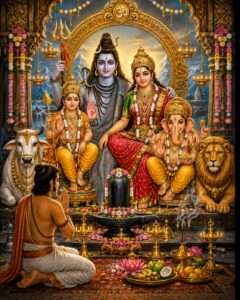
Photo: Kartik Dinesh