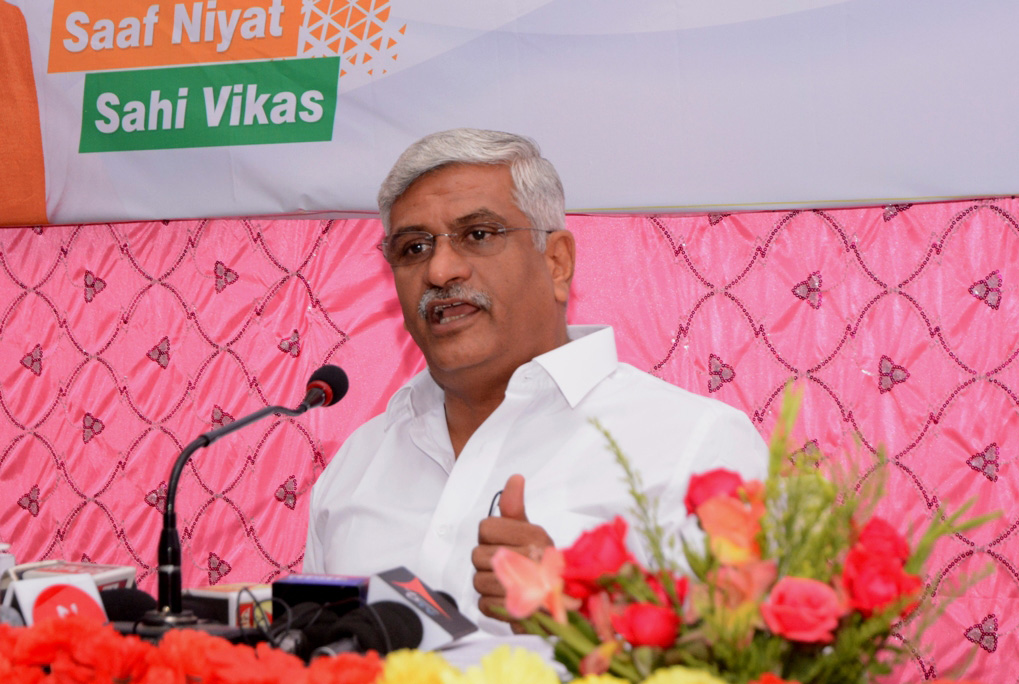
New Delhi: In frank recognition of India’s cultural plurality, Union Culture Minister Gajendra Singh Shekhawat has said Indian civilisation is an “amalgamation” of different faiths, and pages of history, “no matter what their colour”, cannot be removed.
His remarks, during an exclusive interview with PTI Videos on Wednesday, come in the backdrop of various right-wing outfits emphasising “Hindu civilisational identity” before Islamic rule began in roughly the 12th century.
“Heritage means heritage for us, and that is equally valuable,” Shekhawat said, referring to the abundance of historic sites in the country, from the 8th century Kailasa temples of Ellora, the 10th century Khajuraho temples to later era Islamic architectural marvels including the Taj Mahal.
Both hold “equal importance” for the civilisation of India, Shekhawat, who is also the tourism minister, said.
“The history of civilisation of India is a history of continuity, of more than 10,000 years of continuity. Pages of that history, no matter what their colour, cannot be removed. They are part of our history. It is as important a heritage for us as any Vedic-era heritage is… as the major legacy sites of Rakhigarhi or Sanauli are,” he said.
His comments come at a time a section of society is displaying growing assertiveness to “reclaim” several historic disputed sites, contending that they were originally Hindu temples later converted to mosques during the rule by various Islamic rulers.
The latest case is of the Bhojshala Temple-Kamal Maula Mosque complex, an ASI-protected monument in Madhya Pradesh which was declared a Hindu site by the Indore bench of the state’s High Court on May 15.
Asked how he feels as culture and tourism minister when he sees conflicts between Hindus and Muslims in many parts of the country over sites that can be tourist wonders, Shekhawat said it would be inappropriate to comment since many of them are in legal pendency.
“But ultimately we will have to accept this fact that the things which were changed based on the power of the sword, and if it is proved, then it is not only expected from Hindus but it is also expected from other communities that they should also look back at it, understand its importance and its faith, and take a decision,” he said.
Referring to the Bhojshala order, he said the Archaeological Survey of India, which comes under his ministry, studied scientific evidence.
“In that scientific study, numerous evidences were found that this Bhojshala was earlier a Sanskrit research centre, a Sanskrit study centre, and there was also a temple of Vagdevi (Saraswati),” he said.
Now that the court has ruled, both sides should see how they can “move forward on this by accommodating each other. With mutual consent we will have to move forward”, Shekhawat added.
The minister also rejected suggestions that disputed religious sites be turned into tourist sites that can be visited by people from all sections of society. “Can you make the structure that stands next to the Kashi Vishwanath Temple a tourist site? You and I, all know about the kind of structure that stands near the Janmabhoomi, near the Mathura temple, the entire country knows about it, both sides know why it was built, when it was built, and under what circumstances. Can it be made a tourist site?” he asked.
Notwithstanding these disputes, Shekhawat batted for preserving the plurality of India’s cultural identity.
“India has an identity. India’s identity is its diversity, its inclusivity. India’s identity is its cultural identity. It is the amalgamation of different cultures, different faiths, different beliefs, different cultural practices, different types of nature, different types of culture; only then is it one India,” he asserted.
The ancient Kashi Vishwanath Temple in Varanasi is located on the banks of river Ganga. The neighbouring Gyanvapi Mosque structure has been a source of contention between the Hindu and Muslims.
The Krishna Janmabhoomi and Shahi Idgah mosque dispute in Uttar Pradesh’s Mathura has been another source of contention between the two communities. A section of Hindus claim that the Mughal-era mosque was built after demolishing a temple at the birthplace of Lord Krishna.