



There is a growing tendency in a section of the media to manufacture a controversy first and explain the facts later. The latest attempt revolves around the Election Commission of India and the Special Intensive Revision (SIR) of electoral rolls. What is being presented as evidence of an institutional rupture may, on closer examination, simply be evidence that the institution actually allows its members to question, scrutinise and improve proposals before a final decision is taken.
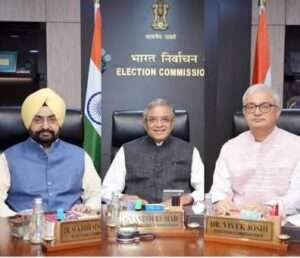
An ‘investigative’ report has revealed that Election Commissioners Sukhbir Singh Sandhu and Vivek Joshi recorded objections or raised concerns on at least 14 occasions over 10 months on matters relating to electoral-roll management, including Form 6, voter deletions and the centralisation of electoral-roll databases.
That is a legitimate subject for reporting. But turning every internal objection into a constitutional crisis is something entirely different.
The Election Commission itself has clarified that such queries, observations and suggestions are part of the normal deliberative process. It has stated that the final decisions relating to SIR and other matters were approved unanimously by all three Election Commissioners.
This distinction is crucial.
The ECI is a three-member constitutional body comprising the Chief Election Commissioner and two Election Commissioners. Under the Chief Election Commissioner and Other Election Commissioners Act, 2023, the Commission is expected, as far as possible, to transact its business unanimously; where differences remain, they are decided by majority.
In other words, disagreement during deliberation is not a malfunction of the system. It is built into the system.
Indeed, what would be more disturbing? Two Election Commissioners raising questions inside the institution and having those concerns examined, or two Commissioners remaining silent while believing that something was wrong?
The very purpose of a multi-member constitutional body is to prevent unquestioned unilateral decision-making. If Commissioners raise concerns about voter registration, deletion procedures, technology, database access or statutory forms, those concerns deserve to be recorded and examined. That is institutional scrutiny—not automatically institutional rebellion.
The crucial question therefore is not whether objections were raised. The crucial question is: What happened to those objections before the final decision?
If concerns were examined, modifications made where necessary, differences resolved and final orders approved collectively, then the process demonstrates checks and balances functioning—not collapsing.
Yet a section of the media appears determined to transform this distinction into a dramatic narrative of an “ECI split”. Opposition politicians, predictably, have seized upon the report and demanded action against the Chief Election Commissioner. The political reaction is understandable as politics. But journalism should not become an amplifier for political interpretation without examining what the institutional record actually establishes.
There is nothing wrong with investigating the Election Commission. In fact, the institution should face scrutiny precisely because electoral rolls and the right to vote are fundamental to democracy. The media has every right to ask why objections were raised, how they were handled and whether procedures were followed.
But there is an equally important journalistic responsibility: do not manufacture a constitutional crisis where the available evidence establishes an internal deliberation followed by a collective decision.
The obsession with controversy has become a business model for some sections of the media. A routine disagreement becomes a “rift”. A query becomes “dissent”. A dissent becomes “rebellion”. And before the public gets to examine the underlying facts, the headline has already delivered the verdict.
That is not investigative journalism. It is controversy manufacturing.
The irony is that the very process being portrayed as proof of institutional weakness could equally be read as proof that the institution has internal checks. Commissioners are expected to question. Files are expected to contain observations. Proposals are expected to be debated. And final decisions are expected to emerge through the prescribed mechanism.
The public deserves scrutiny, not manufactured suspicion.
The ECI should certainly remain accountable. Its procedures should withstand judicial, constitutional and public scrutiny. But accountability cannot mean converting every internal disagreement into a scandal.
Democracy needs a vigilant media. It does not need a media ecosystem that creates controversies merely to remain relevant.
When there is a real institutional failure, expose it without fear. When there is none, do not manufacture one.
Making controversy out of non-controversy may sell headlines. It does little for democracy or for the media’s own professional credibility.

