


When the mighty Karna beheld the scattered ranks of the Kauravas, their spirits shaken and their courage dimmed like lamps in a tempest, he resolved within his heart to rekindle their valor. Thus, standing firm upon the field of destiny, he addressed them in a voice resounding like a war-drum: “The sons of Yudhishthira—Bhima, Arjuna, Nakula, and Sahadeva—are warriors who never retreat from battle, and the pride of Satyaki is indeed formidable; yet I shall shatter them to dust with the irresistible storm of arrows from my invincible bow. I shall restore to our lord, Duryodhana, the splendor and sovereignty of the Kuru throne. But if fate decree otherwise, I shall listen to the celestial music of the Gandiva and ascend gladly to the hero’s heaven.”
With a mind ablaze like sacrificial fire, he further declared that, guarding the Kaurava hosts and striking down the Pandavas at every turn, he would blaze across the battlefield like a consuming flame, earning the applause of warriors and the admiration of all. He proclaimed that, having fulfilled his duty, he would attain the revered presence of the grandsire Bhishma, for what greater glory could a warrior desire than such an end crowned with honor and remembrance.
Then Karna commanded his charioteer to prepare the resplendent chariot adorned with gold and precious stones, harnessed with swift and noble steeds. He ordered that weapons of every kind be arranged in abundance, that the radiant banner studded with gems be raised aloft, and that kettle-drums, trumpets, and conches be kept ready to proclaim his advance. In but a moment, as though by divine will, the chariot stood prepared, gleaming like the rising sun and equipped with all instruments of war.
Clad in shining armor and adorned in princely attire befitting his valor, Karna mounted the chariot that flashed like lightning amid storm clouds. Bowing reverently to King Duryodhana, he was extolled by hosts of warriors and followed by a vast retinue whose banners fluttered like restless flames, striking dread into the hearts of the enemy. Thus, with majestic bearing, he proceeded to the place where the grandsire Bhishma lay upon his bed of arrows.
There he beheld a sight both wondrous and sorrowful: the mighty Bhishma, fallen yet radiant, resembled a celestial being cast down from the heavens, like a great mountain shorn of its wings, or a noble elephant pierced by shafts and seeking repose by the sacred waters of the Yamuna River. Approaching with trembling steps, Karna touched the feet of the grandsire; tears welled in his eyes like pearls of grief, and he stood before him with folded hands and deep humility.
“O noble scion of the Bharata race,” he said, his voice softened by reverence, “I, Karna, have come to behold you. Open your eyes and cast your gracious glance upon me. Is this the fruit of a warrior’s righteous life, that he should lie thus upon the field? Yet such is the inscrutable decree of fate. You, who have ever stood steadfast in truth and righteousness, who are a treasure-house of courage and the illustrious son of King Shantanu, deign to bless and guide me, for your words are sweeter than celestial melody.”
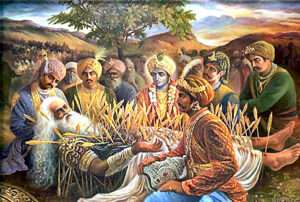
He continued, praising the grandsire’s unmatched prowess, recalling how none could equal him in leading armies or reducing foes to ashes with his arrows. He spoke also of Arjuna, whose shafts, driven like flames by the will of Krishna, threatened to consume the Kaurava forces like a forest fire, and whose conch, Panchajanya, resounded across the quarters, joined by Devadatta, striking terror into every heart. “Yet,” he said, “only you have restrained such a warrior—he who contended with Shiva and obtained divine weapons, and who destroyed the mighty Nivatakavachas at the behest of Indra.”
Then Karna, with renewed fervor, declared, “Command me, O venerable one. I alone shall subdue Arjuna, even as sacred incantations subdue a serpent; by my strength and mastery of arms, I shall bring him low and secure victory for our king.”
Hearing these words, Bhishma opened his eyes and, with a gaze filled with wisdom and affection, spoke thus: “O Karna, mighty among warriors, if the Kauravas flourish under your protection like fields nourished by timely rains, like rivers swelling toward the ocean, or like seeds ripening into abundant harvest, then what more could I desire? You are as dear to me as Duryodhana himself, for bonds of friendship, as the wise declare, often surpass those of blood. The burden of royal protection rests upon your shoulders, and you have already subdued many kingdoms, such as Videha and others, making them vassals of our lord. Therefore, go forth, ensure the safety of your kin, and lead them to victory.”
Filled with joy and reverence at these gracious words, Karna bowed low, placing his head upon the grandsire’s feet. Having received permission, he departed; mounting his chariot once more, he cast his gaze upon the despondent army and, like the rising sun dispelling darkness, infused them with courage and renewed confidence.
Thus did Sanjaya relate to King Dhritarashtra how Karna, to the delight of Duryodhana, restored faith in the fourfold army. His red steeds, golden chariot, resplendent banner, royal umbrella, and shining armor filled the Kaurava hosts with hope and renewed spirit.
Then did Duryodhana approach Karna with gladness and say, “O Karna, the army that was bereft of leadership now shines under your command; declare, therefore, what should be our foremost course of action.”
To this Karna replied with measured wisdom: “O king, seeker of the welfare of all, your discernment surpasses that of others; yet hear my thought. Our forces fought bravely under the illustrious Bhishma, who upheld the glory of the Kuru race. Now, however, an army without a commander is like a ship without a helmsman, destined to sink amidst the ocean of war. Therefore, it is for you to appoint a worthy commander-in-chief, that our strength may be united and our victory secured.”
Thus spoke Sanjaya, revealing that Duryodhana, mindful of the fall of Bhishma, turned his mind toward the solemn task of choosing a new leader for the Kaurava hosts, even as the great war surged onward like an unending tide.

