



The question confronting modern air defence is no longer merely whether an enemy drone can be shot down. It is whether a nation can afford to keep shooting down hundreds of inexpensive drones with enormously expensive missiles. That is precisely where the latest advances by the Defence Research and Development Organisation (DRDO) assume strategic significance. Bharat is moving towards a new generation of warfare in which the cost, speed and availability of the weapon could become as important as its destructive power. DRDO’s progress on a 30 kW-class Directed-Energy Weapon (DEW), designed to engage drones, UAVs and surveillance systems, is a striking example of this transformation. The truck-mounted laser has reportedly demonstrated engagements at ranges of up to 5 km, and DRDO is now preparing to move the system towards a production model by bringing in an industry partner. The significance is much greater than another weapon entering Bharat’s arsenal. Imagine an adversary launching a swarm of relatively cheap drones to saturate an air-defence network. Using a conventional missile interceptor against every small drone can rapidly become an economically unsustainable proposition. A laser, by contrast, uses directed energy rather than a physical interceptor. Once the target is detected and precisely tracked, the beam reaches it virtually instantaneously. This is where the economics of warfare could change dramatically. A missile has to be manufactured, stored, transported and replaced after being fired. A laser weapon, subject to power availability, cooling and other operational constraints, does not require a new missile for every engagement. It therefore offers the possibility of repeated engagements at a radically different marginal cost. That does not make conventional missiles obsolete; rather, it gives commanders another layer with which to deal with large numbers of relatively inexpensive aerial threats. And DRDO’s progress has not happened overnight. Bharat’s directed-energy programme has evolved through successive generations. DRDO’s smaller 2 kW system has already moved into production, while the 10 kW variant has received Acceptance of Necessity for an initial 10–12 systems, with Larsen & Toubro and Bharat Electronics among the associated development and production partners.
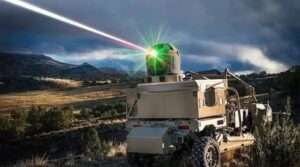
The 30 kW system represents the next major step. Its development and trials demonstrate something equally important: Bharat’s defence laboratories are increasingly moving beyond laboratory prototypes towards systems that can eventually be manufactured at scale with participation from domestic industry. That transition from invention to induction is critical. For decades, one of the persistent challenges in defence technology has been the gap between developing a prototype and producing it in sufficient numbers for the armed forces. DRDO’s present approach—retaining focus on core technologies while transferring production responsibilities to industry—could help narrow that gap. DRDO has already been transferring technologies relating to laser systems to industry partners. The larger strategic picture is even more significant. Directed-energy weapons are being developed as part of a layered air-defence architecture, including the broader Integrated Drone Detection and Interdiction System. The Government has also described the proposed ‘Sudarshan Chakra’ concept as a multi-level modern air-defence system. This is how a serious military power is built—not merely by acquiring more weapons, but by developing the science, sensors, electronics, propulsion, software and manufacturing ecosystem behind them. The next frontier is already visible. DRDO is pursuing higher-power directed-energy systems in the 50–100 kW range and beyond, potentially expanding their utility against larger and more demanding aerial threats. The message is therefore unmistakable. Bharat’s military transformation is not confined to bigger missiles or larger guns. It is increasingly about technologies that can fundamentally alter the economics and speed of warfare. The battlefield of tomorrow may belong not simply to the country possessing the largest arsenal, but to the country capable of defeating a swarm with technology that costs a fraction of what the attacker spent to create it. DRDO’s laser programme is an important step in that direction.

