



Raja Rao Pochiraju
For nearly three centuries, Great Britain proudly wore the crown of the world’s foremost imperial power. The sun famously never set on the British Empire, which governed nearly one-fourth of humanity and influenced administrative systems from Bharat to Africa, from the Middle East to the Caribbean. British institutions, parliamentary democracy, civil services, the rule of law, and governance models became templates for dozens of nations.
Today, however, the very nation once hailed as the “Mother of Administration” finds itself confronting a crisis of identity, integration and governance.
A country that lectured the world about law, order, and institutional strength is now struggling to answer a fundamental question: What does it mean to be British in the 21st century?
The issue extends far beyond religion. It encompasses immigration, demographic changes, multicultural policies, secularism, national identity and the inability of political establishments to address difficult questions without fear of being labelled intolerant or racist.
A Dramatically Changing Britain
The United Kingdom of 2026 is not the Britain of the 1950s.
Muslims today constitute approximately 6 to 6.5 per cent of Britain’s population, numbering over four million people. The growth has largely been driven by immigration and relatively higher birth rates.
British Muslims are also among the country’s youngest demographic groups, with a substantial percentage born within Britain itself.
Yet another trend is unfolding simultaneously.
Britain is becoming increasingly secular. Christianity, once the unquestioned cultural backbone of British society, is witnessing a steady decline. Surveys repeatedly show that people identifying with no religion—atheists, agnostics and secular citizens—constitute the fastest-growing category.
In essence, Britain is simultaneously becoming less Christian and more religiously diverse.
That transformation has created intense debates about identity.
Multiculturalism: Success Or Failure?
For decades, Britain embraced multiculturalism as a state policy.
The idea appeared noble: allow communities to preserve their cultural and religious identities while coexisting under a common British framework.
However, critics now argue that Britain built parallel societies rather than integrated communities.
Mosques have become prominent features in many cities. Halal food options are routinely available in schools and public institutions. Islamic schools have expanded. Muslim politicians occupy influential positions, including the Mayor of London and several local government offices.
None of these developments are inherently problematic in a democratic society.
The real question lies elsewhere.
Has Britain successfully integrated these communities into a unified national identity?
Or has it allowed separate identities to flourish without sufficient emphasis on shared values?
Even within Britain’s Muslim community, opinions vary enormously.
Polling suggests there is no single Muslim viewpoint regarding issues such as Sharia law, cultural integration or the relationship between faith and British law. Many Muslims fully embrace British constitutional values, while others advocate a greater role for religious principles in public life.
This diversity of opinion often gets lost amid sensational headlines.
The Grooming Gangs Scandal: Britain’s Deepest Institutional Failure
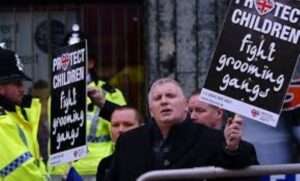
If there is one issue that has shaken Britain’s conscience, it is the grooming gangs scandal.
Recent attention has focused on a private inquiry led by British Member of Parliament Rupert Lowe.
The report estimates that as many as 250,000 women and girls may have been sexually exploited by organised gangs since 2000.
The figure itself remains contested because it comes from an independent, crowdfunded inquiry rather than an official government count. However, the report argues that the true number may be much higher because many victims never report abuse.
What is undisputed is that Britain has already witnessed horrific scandals.
The most infamous example was the town of Rotherham, where official investigations established that more than 1,400 children were abused over many years.
Investigations found that many perpetrators belonged to gangs primarily composed of British-Pakistani men.
The issue is not merely about the crimes themselves.
It is about institutional paralysis.
Reports repeatedly accused local councils, police departments and social workers of failing to act due to fear of being branded racist or Islamophobic.
That accusation has triggered nationwide outrage.
When political correctness begins to obstruct justice, society itself becomes endangered.
Protecting children should never become subordinate to protecting reputations.
Political Cowardice Or Administrative Collapse?
Britain now faces uncomfortable questions.
How could one of the world’s oldest democracies allow vulnerable girls to be victimised for decades?
How did institutions designed to protect citizens become paralysed?
Why were whistleblowers ignored?
Why were survivor testimonies dismissed?
These are not anti-Muslim questions.
They are governance questions.
The British Parliament is fiercely debating these issues.
Some politicians, including Rupert Lowe, are demanding stricter immigration policies and immediate deportation of foreign offenders involved in such crimes.

Meanwhile, the government has launched Operation Beacon, reformed rape consent laws and established further inquiries into how cultural and group dynamics may have contributed to these failures.
The debate is no longer confined to fringe political circles.
It has entered mainstream British politics.
A Dangerous Mistake: Generalising An Entire Community
However, Britain must avoid committing another grave error.
Criminal gangs do not represent an entire religion.
Millions of British Muslims are law-abiding citizens, professionals, doctors, entrepreneurs, soldiers, teachers and public servants.
Holding an entire community responsible for crimes committed by specific criminal networks would be unjust and counterproductive.
At the same time, refusing to discuss patterns identified in official investigations is equally dangerous.
Democracies survive by confronting uncomfortable truths, not suppressing them.
The challenge lies in balancing accountability with fairness.
The World Is Watching Britain
There is irony in Britain’s predicament.
For centuries, Britain exported governance models to its colonies. It advised nations on administration, institutional integrity and law enforcement.
Today, many of those same nations are watching Britain struggle with its own governance crisis.
The lesson is universal.
Civilisations rarely collapse because of external enemies alone.
They weaken when institutions lose courage.
They weaken when political convenience overrides truth.
They weaken when leaders become afraid to confront difficult realities.
Britain today stands at such a crossroads.
This is not a battle between Christians and Muslims.
It is not a battle between natives and immigrants.
It is a battle between effective governance and political timidity.
The “Mother of Administration” now faces the ultimate test of its own administrative philosophy.
Whether Britain rediscovers the courage to defend its institutions without compromising democratic values will determine not merely its future, but also its place in history.
For the world, Britain is no longer a teacher.
It has become a cautionary tale.


A nation’s strength is measured not only by its laws and institutions, but by its willingness to uphold justice without fear or prejudice. Crimes must be confronted firmly, regardless of the ethnicity, religion, or background of the perpetrators. At the same time, the actions of criminals should never be used to stigmatize entire communities. Institutional failures deserve scrutiny, but accountability and social harmony must go hand in hand. A healthy democracy protects both public safety and equal rights for all citizens.
A remarkably thoughtful and well-balanced piece. What stands out is not just the depth of analysis, but the courage to address a sensitive subject with fairness and clarity. The article avoids easy generalizations and instead focuses on the importance of strong institutions, accountability, and principled governance. It is the kind of writing that encourages readers to think critically rather than react emotionally. A truly insightful contribution well done, sir.
This is the same way repeating how Britishers captured and ruled on major parts of globe and before leaving looted wealth and ruined culture.
I could not understand the meaning of secularism when one community is given special privileges beyond constitution. What is the meaning of secularism politicians means .
It is like camel allowed to put his neck in tent during storm in desert and slowly captures whole tent throwing out master.
Any country with sovereign power has the right to punish the offenders.We cannot blame one community if its members are misusing the laws and outcast the whole community.It rests on the Law and Order of that particular country to deal strictly with the offenders.Leaving them scot free because of Political power will lead to the deterioration of that country.
Good and bad coexisted in Maha Bharata times as well as Ramayana times.May be dimensions are more at present.British who migrated and made colonies 300years back now experiencing reverse migration from colonies. Crime and punishment are Natural part of human lives at the end of day🤔🙏😥
Nicely presented and well researched…..Britain is paying the price for being lax in nipping in the bud any illegal activity by immigrants and disrespect to British way of life
Beautiful Analysis.
well captured the essence of democratic survival story of GB..
everything starts small….
and so does conversion..
as long as, the law and order is maintained as per the law of the land… everything is under control..( under true and working democracy)…
we have seen carpet bombing and conversions..in many countries over the last century….GB is at cross roads…
truly captured the immenent turmoil…first GB, then Europe and India has to face…
democracy is good…but people should be put in place… when law of land is taken for a ride by criminals and terrorist…
The article is bold and truly depicts the present conditions in UK. This is definitely a pathetic situation. Corrective measures if not initiated by the government immediately situation will deteriorate beyond repair.
Surprised to see once the world leader of governance has become a prey to anti social elements who are trying to dominate the mainstream. Unfortunately it appears no remedial recourse is visibly attempted by the administration to prevent dropping. From social media we see that the situation has been slipping down. It may further reach a situation to a point of no return. It is the responsibility of the,citizens, the society and the administration to act firmely to avert further slip towards wrong direction. Any corrections if not made will effect the original community in general and will ultimately smash its culture.
Time for community, society and administration to follow a unified method with concentration to stop further fall and to bring back it’s past Glory.
Surprised to see once the world leader of governance has become a prey to anti social elements who are trying to dominate the mainstream. Unfortunately it appears no remedial recourse is visibly attempted by the administration to prevent dropping. From social media we see that the situation has been slipping down. It may further reach a situation to a point of no return. It is the responsibility of the,citizens, the society and the administration to act firmely to avert further slip towards wrong direction. Any corrections if not made will effect the original community in general and will ultimately smash its culture.
Time for community, society and administration to follow a unified method with concentration to stop further fall and to bring back it’s past. Glory.
Surprised to see once the world leader of governance has become a prey to anti social elements who are trying to dominate the mainstream. Unfortunately it appears no remedial recourse is visibly attempted by the administration to prevent dropping. From social media we see that the situation has been slipping down. It may further reach a situation to a point of no return. It is the responsibility of the,citizens, the society and the administration to act firmely to avert further slip towards wrong direction. Any corrections if not made will effect the original community in general and will ultimately smash its culture.
Time for community, society and administration to follow a unified method with concentration to stop further fall and to bring back it’s past Glory.
Sir, I would say, you have touched one part of the problem, but not authenticate the real problem. Why britain people going out of Christi@nity is because the ideology which is not a common universal human practice like sanatana Dharma. So they showed softer view to other religions. But they unable to understand the !sl@m which is too uncommon practice for universal humanity. If you softer to its ideology and practices then what we see now in Britain is inevitable to happen.
Excellent analysis on political degeneration of a nation which boasted of Administrative and political theories..being violated by its own habitants inside caring a damn for peace and order . Karma is not simply individual based , it’s obvious that it applies equally to Nations too .
It is nature’s
s order”What goes up has to come down, tht is what happens g I. Britain to day,Surprising Elected Givernments are un. wiitingly support gangs and scandals,Elected representatives should put their conscience to test before further unrepairable changes occur