



Antibiotics have transformed modern medicine. Diseases that once claimed countless lives became treatable after their discovery.
Today, complex surgeries, cancer treatment, organ transplantation, and intensive care are possible largely because effective antibiotics can prevent and treat bacterial infections. Yet, one of the greatest threats to these life-saving medicines is not the lack of newer drugs. It is the way they are being used.
Antibiotic misuse in India is a major public health emergency driving extreme levels of antimicrobial resistance (AMR). Over 83% of bacteria isolated in Indian hospital settings show resistance to standard antibiotics. This crisis is fuelled by widespread unregulated pharmacy sales, poor prescription practices, and pervasive public misconceptions.
Alarming statistics: Public Misuse: A nationwide survey revealed that 61.9% of participants took antibiotics for common colds without a doctor’s advice. Further Massive Consumption has been identified that in 2020, over 12.1 billion standard units of systemic antibiotics were sold in the country. Many of these are “Watch” group antibiotics—drugs that the World Health Organization recommends reserving for specific, severe infections—which make up more than half of the national consumption.
Fixed-Dose Combinations (FDCs): Over a third of all antibiotics sold are FDCs (multiple drugs in a single pill), and a significant portion of these are unapproved or discouraged. The Indian Council of Medical Research reported the clinical impact of that nearly 50% of patients have developed resistance to strong antibiotics used for common hospital-acquired infections.
The Institute for Health Metrics and Evaluation estimates that AMR is associated with over 987,000 deaths annually in India. In many households, antibiotics have become almost as common as painkillers. A fever, sore throat, cough or cold often prompts someone to search for an old prescription, buy antibiotics directly from a pharmacy, or accept advice from a friend or relative who “took the same medicine last time.” Others stop taking antibiotics as soon as they feel better, while some save the remaining tablets for future illnesses.
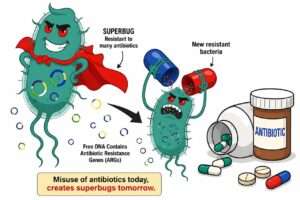
These practices may appear harmless, but collectively they contribute to one of the fastest-growing public health threats in the world.
Antibiotics are double-edged knives: One of the biggest misconceptions is that antibiotics work against every infection. They do not. Antibiotics are designed to kill bacteria. They have no effect against viruses, which are responsible for illnesses such as the common cold, influenza, COVID-19, most sore throats, viral fevers, dengue, and chikungunya are viral illnesses.
Likewise, malaria is caused by a parasite and requires antimalarial medicines rather than antibiotics.
According to the World Health Organization Aware Antibiotic Book (2022), antibiotics should be prescribed only when there is reasonable evidence of a bacterial infection. Using them for viral illnesses offers no benefit and unnecessarily exposes individuals to side effects while accelerating antibiotic resistance.
This often explains why antibiotics appear to “work” even when they were never needed. Most viral infections improve naturally within a few days. If an antibiotic is started around the same time recovery begins, it is easy to assume the medicine cured the illness. In reality, the body’s immune system may already have been doing the job. According to a review published in The Lancet Infectious Diseases (2024), this mistaken association remains one of the major reasons for inappropriate antibiotic use worldwide. WHEN THEY SAVE LIVES None of this means antibiotics are unnecessary. Quite the opposite.
When used appropriately, antibiotics remain among the most powerful medicines available. They are essential in treating bacterial pneumonia, tuberculosis, typhoid fever, bacterial meningitis (infection of the protective covering of the brain and spinal cord), urinary tract infections, cellulitis (a bacterial infection of the skin and deeper tissues), and sepsis (a life-threatening condition in which the body’s response to an infection damages its own organs).
In such situations, delaying treatment may have serious consequences. The challenge is knowing which illnesses require antibiotics and which do not. That decision is rarely based on fever alone. Doctors consider the patient’s symptoms, physical examination, and medical history and, when necessary, investigations such as blood tests, cultures or imaging before deciding whether an antibiotic is truly required.
Era of the Big Bug: The World Health Organization has repeatedly warned that the world is facing a growing threat from antimicrobial resistance, often referred to as the era of the “Big Bug” or “superbugs.” This does not mean that bacteria have become bigger. It means they have become smarter. Each unnecessary antibiotic creates an opportunity for bacteria to adapt and survive. Over time, these resistant bacteria learn how to defeat medicines that once killed them. The result is antimicrobial resistance—one of the greatest public health challenges of our time.
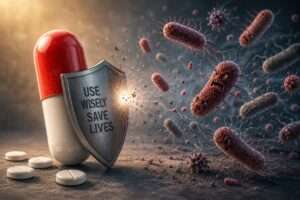
According to the WHO Global Antimicrobial Resistance and Use Surveillance System (GLASS) Report 2025, resistant infections are increasing across the world, making common bacterial infections progressively more difficult and expensive to treat. The consequences extend far beyond respiratory infections. Routine surgeries become riskier. Joint replacements, caesarean sections, cancer chemotherapy, organ transplantation, and intensive care medicine all depend upon antibiotics that still work. If resistance continues to increase, even relatively simple infections could once again become life-threatening.
A shared responsibility: India is among the world’s largest consumers of antibiotics. According to the Indian Council of Medical Research (ICMR) Antimicrobial Treatment Guidelines (2023), inappropriate antibiotic use in both hospitals and the community remains an important driver of antimicrobial resistance. Several common practices contribute to this growing problem—taking antibiotics without medical advice, demanding antibiotics for viral illnesses, using leftover medicines from previous illnesses, sharing prescriptions with family members, skipping doses, or stopping treatment midway because symptoms have improved.
Equally important is avoiding the temptation to use a “stronger” antibiotic simply because another medicine did not seem to work. The choice of an antibiotic depends on the type of infection and the bacteria involved, not on how powerful its name sounds. Antibiotic stewardship—the careful and responsible use of antibiotics—is now recognised worldwide as one of the most effective strategies to preserve these medicines for future generations.
Recent reviews published in Nature Reviews Microbiology (2025) and the New England Journal of Medicine (2025) continue to emphasize that responsible prescribing, improved infection prevention, vaccination, and public awareness are essential to slowing the spread of antimicrobial resistance.
Protecting a precious discovery: Antibiotics remain one of the greatest achievements in the history of medicine. Their success, however, depends on how wisely they are used. Every unnecessary prescription, every incomplete course, and every episode of self-medication contribute, in some measure, to the growing problem of antibiotic resistance.
These medicines should never be treated like ordinary tablets kept at home “just in case”. They are a precious resource that modern medicine cannot afford to lose. Protecting antibiotics today is not merely about treating the present illness correctly—it is about ensuring that future generations continue to have medicines capable of saving lives when they are truly needed. Antibiotics are among humanity’s greatest discoveries. They should be used with respect, not routine.

