N. Nagarajan
The Supreme Court recently observed that voters whose names were deleted from the electoral rolls and who subsequently submitted Form 6, meant for new voter registration, would not face any punishment. While the observation may offer some reassurance, I would respectfully urge the authorities to examine the chronology of events and the ground realities faced by ordinary voters.
The problem is not merely about punishment; it is about the ordeal of proving one’s identity and reclaiming a legitimate place on the electoral roll.
Amid the political din surrounding the Special Intensive Revision (SIR), with the ruling party defending the exercise and the Opposition Congress and other parties raising objections, genuine voters are caught in the middle. Political rhetoric is abundant, but practical assistance is conspicuously missing.
Neither the Election Commission (EC) nor the political parties have adequately addressed the difficulties confronting those whose names have been deleted. Borrowing Union Home Minister Amit Shah’s famous expression, “Chronology Samajhiye”, here is my chronology.
SIR began in our State in June.
There are two voters in our family. I submitted my enumeration form physically to the Booth Level Officer (BLO), as I could not complete the online process. My spouse, whose enumeration form never reached her, submitted it online and received an acknowledgement.
She is not a new or occasional voter. She has been a regular voter and has even performed election duty, including serving once as a Presiding Officer. Having fulfilled all the requirements, she naturally expected her name to remain on the electoral rolls. Instead, she was shocked to discover that her name had been deleted and her status classified as “Permanently Shifted”.
More disturbing was the absence of any physical verification or visit by the BLO before such a consequential classification was made. How can a genuine voter, who continues to reside at the same address, suddenly become a permanently shifted person without even being contacted?

Left with no alternative, she submitted Form 6 on August 31. After waiting for 45 days, the application was rejected on the ground that the address was incomplete. She was instructed to resubmit it using the municipal door number, although the EC guidelines refer to a full postal address. The relevant guideline is reproduced below.
Item 8 (Present Ordinary Residence):
*(a) Complete postal address with PIN code should be mentioned along with a self-attested copy of any
of the mentioned documents in the name of applicant/parents/spouse as proof of ordinary residence.
A visit to EC officials and staff did not resolve the issue. When she attempted to submit the form again using the municipal door number, the e-sign process became another hurdle. Worse, the online system offered no facility to save an incomplete application and resume it later. A process ostensibly designed to make registration easier was turning into an exercise in frustration.
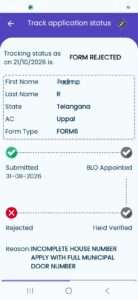
This raises some fundamental questions. If a voter submits an application, receives an acknowledgement and waits 45 days, only to be rejected over an address-format issue, who is accountable for the delay? Why should a genuine voter bear the consequences of technical limitations, inconsistent interpretations or inadequate verification?
Will the Prime Minister, the Home Minister, the Election Commission, the Opposition and other political parties spare a thought for lakhs of voters who may be encountering similar difficulties across the country? Instead of confining themselves to political rallies, press conferences and accusations, parties could organise assistance centres, deploy volunteers and help affected voters complete the required formalities.
The Congress has announced a rally in Delhi demanding the removal of the Election Commission. Political parties are entitled to raise institutional questions, but would it not be equally meaningful if they stood beside voters struggling to get their names restored? Public mobilisation need not always mean a procession to Delhi; sometimes it means helping a citizen navigate a government portal.
Electoral rolls must be accurate, and the need to identify ineligible entries cannot be disputed. But accuracy must go hand in hand with fairness, transparency, and an accessible grievance-redressal mechanism. No genuine voter should be made to pay the price for administrative or technological shortcomings.
SIR should strengthen democracy, not become a ‘Sar-Dard’ for its citizens. The right to vote is too precious to be lost in a maze of forms, acknowledgements, rejections and e-signatures. The Election Commission must ensure that every genuine voter gets a fair opportunity to be heard and have their name restored.
After all, democracy is not merely about conducting elections. It is equally about ensuring that every eligible citizen gets to participate in them.