



अस्माकं तु विशिष्टा ये तान्निबोध द्विजोत्तम ।
नायका मम सैन्यस्य संज्ञार्थं तान् ब्रवीमि ते ॥
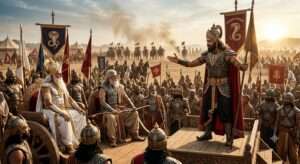
Duryodhana, having surveyed the opposing armies assembled on the battlefield of Kurukshetra, turns towards Dronacharya and says that he will identify for him the distinguished warriors of his own army. On the surface, these words appear to be a straightforward enumeration of military strength. Yet, when viewed through the larger philosophical and psychological framework of the Bhagavad Gita, they reveal a mind struggling to maintain confidence at the very moment when its inner certainty is beginning to fracture.
Duryodhana addresses Dronacharya as dvijottama, the best among the twice-born. The expression is outwardly one of respect, but within the context of the scene it carries a deeper psychological significance. Dronacharya is not merely the commander of a section of his forces; he is Duryodhana’s teacher and one of the elders whose presence gives legitimacy and strength to the Kaurava side. By repeatedly invoking the greatness of his preceptor and the distinguished warriors surrounding him, Duryodhana appears to be reassuring not only Drona but also himself.
The historical and ithihasic significance of this moment lies in the contrast between external power and internal confidence. The Kaurava army is formidable. It contains celebrated warriors such as Bhishma, Drona, Karna, Kripacharya, Ashvatthama and many other accomplished fighters. Numerically and militarily, Duryodhana possesses considerable strength. Yet the opening movement of the Gita demonstrates that physical resources and psychological security are not necessarily the same thing. A person may stand surrounded by immense power and still experience fear when confronted by the moral consequences of his own actions.
This distinction is central to understanding Duryodhana’s behaviour. His anxiety does not arise simply because the Pandava army is strong. The deeper disturbance comes from the fact that the battlefield represents the accumulated consequences of years of rivalry, injustice, humiliation and political manipulation. Kurukshetra is therefore not merely a geographical location where two armies meet. It becomes the visible stage upon which an entire history of choices is about to bear fruit.
From the perspective of social psychology, Duryodhana’s speech illustrates a familiar mechanism of threatened self-confidence. When individuals perceive that their position is endangered, they often begin to emphasize the resources available to them. They enumerate allies, authority, achievements and material strength. Such enumeration can serve two purposes: it communicates confidence to others, and it temporarily restores confidence within the speaker himself. Duryodhana’s detailed reference to his commanders can therefore be understood as an attempt to construct psychological certainty through verbal affirmation.
There is another important dimension. Duryodhana is acutely aware that Dronacharya’s emotional relationship with the Pandavas is complicated. Drona had taught both Kauravas and Pandavas, and Arjuna in particular had been among his most accomplished disciples. The warriors now standing on opposite sides of the battlefield are therefore not strangers to one another. They are teachers, students, relatives and former companions who have been transformed into opposing combatants by political circumstances.
This creates an unusual psychological tension for Duryodhana. He cannot openly accuse Drona of disloyalty, because Drona is indispensable to his military strength. At the same time, he cannot completely silence the suspicion that a teacher who loved and admired Arjuna might possess an emotional attachment to the opposing side. Consequently, Duryodhana’s praise of Drona contains an element of psychological pressure. By drawing attention to the warriors assembled on his side, he subtly reminds his teacher of the responsibility he now carries toward the Kaurava army.
His words therefore operate on several levels simultaneously. They are military assessment, respectful address, encouragement, self-reassurance and indirect persuasion. This layered character is one reason why the opening verses of the Gita are psychologically profound. The text does not begin with abstract philosophy. It begins with human beings under extreme emotional pressure, revealing through their speech the conflicts that exist beneath their outward conduct.
Duryodhana’s predicament also illustrates the difference between guilt and fear. Guilt arises from awareness that one’s actions have violated a moral standard; fear arises from anticipation of consequences. The two can reinforce each other. When a person knows that a confrontation is approaching and simultaneously carries unresolved moral conflict, external danger can appear greater than it objectively is. The mind begins to interpret every sign as confirmation of impending defeat.
This does not mean that every act of Duryodhana should be reduced to personal guilt. The Mahabharata presents a far more complex world in which duty, ambition, family loyalty, political authority and personal resentment continually intersect. Yet the epic repeatedly shows that unchecked attachment to power can gradually weaken the judgment of the person who possesses it. Duryodhana’s tragedy is not that he lacks intelligence or courage. It is that his intelligence becomes increasingly subordinated to attachment, rivalry and the need to preserve a position that has become psychologically inseparable from his identity.
His reference to the strength of his own army can consequently be seen as a defensive response to the moral and emotional pressure generated by the opposing camp. He knows that the Pandava side contains formidable warriors. More importantly, he knows that many of them are personally known to the elders standing beside him. The battlefield has converted relationships into political divisions. That transformation itself becomes a source of psychological strain.
The ithihasic genius of the Mahabharata lies in presenting such inner conflicts without separating them from the social world. Individual psychology is shaped by family structures, political institutions, loyalties, memories and collective expectations. Duryodhana does not stand alone. He carries the weight of the Kuru dynasty, the expectations of his father, the influence of Shakuni, the authority of Bhishma and Drona, and the rivalry with the Pandavas. His personal anxiety is therefore inseparable from the larger crisis of the kingdom.
The verse also reminds us that confidence based solely upon external strength is inherently unstable. A person may possess armies, wealth, authority and powerful associates, but if the mind itself is divided, those advantages cannot guarantee inner stability. True strength requires coherence between thought, conviction and action. When that coherence is absent, even abundance can produce insecurity.
In this sense, Duryodhana’s speech becomes an important prelude to the spiritual teaching that follows. The Gita gradually moves from the battlefield outside to the battlefield within. Arjuna’s crisis is open and visible; Duryodhana’s disturbance is concealed beneath political language and military calculation. Arjuna eventually admits his confusion and places himself before Krishna as a seeker of wisdom. Duryodhana, by contrast, attempts to overcome uncertainty by repeatedly asserting the strength of his side.
This contrast is philosophically significant. The willingness to acknowledge inner confusion can become the beginning of wisdom, whereas the refusal to recognize one’s own psychological conflict can deepen it. The Gita therefore does not present strength merely as the capacity to command others. It points toward a deeper strength arising from clarity, self-knowledge and alignment with dharma.
Duryodhana’s words thus carry an irony that becomes visible only through the larger narrative. He speaks of the distinguished warriors of his army because he wants to establish confidence in its power. Yet the very need to emphasize that power reveals the insecurity beneath his confidence. His external world is crowded with heroes, but his internal world is already unsettled.
Kurukshetra consequently becomes more than a war between two branches of a royal family. It becomes a symbolic field in which human motives are exposed. Ambition confronts conscience, attachment confronts duty, power confronts righteousness, and fear confronts self-knowledge. The armies are assembled outside, but the decisive struggle has already begun within the human mind.
The enduring truth of the Gita emerges from precisely this understanding. Human beings often attempt to silence inner uncertainty by accumulating external strength—position, possessions, allies, recognition and authority. Yet no external possession can permanently compensate for an unsettled conscience. The Gita’s wisdom begins when the human mind turns away from the mere measurement of worldly power and begins to examine the quality of thought, intention and action.
Duryodhana therefore stands at the threshold of a great historical and spiritual drama. His words are not simply the speech of a king describing his army. They are the expression of a human mind attempting to remain powerful while confronted by forces that it cannot control. In that tension lies one of the timeless lessons of the Bhagavad Gita: when the foundations of inner conviction are weak, the loudest declaration of strength may itself become evidence of fear.

