



Dussasana, consumed by rage, hurled a heavy pestle at Bhīma with all the strength he possessed. Bhīma shattered it effortlessly. At that very moment, the agonies of thirteen long years surged through his heart like a storm. Every humiliation, every sorrow, and above all, the unbearable memory of Draupadī’s dishonour in the royal assembly blazed within him like lightning. That sacred vow, preserved in the depths of his soul through years of exile and suffering, now awakened with irresistible force. His wrath became the instrument of destiny.
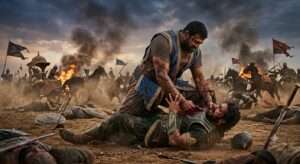
With the irresistible strength of his mighty mace, Bhīma struck Dussasana. The dreadful blow sent him crashing to the earth, his body drenched in blood. Before he could recover, Bhīma leapt upon him like a fierce tiger overpowering a helpless deer. Placing one foot firmly upon his neck, his eyes blazing with righteous fury, he cried aloud, “Where are the boastful words you uttered in the Kuru assembly? You searched for this moment; now behold its fulfilment. My heart has burned unceasingly since that day. Today the fire of my vengeance shall be quenched.”
Sanjaya, narrating the fearful spectacle to Dhritarashtra, said that Bhīma appeared like the blazing fire of dissolution. His terrible roar shook the battlefield. The Kaurava army, unable to endure the brilliance of his courage, scattered in every direction like frightened deer fleeing a raging forest fire. His presence flashed across the battlefield like lightning illuminating a dark sky. The warriors stood stunned, their minds paralysed by terror, unable either to advance or retreat.
Bhīma seized Dussasana with astonishing ease, whirling him through the air as though he were a mere toy before hurling him violently upon the ground once more. He kicked him with crushing force, pressed his body beneath his knees, and again pinned down his neck with overwhelming strength. Then, rising with a fierce and dreadful laugh that echoed across the field, he declared before both armies, “Hear me well! Today I shall tear open your chest and drink your blood, just as I vowed before kings and elders. If any among you possesses the courage to stop me, let him come forward.”
His terrible proclamation froze every warrior with horror. Taking up a keen weapon, Bhīma tore open Dussasana’s chest with the ferocity of Narasimha rending the body of the tyrant Hiranyakashipu. Blood gushed forth in torrents. Bhīma gathered it in his hands and drank it, proclaiming that no nectar had ever tasted sweeter than the blood of the wicked who had insulted virtue itself. He smeared the blood upon his face and body, becoming a terrifying embodiment of divine retribution. His appearance struck fear into every heart, and none could gaze upon him without trembling.
Looking upon the lifeless body of Dussasana, Bhīma proclaimed that neither a mother’s milk, nor honey of many kinds, nor sweet milk mixed with jaggery had ever given him the satisfaction that came from fulfilling his vow against the oppressor of Draupadī. His mighty voice thundered across the battlefield as he rejoiced in the completion of his solemn oath. He struck his powerful arms with resounding force, roaring like a victorious lion.
The soldiers of both armies were overcome with fear. Many believed that no ordinary man could perform such an act and imagined that some dreadful celestial being had assumed Bhīma’s form. Warriors abandoned their weapons and fled. Those who remained stood rooted to the ground, unable to comprehend the terrifying spectacle before them. His fearsome appearance and unconquerable fury seemed capable of consuming the entire battlefield.
After a few moments, Bhīma stood like Yama, the Lord of Death, at the end of time. Though his body was crimson with blood and his face still blazed with wrath, his majestic splendour remained undiminished. Holding his massive mace, he advanced once more into the battle with irresistible courage. Like a maddened elephant scattering an opposing herd, he broke through the Kaurava ranks, leaving confusion and destruction wherever he passed.
Still burning with the memory of ancient wrongs, Bhīma cried aloud before the assembled warriors, “Was it not enough that I was poisoned and cast into the waters? Was it not enough that I was delivered into the midst of venomous serpents? In the presence of elders, teachers, and relatives, you insulted us without righteousness or shame. We endured every outrage in silence, waiting only for the hour appointed by destiny. Tell me, has such wickedness ever been seen elsewhere? Does victory gained through deceitful dice deserve honour? Today justice itself has answered your crimes.”
Even after Dussasana’s death, Bhīma’s anger had not subsided. Swinging his mighty mace in astonishing circles, he surveyed both armies with blazing eyes. Turning towards the Kaurava warriors, he declared, “The first of my vows has been fulfilled. One remains. I shall shatter the thighs of Suyodhana, who shamelessly mocked the honour of our queen. Until that oath is accomplished, my wrath shall know no rest.”
Sanjaya said to Dhritarashtra, “Had wise counsel prevailed in the royal assembly, this dreadful calamity would never have arisen. The sons whom your court sought to humiliate now stand radiant in unsurpassed heroism. Bhīma has fulfilled the vow he uttered before the assembled kings. The second awaits its destined hour.”
The terrible end of Dussasana cast a shadow over the Kaurava host. Even Karna and the foremost warriors stood motionless, overwhelmed by the dreadful sight. None dared confront Bhīma in that fearful moment. He seemed no longer merely the son of Vāyu, but vengeance itself walking in human form. When at last the Kaurava warriors recovered from their terror, they slowly gathered their courage and prepared once again for battle, though the memory of Bhīma’s fearful wrath remained engraved upon every heart.

