
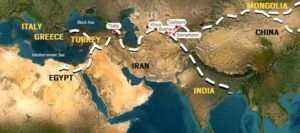
Nearly a thousand years ago, a medical prescription originating in India travelled thousands of kilometres across the Silk Road into Central Asia, carrying with it more than a medicinal formula. It carried a fragment of India’s rich medical heritage, preserved in a language that would eventually help modern scholars unlock a centuries-old mystery in the original Sanskrit text.
The remarkable story revolves around the Jīvakapustaka, a 10th-century bilingual medical manuscript discovered among the extraordinary collection of ancient documents preserved in the Mogao Caves near Dunhuang, China. Hidden for centuries in Cave 17, sealed within the dry desert environment, the manuscript offers a fascinating glimpse into the movement of medical knowledge between India and Central Asia.
Written in Sanskrit and Late Khotanese, an Eastern Iranian language once spoken along the Silk Road, the manuscript demonstrates how ancient medical knowledge crossed geographical, linguistic and cultural boundaries. Its significance, however, extends beyond documenting the transmission of Ayurveda. It has also provided modern scholars with a valuable clue to interpreting an obscure ingredient in an ancient Indian medical prescription.
At the heart of this discovery is a preparation known as Hapuṣādyaghṛta, a medicated ghee formulation derived from the Siddhasāra, a seventh-century Indian medical treatise composed by Ravigupta. The preparation’s formula appears in the Central Asian manuscript, identified as formula JP 26, and has become the subject of renewed scholarly interest.
The puzzle concerns a seemingly ordinary Sanskrit word: amla, generally meaning sour or acidic.
In modern readings of the Sanskrit source text, the term had commonly been understood as referring to a sour liquid obtained from ingredients such as jujube and radish. Yet the 10th-century Khotanese translation offered a more specific interpretation. Instead of rendering the ingredient merely as something sour, the translator identified it as drrą̄ma, meaning pomegranate, corresponding to dāḍima in Sanskrit.
This difference may appear minor, but in the interpretation of historical medical texts, the identity of an ingredient can fundamentally change the understanding of a prescription.
Philologist Mauro Maggi revisited this question in a 2022 study, examining the Khotanese evidence alongside parallel formulations found in two important Sanskrit medical works: the Carakasaṃhitā and Vāgbhaṭa’s Aṣṭāṅgahṛdayasaṃhitā.
The comparison led Maggi to propose that amla in the original formulation was not simply a generic reference to sourness or a sour liquid. Instead, it may have functioned as an epithet describing sour pomegranate.
The implication is significant. A translation produced in Central Asia nearly a millennium ago may preserve a more precise understanding of an Indian medical formulation than the interpretation subsequently adopted by modern readers of its Sanskrit source.
Maggi’s reading also raises an intriguing possibility about the intellectual environment in which the translation was produced. The Khotanese translator may have drawn upon living oral Ayurvedic traditions circulating across Central Asia, potentially influenced by the medical lineage associated with Vāgbhaṭa. Medical knowledge was not necessarily transmitted through written manuscripts alone; practitioners, translators and scholars could also carry interpretations across regions, adapting terminology while retaining the substance of established medical practices.
The Silk Road, therefore, was more than a network of trading routes connecting distant markets. It was a conduit for the exchange of ideas, scientific knowledge, religious traditions and practical skills. Indian medical systems travelled alongside other intellectual traditions, interacting with the cultures through which they passed.
The Jīvakapustaka provides tangible evidence of this exchange. Its bilingual character illustrates the role of translation in transmitting knowledge across linguistic frontiers, while its preservation in the Mogao Caves highlights the extraordinary value of manuscripts that survive beyond the intellectual worlds in which they were created.
For contemporary scholars, the episode offers an important methodological lesson: ancient translations should not always be treated as secondary witnesses of limited value. When read critically and compared with parallel texts, they can preserve interpretations that illuminate ambiguities in the original.
The Khotanese rendering does not automatically settle every question surrounding the Sanskrit prescription. Historical texts demand careful interpretation, and a proposed reading must be assessed against linguistic, textual and medical evidence. Nevertheless, the pomegranate clue provides a compelling example of how cross-cultural scholarship can reopen questions that appeared settled.
Nearly a thousand years after the manuscript was written, a word preserved in an ancient Central Asian translation is helping researchers look afresh at India’s medical past. What travelled along the Silk Road was not merely a prescription, but knowledge capable of acquiring renewed meaning centuries later.
In this remarkable encounter between Sanskrit medicine and Central Asian translation, the past has offered the present a valuable gift: a new key to understanding an old text.