Bheema Sena (continued)
This is an article series. Please read all previous articles before reading this article. The URLs for all previous articles are located in the SPECIAL THOUGHTS section.
Earlier we had pondered over the Bheema Sena Avataara of Shree Mukhya Praana Devata. Let’s continue to ponder over this really amazing Avataara of Shree Mukhya Praana Devata, namely Bheema Sena.
Earlier, I had mentioned a great pontiff popularly known as Shree Shreepaada Raaja (1389–1487 CE) who composed a great poem, titled “Madhva Naama”, in praise of Shree Mukhya Praana Devata and his three Avataara-s. We had pondered over 4 anecdotes. Let’s ponder over a few more anecdotes about Bheema Sena’s valour as portrayed in the aforesaid poem.
5. Bheema Sena’s valour in Draupadi Swayamvara:
Those who are familiar with the epic Mahaabhaarata will also be familiar with Draupadi’s Swayamvara. King Drupada had setup a Matsya Yantra challenge and had vowed that he would offer his daughter Draupadi to whoever wins this challenge. The challenge involved shooting an arrow, using a specially crafted heavy bow, through a single hole of a spinning wheel, looking at its reflection in the water below and hit the eye of a fish on the other side of the spinning wheel. All Kings and Princes from all over the land had assembled. Most important among them were Jaraasandha and Shalya, King of Madra Kingdom (Maadri’s brother and thus, Paandava brothers’ uncle).
The Paandava brothers had just escaped from Duryodhana’s attempt to burn them in Laakshya Gruha and had been in disguise. They were informed of the Swayamvara but were not inclined to go. However, they were convinced by none less than Shree Vedavyaasa himself to attend Draupadi Swayamvara. Yet, they remained in disguise. When none of the assembled princes could win the challenge, the King had opened this challenge to anyone who had assembled. That’s when Arjuna, still disguised as a Braahmana, had stepped up, won the challenge, and Draupadi’s hand too.
But this caused a huge uproar in the assembly as the princes thought that they had been invited only to be humiliated. They attacked the Paandava brothers disguised as Braahmana-s. While Arjuna’s face-off was only with Karna, it was Bheema Sena who held all the rest by uprooting a huge tree and wielding it like his mace, and guarding all his brothers and Draupadi too. Most important among the attackers was Shalya, the King of Madra who was considered the 3rd most agile wrestler in the world at that time. Bheema Sena knew fully well that Shalya was his uncle and yet, he had picked Shalya up and literally body-slammed him. Compare this with Arjuna’s reaction upon seeing all his relatives in the battlefield, which necessitated Shree Krishna to instruct the great Bhagavad Gita to Arjuna. Bheema Sena didn’t thrash his own uncle because he was just a gluttonous ruffian, but because his strength and conviction were firmly founded on his knowledge and clarity about Dharma. Imagine a forest-bound Bheema Sena who was living like a Braahmana, surviving on Bhikshaa offered by the people in the society, trouncing the 3rd most agile wrestler in the world.
6. Bheema Sena’s acceptance of a Polyandrous marriage with Draupadi:
How is it that a Great Warrior with unmatched strength, skill, and prowess such as Bheema Sena could share his consort with his others, especially his own brothers? And, that too, a woman whom his younger brother had won in a very tough challenge? Would anyone share his wife with his brothers? Actually, Bheema Sena was not in favour of a polyandrous marriage with Draupadi along with his brothers, because such an arrangement would be detrimental to a woman’s reputation. He accepted it only upon approval from none less than Shree Vedavyaasa himself. In a way, Shree Vedavyaasa, being an Avataara of Paramaatma, Bheema Sena was simply obeying Paramaatma’s orders. But once he accepted such a polyandrous marriage, Bheema Sena was the one who was most devout and protective husband for Draupadi and would always go out of his way to fulfil Draupadi’s wishes and to protect her. While all this is true, what we need to gather from Bheema Sena’s acceptance of polyandry is that his Bhakti towards Paramaatma is phenomenally coherent that none of the worldly relationships mattered to him.
The ones who I learnt from have mentioned numerous times that Vedic Philosophy is full of basic human psychology. Understanding these basic things about human psychology is what gets us to the correct attitude necessary to make any spiritual progress. The polyandrous marriage that Bheema Sena and the Paandava-s shared with Draupadi has a lesson to be taken from a “Human Psychology & Attitude” perspective as well. It is always difficult for a man to accept his consort going with another man. Such an act is usually considered insulting and, in today’s age, becomes a reason for divorce. So, how is it that the Paandava brothers could accept polyandry, maintain it, and adhere to each other and to Draupadi?
One spiritual seeker who mentored me stated that, in marriage, one should always serve the purpose. Everyone should strive to find the purpose of their respective lives. Life without a purpose is wasteful. Paandava brothers could accept and adhere to their polyandrous marriage because of the clarity they had about the purpose of their Avataara… because of their alignment with Dharma… and because of their commitment to Dharma Samsthaapana. Everything they did pertaining to Iha (this world) was for the purpose of upholding Dharma and to impart a sense of Dharma in the minds of their citizens. And, everything they did pertaining to Para (the world beyond) was for earning Paramaatma’s Anugraha, which can never be earnt without the correct attitude. The attitude of Paandava brothers was centered around compassion, forgiveness, gratitude, and servitude.
The above account of polyandry should teach us that the attitude of a spiritual seeker must always be such that… about the self, one should always strive to make progress towards Moksha, however small it may be… And, pertaining to others, one should do the best to protect them, help them to stay on track and make progress, but never harm their efforts to make progress.
7. Rajasooya Yaaga
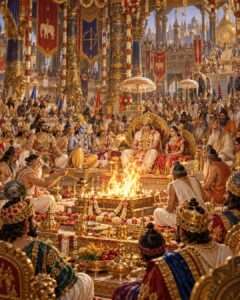
Most Hindus do some Pooja at home, though it is dwindling drastically these days. The shortest Pooja can last a few minutes, while a more elaborate Pooja can last a couple of hours. Pooja on a certain festival day may last an entire day. Often, we hear about some famous temples organizing Brahmotsava which may last an entire week. Certain Utsava-s such as Raama Navami Utsava, Ganeshotsava and Navaraatri Utsava may last longer than a week or may extend even up to a month. But that is about how long a worship we’re aware of in our current times. However, Vedic times were much different. Those were the times when the Kings performed various Yaaga-s, which lasted several weeks to even months. One such Yaaga we hear about from the Vedic times is the Raajasooya Yaaga. Why is this such a big deal?
Performing the Raajasooya Yaaga was and is the Vedic way of declaring one’s Chakraadhipatya (Emperorship) over the entire land. This would not be possible without all the neighbouring Kings’ acceptance of this declaration. Thus, Raajasooya Yaaga often began with a military campaign in all directions. All those who opposed would have to battle the challenger. As long as the challenger remains undefeated, the campaign will continue. Once all opponents are defeated and everyone accepts the challenger as Chakravarti (the Soul and Supreme Emperor), Raajasooya Yaaga will be performed in culmination and celebration of this accomplishment. The last Raajasooya Yaaga performed on the land of Bhaarat was by the Paandava-s. It has not happened since then.
As explained above, performing the Raajasooya Yaaga was/is never easy. It wasn’t easy for the Paandava-s either. Their main impediment was Jaraasandha, the King of Magadha (which is today’s Bihar. Its capital Patna, used to be called Paataliputra in the past). While Paandava-s had the ability to subdue all other Kings, Jaraasandha had a plan of his own to become the Chakravarthi. He was evil personified. As part of his evil design, he ensured that none of the wise Braahmana-s cause any impediments by allowing them full access to his palace without any blockade or checks… and always offered them generous gifts and remuneration. This cunning move was enough to get the wise ones on his side. Next, he would attack all other kingdoms and imprison the heir to the throne, thus ensuring that there was no successor to the kingdom. With this, when the current King of that kingdom dies, there is no successor to the throne and therefore, the entire kingdom would be annexed to Magadha. In this way, Jaraasandha had imprisoned several princes and heirs (numbers vary in different sources, with some saying 86 and some going all the way up to 23000+). His evil plan was to offer these princes as human sacrifice to Shiva and thereby become cosmically invincible. By the way… even the most evil people will follow some principles. The principle that Jaraasandha followed was that he would never imprison princesses. But Narakaasura, who was a close friend, apparently had no issues accepting the princesses captured by Jaraasandha. It is well known that some 16000 princesses were in Narakaasura’s captivity. Therefore, extrapolating from that figure, the number of princes imprisoned by Jaraasandha may’ve been closer to 23000. Overall, Jaraasandha’s plan was colossally evil. And Jaraasandha had the physical strength and wherewithal to implement this plan. Paandava-s could not have aspired to complete Raajasooya Yaaga without trouncing Jaraasandha.
Shree Krishna had already killed Kamsa who had married Jaraasandha’s daughters. Therefore, Jaraasandha had already conducted 17 massive military campaigns with the soul intention of killing Krishna and to wipe out the Yaadava dynasty. Shree Krishna had successfully defeated Jaraasandha each time. But yet, Shree Krishna had spared Jaraasandha’s life each time. Now that the Paandava-s were considering performing the most auspicious Raajasooya Yaaga, it was time to eliminate Jaraasandha. So, who is to eliminate someone who had attacked Shree Krishna 17 times already? Yudhishtira was extremely afraid of Jaraasandha that he was willing to let forego the Raajasooya Yaaga. That’s when Shree Krishna stepped in and convinced Yudhishtira and urged him to send Bheema Sena and Arjuna with him. Yudhishtira had agreed deeply reluctantly and fearfully. It seems as though Bheema Sena slaying the gigantic Bakaasura and Hidimba too had not convinced Yudhishtira.
Shree Krishna, Bheema Sena and Arjuna left for Magadha disguised as Braahmana-s. As mentioned earlier, Jaraasandha had maintained an open-door policy for the Braahmana-s in his palace. Disguised as Braahmana-s, Shree Krishna, Bheema Sena and Arjuna could’ve casually walked in to Jaraasandha’s palace’s main gate. But yet, they hopped over the fence walls to enter his palace. Upon meeting Jaraasandha, he asked them as to why they had jumped over the fence wall when the door was open. To this Shree Krishna replied that they had not come to appease, but to battle with him. Jaraasandha was asked to choose whoever he wants to wrestle. Jaraasandha was fearful of wrestling Shree Krishna and so, he made excuses – by calling him a cowherd who had run away from Mathura & so on – and chose to not engage Shree Krishna in a duel. He didn’t pick Arjuna either. His logic was… if he won against Arjuna, then people might deride him that he won against a puny opponent… and if he lost against Arjuna (which was the higher likelihood), then it would really shameful.
So, he pretty much had no choice but to pick Bheema Sena. Plus, Jaraasandha was a masterful in hand-to-hand combat. He had openly stated that if he had to wrestle unto death, then he would rather duel with the most formidable opponent. Bheema Sena was the only person who met his definition of The Most Formidable Opponent. The duel between Jaraasandha and Bheema Sena lasted day and night for several days. And finally, Bheema Sena literally tore Jaraasandha apart and threw the two halves of his body in opposite sides thus removing the most significant obstacle to the most auspicious Raajasooya Yaaga.
8. Fetching the Saugandhikaa Pushpa
This is perhaps the most incredible anecdote about Bheema Sena’s super-luminous wisdom and his Galactic strength. Perhaps, this one anecdote dwarfs all other anecdotes about Bheema Sena’s accomplishments.
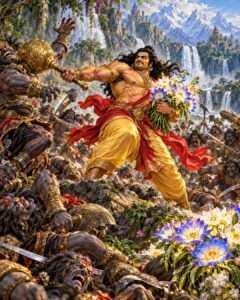
As mentioned several times already, Bheema Sena is Avataara of a Para Shukla Traya Devata. He has full clarity about the purpose of his Avataara and is fully cognisant of what the future holds. Dwaapara Yuga is nearing its end and Kali Yuga has to start. Kali, the most evil among all Asura Shakti-s, has taken Avataara as Duryodhana. Various Asura-s have also taken Avataara-s. On the other hand, Paramaatma himself has taken Avataara as Shree Krishna. Several Devata-s too have also taken Avataara-s. Any way we analyse… any scenario we consider… conflict is totally inevitable and the Paandava brothers will be at the very epi center of such a conflict. Therefore, during their Vanavaasa, both Draupadi and Bheema Sena (the two Para Shukla Traya Devata Avataara-s) are evaluating the best possible scenario for Dharma to win. At this point, Draupadi expresses her concern over the Asura-s assembled in the celestial Gandha-Maadana mountain. How many had assembled? Numbers vary with one account putting it at 1 billion and another at 3 trillion or even a quadrillion. What concerned Draupadi was… these Asura-s will absolutely not join the Paandava-s and will most definitely support Duryodhana. With such a colossal number of Asura-s joining Duryodhana, Dharma stood no chance. Therefore, it would be best to pre-empt the possibility of the Asura-s joining Duryodhana. With this pretext, Draupadi pleads with Bheema Sena to fetch the celestial Saugandhikaa Pushpa from the celestial Gandha-Maadana mountain.
Gandha-Maadana mountain was the abode of Kubera and was guarded by the Krodha-Vasha Gana of Asura-s lead by Manimanta. On his way to this celestial abode, Bheema Sena’s path was obstructed by the tail of a frail monkey, who was none other than Hanumaan. Bheema Sena could’ve simply walked past the frail monkey’s tail or around it. But he tried to lift it and put it away… and appeared to fail at it. Why? Being the two Avataara-s of the same Devata, there is no lack of clarity for either… nor is one Avataara any stronger than the other. So, why was Bheema Sena unable to lift a frail monkey’s tail?
Because this was pretence… and it was essential to conceal, and premature revelation of Bheema Sena’s Galactic agility or else the Krodha-Vasha Gana of Asura-s would’ve avoided conflict with him. And, had there been no conflict with them… they would’ve saved themselves to join hands with Duryodhana later, and that would’ve caused a much harder problem to deal with. The pretence worked. The Asura-s fell for it and grossly underestimated Bheema Sena’s knowledge and ferocity. Apparently, Krodha-Vasha Gana Asura-s had gained their strength through a boon from Shiva. Therefore, they debated with Bheema Sena. But Bheema Sena vanquished them all in a philosophical debate. Angered by this, the Asura-s attacked Bheema Sena. That is when Bheema Sena unleashed his Galactic strength and slayed each and every last one of them, thus pre-empting a huge army of Asura-s from joining hands with Duryodhana.
There are more superlative accomplishments to Bheema Sena’s credit. We’ll continue to look at them. For now, let’s take a moment to recognize one more time…