M Jaishree
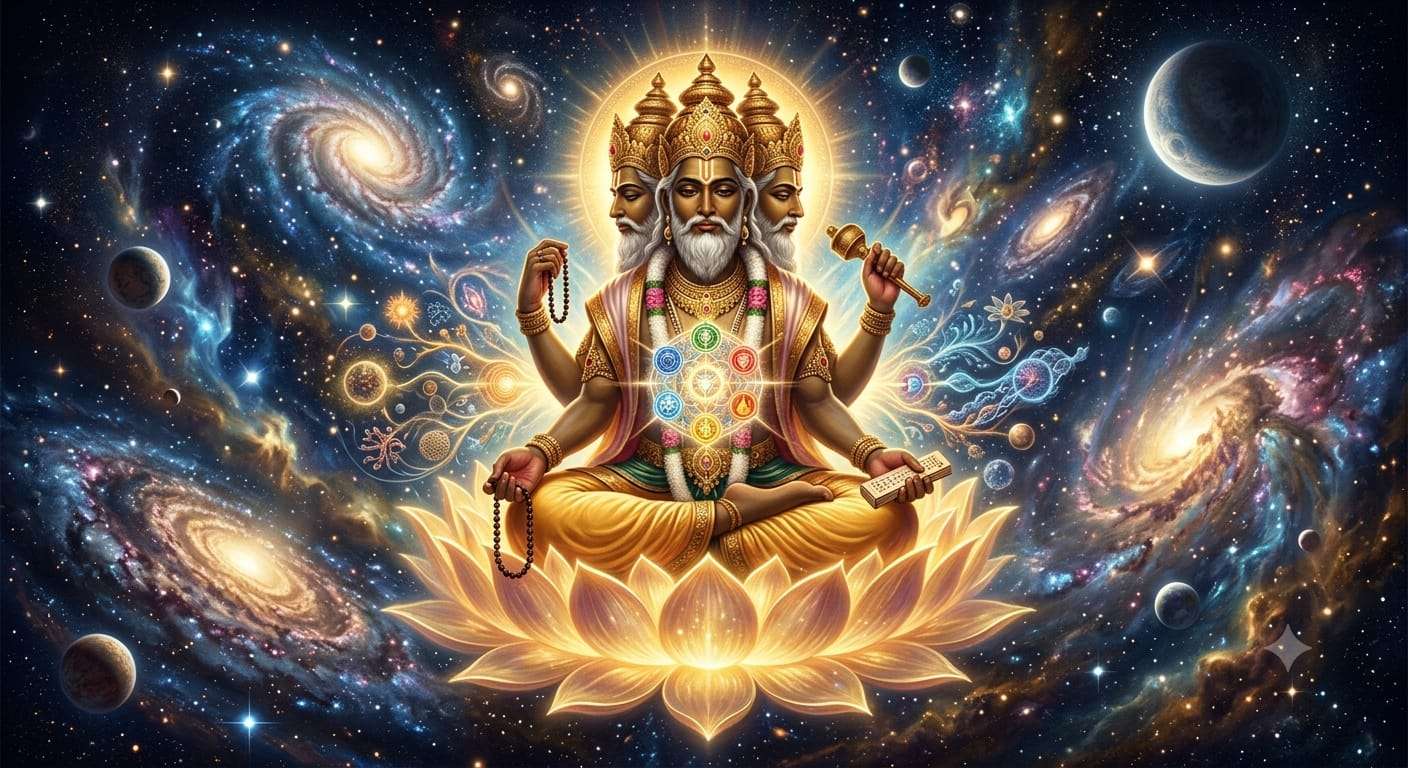
The sky is infinite, the ocean is immeasurable, the earth is enduring, and the Divine is eternal. Life appears in countless forms, passing through birth, growth, decline, and renewal, yet existence itself continues beyond the limits of individual experience. In this vast order of creation, the Veda occupies a unique place in the intellectual and spiritual history of humanity. It is not the possession of a particular caste, clan, kingdom, or country. In its deepest conception, it is a treasure of the entire human race, preserved through the civilisational memory of Bharata.
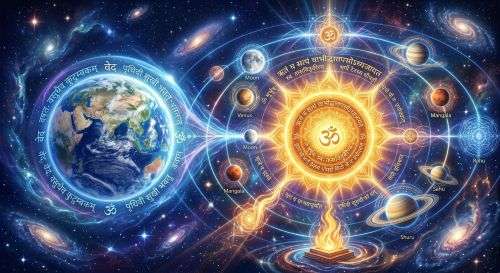
The earth is the foundation upon which human civilisation has unfolded, and the Vedic vision places the earth within an even larger cosmic order. The Vedic expression Aditi signifies the boundless, the undivided, and the infinite motherly expanse from which the visible and invisible dimensions of existence are contemplated. The underlying principle is that reality cannot ultimately be fragmented merely because human beings perceive it through separate identities. Nations may have boundaries, communities may have distinctions, and individuals may possess different languages and traditions, but the cosmic order that sustains them is indivisible.
The Sun gives light without asking who receives it. Its rays fall upon mountains and valleys, forests and oceans, cities and deserts, without discrimination. In a similar philosophical sense, the Veda offers a vision of life that transcends narrow human divisions. It seeks ṛta—the principle of cosmic order—and connects that order with dharma, the discipline by which human life may remain harmonious with the larger reality. The Veda does not merely provide information about the external world; it asks the human being to inquire into the relationship between the individual, nature, society, consciousness, and the ultimate reality.
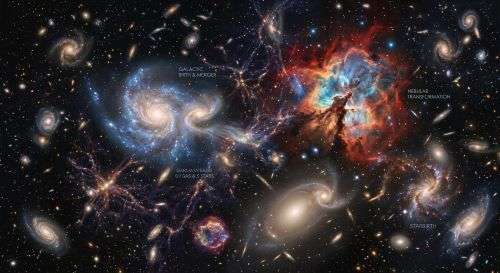
The Vedic tradition repeatedly directs the human mind from the visible towards the invisible. What existed before creation? From where did existence arise? What is the origin of life? How did the heavens come into being? What is the relationship between the waters, the earth, the atmosphere, light, time, and consciousness? Such questions are found with remarkable depth in the Vedic hymns. The famous Nāsadīya Sūkta of the Ṛgveda does not present a simplistic answer to the mystery of creation; instead, it displays an extraordinary intellectual humility before the unknown. It asks whether anyone can truly know how creation originated and whether even the highest being knows its ultimate beginning. This willingness to question is an important feature of the Vedic intellectual temperament.
The Vedic conception of knowledge therefore need not be understood as a closed collection of propositions. It is better understood as an enduring stream of inquiry, contemplation, recitation, memory, ritual knowledge, philosophical reflection, and spiritual experience. The Sanskrit word veda derives from the root vid, meaning “to know.” Knowledge, in this sense, is not merely accumulation of facts. It is an attempt to understand reality and to transform the quality of human existence through that understanding.
The Vedic corpus that has reached the present age is the result of an extraordinary historical process. Tradition attributes to Vedavyāsa the systematic division of the vast Vedic material into four principal collections—the Ṛgveda, Yajurveda, Sāmaveda, and Atharvaveda. The traditional account associates this organisation with the needs of transmission and preservation. In an age when knowledge depended predominantly upon human memory and oral instruction, systematic classification was essential. The division did not signify the destruction of an original unity; rather, it provided a structured means through which an immense body of knowledge could be transmitted to succeeding generations.
The oral tradition is perhaps one of the most remarkable dimensions of Vedic preservation. Vedic scholars developed highly sophisticated methods of recitation in which not merely the words but also their sequence, phonetic precision, accent, duration, and tonal qualities were carefully maintained. Forms of recitation such as saṃhitā, pada, krama, jaṭā, and ghana created multiple safeguards against corruption of the transmitted text. In this respect, the preservation of Vedic sound demonstrates a remarkable human achievement in the science of memory, phonetics, linguistic discipline, and oral transmission.
The significance of Vedic chanting therefore extends beyond the literary meaning of the words. Sound itself was treated as an important dimension of sacred knowledge. Śabda became a profound philosophical category, while mantra represented disciplined sound whose efficacy was associated with correct pronunciation, intonation, intention, and ritual context. The tradition’s insistence upon phonetic accuracy created a culture in which generations of teachers and students assumed responsibility for preserving even minute distinctions in pronunciation.
The continuity of this tradition across many centuries is particularly striking when viewed against the impermanence of material civilisation. Human beings have raised magnificent monuments, carved mountains, built cities, accumulated gold and silver, and constructed structures of extraordinary architectural brilliance. Yet physical objects are vulnerable to war, theft, decay, earthquakes, weather, political upheaval, and the passage of time. What is preserved through disciplined human memory can sometimes survive precisely because it does not depend entirely upon stone, metal, or written material.
The achievement of Vedic preservation should not, however, be romanticised by denying historical change. Vedic traditions have encountered political transformations, linguistic developments, regional variations, social changes, competing intellectual systems, and the enormous influence of modern education and print culture. Yet the continuity of Vedic recitation demonstrates the extraordinary resilience of a knowledge tradition that adapted its modes of transmission while maintaining a strong concern for textual and phonetic fidelity.
The comparison between material monuments and Vedic oral preservation is therefore philosophically illuminating. A pyramid may stand for centuries, yet it remains dependent upon physical matter. Gold can be melted, silver can be stolen, and stone can be shattered. A carefully preserved oral tradition exists differently: its continuity depends upon human beings who learn, remember, practise, teach, and transmit. The living voice becomes the vessel. The human intellect becomes the archive. The disciplined teacher and student become the custodians of an inheritance that cannot survive without conscious participation.
The Vedic tradition also presents a profound relationship between humanity and nature. The hymns address Agni, Vāyu, Sūrya, Uṣas, the waters, the earth, the atmosphere, and other manifestations of the natural and cosmic order. These should not be reduced simply to primitive explanations of physical phenomena. They represent a symbolic, ritual, poetic, and philosophical engagement with nature in which human existence is perceived as inseparable from the larger order of the cosmos. Modern science investigates nature through observation, measurement, experimentation, and mathematical modelling; Vedic thought approaches many aspects of existence through contemplation, symbolism, linguistic analysis, ritual experience, and philosophical inquiry. These are different epistemological approaches, and they should neither be artificially equated nor unnecessarily placed in opposition.
The scientific temperament becomes particularly visible in the Vedic willingness to ask fundamental questions without always forcing certainty where certainty is unavailable. The universe remains vastly larger than human experience. The age of the cosmos, the formation of stars and planets, the origin of life, and the ultimate nature of consciousness remain subjects of continuing investigation. Modern cosmology has transformed our understanding of cosmic time and evolution, while biology has deepened our understanding of life. The Vedic tradition belongs to a much older intellectual world, yet its persistent questioning of origins and existence can still stimulate philosophical reflection.
The Vedic idea of cosmic time is also extraordinarily expansive. The concepts of yuga, manvantara, and kalpa present time on scales far beyond ordinary human chronology. These traditional cosmological frameworks should be understood within their own philosophical and religious context rather than treated as direct substitutes for modern scientific chronology. Their deeper significance lies in their insistence that human history is only a small interval within an immense cycle of existence, dissolution, and renewal.
From this perspective, the changing yugas do not necessarily imply the disappearance of knowledge. Rather, the tradition imagines knowledge as something that may become obscured, fragmented, rediscovered, interpreted, and transmitted again. Civilisations rise and decline, languages evolve, political powers disappear, and social structures transform, while certain fundamental human questions remain: Who am I? What is the nature of reality? What is the purpose of life? What is truth? How should human beings live with one another and with nature?
The Vedic response to these questions eventually develops into the broader philosophical world of the Upaniṣads, where the inquiry turns increasingly inward. The question is no longer only how the cosmos began but also who is the knower of the cosmos. The distinction between the changing and the unchanging, the apparent and the ultimate, the body and consciousness, becomes central. The celebrated mahāvākyas of the Upaniṣadic tradition express this inward movement of inquiry, directing the seeker towards the relationship between ātman and brahman.
Thus the Veda may be viewed not merely as an ancient literary collection but as the beginning of a long civilisational conversation about existence. It generated ritual traditions, philosophical schools, linguistic disciplines, systems of interpretation, music, poetry, ethics, metaphysics, and methods of memorisation. Its influence cannot be confined to one dimension of Indian civilisation because its intellectual descendants appear in many different forms across the centuries.
The assertion that “the Veda is everything” should therefore be understood as a statement of civilisational reverence rather than as a claim that every modern scientific or historical question has already been answered within the ancient texts. The Vedic tradition itself encourages inquiry. Its greatness does not depend upon attributing every contemporary discovery to an ancient hymn. Its enduring value can instead be found in the depth of its questions, the discipline of its transmission, the philosophical sophistication of its later interpretations, and the continuity of its intellectual and spiritual influence.
The statement anyathā śaraṇaṃ nāsti is often understood in devotional contexts as expressing complete reliance upon the Divine or upon the chosen spiritual refuge. Within a broader Vedic perspective, however, the seeker is repeatedly encouraged to move beyond dependence upon superficial certainty and towards direct understanding. Faith and inquiry need not be enemies. Faith can provide the inner orientation for inquiry, while inquiry can prevent faith from becoming mere habit or unexamined belief.
What survives through the centuries is consequently more than a collection of ancient sounds. The Vedic chant remains a living cultural practice. When the carefully modulated syllables of a Vedic hymn are recited today, the sound connects the present generation with a chain of teachers and students extending through an extraordinary span of time. Its continuity is not evidence that history has stood still; rather, it is evidence that human beings have repeatedly chosen to preserve something they considered sacred and intellectually valuable.
Bharata’s contribution to humanity can be celebrated most meaningfully when pride is accompanied by responsibility. A treasure becomes truly valuable when it is understood, preserved, studied, critically examined, translated responsibly, and transmitted without distortion. The responsibility of the present generation is therefore not merely to praise the Veda but to approach it with reverence as well as intellectual discipline, recognising both its historical context and its continuing spiritual significance.
The Veda may be imagined as an ancient river whose visible course has changed while its deeper current continues. Civilisations have altered their forms, generations have disappeared, languages have transformed, and knowledge has acquired new methods of expression. Yet the aspiration to understand existence, to live in harmony with the larger order, and to seek truth beyond the limitations of the individual self remains alive.
The earth continues its journey through space, the oceans rise and recede, the Sun continues to radiate, generations are born and pass away, and the human mind continues to ask questions about the infinite. In that unending dialogue between humanity and existence, the Vedic tradition remains one of the world’s most ancient surviving voices. Its greatest monument is neither gold nor stone. It is the living human voice that remembers, questions, contemplates, and transmits. In that sense, the Vedic heritage of Bharata is not merely a relic of the past; it is a continuing invitation to humanity to seek knowledge, cultivate inner harmony, respect the natural order, and approach the mystery of existence with humility.