



Diplomacy is often conducted through words. Sometimes, however, a single photograph can speak louder than a thousand diplomatic communiqués. The photograph of US President Donald Trump personally receiving Chinese President Xi Jinping on the tarmac at Joint Base Andrews is one such image. Trump did not merely receive Xi in Washington. He went to the military airbase to welcome him personally as he stepped off his aircraft. It is an extraordinarily rare gesture in modern US presidential protocol, where visiting heads of government are ordinarily received at the White House rather than by the President at the airport. And Beijing will certainly understand its propaganda value. China can now project an image of its President being accorded the kind of personal treatment normally reserved for an exceptionally important guest. Whether intended or not, the optics reinforce Beijing’s long-running narrative that China is no longer a power seeking recognition from Washington, but one that expects to be treated as America’s strategic equal. That is precisely where Xi appears to have gained an advantage even before the substantive negotiations began. Diplomatic symbolism matters because great-power competition is also a contest of perceptions. Washington may see the gesture as reciprocity for the elaborate hospitality Trump received during his visit to China earlier this year. Indeed, the White House has explicitly described the airport welcome as a reciprocal gesture following Xi’s hosting of Trump in Beijing. But Beijing can sell the same photograph differently. The Chinese Communist Party can tell its domestic audience—and much of the developing world—that the United States has been compelled to roll out the red carpet for China’s leader. That is not a small diplomatic dividend. More importantly, Trump has created an opening for Xi to negotiate from a position of visible confidence. The agenda is enormous: trade, rare earths, artificial intelligence, Taiwan and broader security questions. Washington and Beijing have already agreed to extend their trade truce, underlining the transactional nature of the engagement.
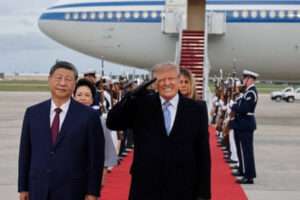
The real question, therefore, is what Trump gets in return for the symbolism. If the answer is substantial Chinese concessions on trade, rare earths, technology or other strategic issues, the tarmac welcome can be dismissed as theatrical diplomacy preceding a hard bargain. But if the concessions are modest while China secures greater room on issues of strategic importance, particularly Taiwan, the optics will look very different. Taiwan is where the stakes become particularly serious. Beijing regards Taiwan as a core sovereignty issue. Washington, meanwhile, has long maintained a delicate position combining support for Taiwan’s self-defence with strategic ambiguity over direct military intervention. The issue remains one of the most dangerous fault lines in US-China relations. Trump’s transactional approach to foreign policy makes the question unavoidable: how far will he go to secure an economic deal? Will Taiwan become part of the bargaining architecture? There is, of course, no evidence that Washington has agreed to trade Taiwan for Chinese purchases of American agricultural products. Such a conclusion would be premature. But the very possibility of treating strategic commitments as negotiating chips is what should concern America’s allies. China does not need to win every negotiation. It only needs to demonstrate that Washington’s red lines are negotiable. Xi has already secured the photograph. Now comes the harder question: what price will Trump demand for the privilege—and what price will America ultimately pay for the deal? The tarmac handshake may have lasted seconds. Its geopolitical consequences could last much longer.

