
History has a curious way of leaving clues in places historians sometimes overlook. One such clue may be standing quietly in our fields: the Indian humped cattle, or zebu.
For more than a century, the idea that a nomadic race of “Aryans” invaded India around 1500 BCE, destroyed the Indus Valley Civilisation (IVC), and introduced cattle, Sanskrit and other cultural elements shaped a particular reading of ancient Indian history. Yet modern archaeology does not support the picture of a violent invasion that simply replaced an existing civilisation. Even scholars who accept some form of Indo-Aryan migration generally distinguish it from the older “invasion” model.
Cattle offer an intriguing piece of evidence in this debate.
Zebu cattle were already domesticated and widespread in the Indus region thousands of years before the traditionally proposed 1500 BCE migration timeline. Their presence is also visible in Indus Valley seals and other archaeological material, demonstrating that these animals were part of the region’s economic and cultural landscape.
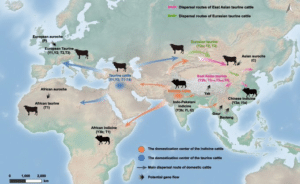
Archaeological and genetic evidence places the domestication of indicine cattle in South Asia more than 8,000 years ago, with the Indus region emerging as an important centre of early domestication.
And then something remarkable happened.
Over subsequent millennia, these cattle travelled far beyond the Indian subcontinent. A 2023 whole-genome study examining 354 indicine cattle from 57 breeds and populations concluded that South Asia was the centre of domestication and reconstructed later dispersal routes into other regions. The study also suggested that the movement of indicine cattle into East Asia may have followed a coastal route rather than simply an inland corridor.
But cattle do not cross continents by themselves.
They are domesticated animals. Their movement necessarily involved human communities—herders, farmers, traders and pastoral populations who had the knowledge and means to transport, breed and maintain them. Cattle genetics can therefore provide an indirect but valuable window into ancient patterns of human mobility.
The contrast with taurine cattle, Bos taurus, is equally revealing. Their domestication is associated with the Fertile Crescent and occurred independently of South Asian zebu domestication. From the Near East, taurine cattle spread with farming communities into Europe, North Africa and other parts of Eurasia.
The genetic record, therefore, reveals multiple directions of movement. South Asian indicine cattle travelled outward and left a lasting genetic imprint on cattle populations across Asia and Africa. African cattle, for instance, carry substantial evidence of later indicine admixture.
What does this mean for the Aryan debate?
It certainly does not, by itself, prove that no human migration ever entered the Indian subcontinent. Nor can cattle genetics alone settle the complex question of Indo-European language origins. Human groups can migrate without taking livestock with them, while cattle can subsequently be exchanged or transported through long-distance trade.
But the evidence does challenge overly simplistic historical narratives.
The older Aryan Invasion Theory presented ancient India largely as the destination of supposedly superior outsiders who entered the subcontinent and transformed its civilisation. The later Aryan Migration Theory replaced invasion with a more gradual movement of people and languages. Modern genetic research has added further complexity, pointing to population interactions and admixture over extended periods rather than a simple replacement of one population by another.
This is where science matters.
The history of ancient India cannot be reconstructed from a single genetic marker, archaeological site or linguistic interpretation. It must emerge from the convergence of archaeology, ancient DNA, linguistics, anthropology, environmental history and, importantly, animal genetics.
Cattle provide an unusual independent record of ancient human networks. Their genomes demonstrate that South Asian domesticated cattle travelled remarkably far beyond the subcontinent. Their dispersal was not merely a biological event; it was connected to people, pastoral systems, agriculture, trade and adaptation.
So perhaps the humble Indian cow has something important to tell historians.
It is certainly not a simplistic “checkmate” to every version of Aryan Migration Theory. Science rarely works through such dramatic final verdicts. But cattle genetics does complicate any narrative that portrays ancient India merely as a passive recipient of outside influences.
The evidence instead presents South Asia as an ancient centre of domestication, innovation, population interaction and outward movement.
The Indian cow, in other words, may be carrying a much bigger historical message than its quiet presence in our fields suggests.