From Ammann’s headquarters in Langenthal, Switzerland, India is a long way away. But as bauma CONEXPO INDIA 2026 approaches, that distance may matter rather less than it once did. There will be machines to see in Greater Noida, customers to meet and competitors to measure, but there will also be something less visible to watch: what the Indian operation tells the company about the opportunity taking shape here.
That makes this exhibition a little more interesting than another product showcase. Ammann India arrives with a wider paving portfolio following the ABG acquisition, an established manufacturing base at Mehsana, a developing concrete proposition and an export business that already accounts for a meaningful share of its revenue. The domestic construction equipment market, after a difficult year, is also showing signs of recovery, with road construction equipment holding up better than the market as a whole.
The question, then, is no longer whether Ammann has an India business. It clearly does, and it is already sizeable. The more interesting question is whether India is beginning to become something more consequential inside Ammann itself, particularly as the company looks at what its Indian manufacturing and engineering capabilities can support beyond the domestic market.
That is what makes Noida worth watching. A business approaching the Rs 1,000 crore revenue mark, manufacturing for domestic and overseas markets and taking on a significantly wider paving proposition has rather more to demonstrate than simply having a good stand at a trade show. India is still a long way from Langenthal geographically. The significance of the Indian business within that global network is becoming more interesting to watch.
The timing matters because the Indian construction equipment market has just come through a mixed year, and the recovery now under way is not quite broad enough to be taken for granted.
Total construction equipment sales in FY2025-26 stood at 136,995 units, about 2 percent lower than the previous year. Domestic sales fell 6.7 percent to 113,229 units, while exports rose by more than 31 percent. Road construction equipment, however, moved in the opposite direction, with sales rising about 6.3 percent to 7,445 units.
The first quarter of FY2026-27 brought a more encouraging picture. Total equipment sales reached 31,945 units, up 11 percent, with domestic sales rising 9 percent and exports increasing 32 percent. The industry has subsequently raised its forecast for domestic construction equipment growth in FY2026-27 to between 9 and 12 percent. It is a healthier outlook, although steel costs, logistics, project execution and wider economic conditions can still disturb the numbers.
For Ammann, the distinction matters because roadbuilding is precisely where the company has its strongest credentials. A recovery in road and infrastructure spending therefore has a more direct bearing on its prospects than the headline construction equipment number suggests. The wider product portfolio gives the company more ways of participating if that recovery broadens.
There is another consideration. Ammann has expanded its offering just as contractors are becoming more conscious of utilisation, operating cost and return on equipment. Simply putting more machines into the market will not be enough. The wider portfolio has to find its place in the economics of actual projects.
Business Base
The financial numbers provide some context for the scale of Ammann’s Indian operation.
Ammann India recorded revenue of Rs 942 crore in FY2024, up from Rs 783 crore in FY2023, while profit after tax rose from Rs 22 crore to Rs 41 crore. The asphalt business accounted for about 45 percent of total income, and exports contributed 24 percent of revenue. MCA filing-based data subsequently put FY2025 revenue at Rs 958.5 crore, keeping the business close to the Rs 1,000 crore mark even though the year-on-year increase was modest.
Those numbers put the current expansion into perspective. Ammann is not attempting to create an Indian business from scratch, nor is it testing the market with a handful of imported machines. It already has customers, manufacturing capability, service infrastructure and experience in overseas markets. The current phase is about adding more possibilities around that established base.
Each additional possibility, however, brings its own demands. A larger paver range requires the right customers, applications and support capability. Concrete requires a different set of project relationships. Exports require consistency in manufacturing and supply. None of these automatically follows from the size of the existing business.
That is why the next stage is more interesting than the headline revenue number.
Paver Expansion
The most visible change has come from paving.
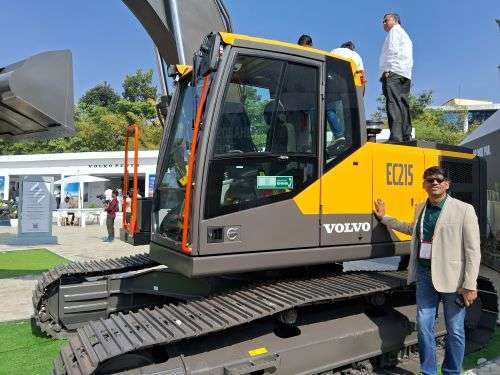
When Ammann completed its acquisition of Volvo Construction Equipment’s global tracked paver business in June 2024, it acquired more than another product line. It moved into a wider paving segment, including machines in the 7.5 to 13 metre class used for large highway projects, where the scale and requirements of the customer are quite different from those of a conventional paver buyer.
Ammann already had a presence in pavers suited to narrower applications. The ABG portfolio gives it access to much larger paving requirements and therefore to another part of the highway construction market.
But the acquisition does not automatically create that business. Ammann now has to build sales, service and customer confidence around the enlarged range, while demonstrating that the different product families can work together as a coherent proposition.
The India angle is also worth watching. The ABG transaction included paving operations in Germany, China and India, with Hameln in Germany continuing as the paving centre of excellence. Ammann has also said that Mehsana in India and Suzhou in China would become sources for ABG pavers in the future.
That does not make Mehsana a global hub overnight, and there is little reason to use that description before the evidence is there. It does, however, give the Indian plant a potentially larger role within Ammann’s manufacturing network, provided production and quality targets are met as the programme develops.

Factory Role
Mehsana is where much of that possibility becomes tangible.
Ammann’s Ditasan facility covers about 120,000 square metres and was transformed between 2014 and 2018. It includes manufacturing, training and testing facilities, along with painting and sandblasting operations. The plant manufactures asphalt plants, pavers, compactors and other equipment and components for Indian and export markets, with robotics used in welding operations.
The export element gives the factory a different role within the business. Ammann India equipment is now exported to more than 100 countries across Africa, the Middle East, Southeast Asia and Latin America, with exports contributing close to 23 percent of overall revenue. The company has also highlighted more than 95 percent localisation at its Gujarat facility, supported by more than 600 Indian vendors and supplier partners.
Taken together, those figures point to an operation that is already doing more than assembling equipment for Indian customers. The Indian factory is part of an international supply chain, which means manufacturing quality, supplier capability, engineering support and delivery reliability matter far more than the simple question of whether a machine can be produced at a competitive cost.
Ammann India Managing Director Dheeraj Panda’s description of the direction is revealing, particularly his formulation of “Make in India for the World.” The phrase itself need not become a slogan. The more important question is whether the manufacturing footprint, supplier network and product range can support that ambition consistently.
If Mehsana eventually becomes a meaningful source for tracked pavers, the factory will be participating in a wider product network rather than simply adding another machine to its production schedule. That would be a more substantive change in its role than an increase in output alone.
Concrete Opportunity
Concrete is another piece of the expansion, although it would be premature to describe it as the next major pillar of Ammann India’s business.
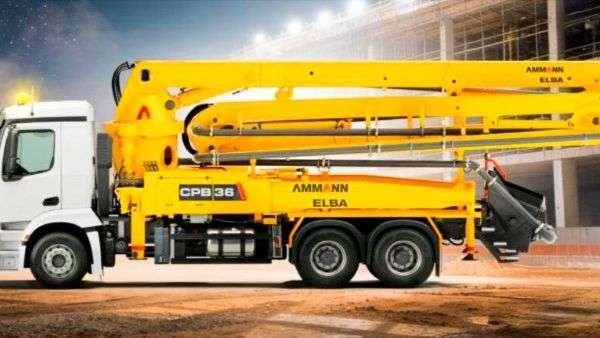
The Indian portfolio includes Ammann Elba concrete mixing plants, adding another product family to a business historically identified much more strongly with asphalt and roadbuilding. There is now a documented example of the equipment being used on the Nashik–Niphad–Yeola–Vaijapur–Aurangabad road upgrade, where Ammann ELBA CC150 batching plants were deployed for the 56 kilometre MSH-2 highway project.
One project does not establish a trend, and Ammann will have to demonstrate that concrete can become a sustained business rather than simply an attractive adjacency. The opportunity itself, however, is difficult to ignore because India’s infrastructure programme is not confined to asphalt. Roads, bridges, urban infrastructure and industrial development create equipment requirements that sit outside Ammann’s traditional core.
The company is therefore beginning to occupy a wider part of the infrastructure equipment landscape. The interesting question is how much of that wider landscape it can realistically convert into business.
Customer Economics
Technology introduces another layer to the question.
Construction equipment manufacturers increasingly talk about telematics, remote monitoring, predictive maintenance, machine control and intelligent compaction. The technology itself is no longer particularly exotic. What matters to the contractor is whether it changes something that can be measured on the project.
Intelligent compaction is a useful example. Real-time information about compaction and density can help an operator determine whether the required result has been achieved rather than simply relying on a fixed number of passes. If the system helps reduce unnecessary passes, improves consistency or provides better visibility of the work being completed, the technology begins to have a direct connection to project economics.
That is also where the customer relationship becomes more important. The emphasis is increasingly on what happens after the machine reaches the site and whether the customer can extract value from it “day after day”, “project after project.” For a contractor, that means uptime, fuel consumption, service response, productivity and resale value rather than technology for its own sake.
Ammann therefore has to make digitalisation part of the equipment proposition rather than allowing it to remain a separate technology story. More choice is useful only if customers understand where each machine fits and have confidence that it will be supported when the project gets difficult.
Competitive Pressure
None of this is happening in an empty market.
The roadbuilding equipment business has some of the strongest international names in construction equipment competing for the same customers. Wirtgen Group brings Wirtgen, Vögele, Hamm and Benninghoven into a broad roadbuilding proposition, while BOMAG has a powerful position in compaction. Caterpillar, CASE, JCB, SANY, LiuGong and others add further competition across overlapping equipment categories, alongside domestic and regional manufacturers that can compete aggressively on price, availability and local support.
That makes the Ammann proposition more complicated than a simple contest between machines. Product breadth matters, but so does dealer reach. Technology matters, but so does service response. Manufacturing efficiency matters, but so does parts availability when a machine is sitting on a project and the clock is running.
Ammann’s answer cannot simply be more products. The wider portfolio has to work as a business system, with the paver, plant, compactor or concrete equipment supported through the life of the project and beyond it.
This is also why the Indian manufacturing base matters. A factory with a strong local supply chain and export experience can potentially give the company a degree of responsiveness that imported equipment alone cannot provide. But that advantage has to show up in the customer’s experience before it becomes a competitive advantage on paper.
Export Potential
The export opportunity may ultimately be just as interesting as the domestic one.
India’s construction equipment exports rose sharply in FY2025-26, and industry expectations remain positive for FY2026-27. That reflects, among other things, manufacturers looking beyond a domestic cycle that can be affected by project timing, monsoons, commodity prices, financing conditions and execution delays.
Ammann already has evidence that its Indian operation can participate in that wider market. The export contribution is substantial, and the company’s more recent comments suggest that it sees room to deepen the role of Indian manufacturing in international supply.
That possibility becomes more credible when considered alongside the ABG acquisition. Ammann has not said that Mehsana will replace its established European paving operations. It has said that India is expected to become a source for ABG pavers in the future.
The Indian operation would not necessarily need to become Ammann’s global manufacturing centre to assume a larger role within the group. It needs to remain a reliable and competitive part of the company’s international manufacturing and supply chain, with the capability to take on additional responsibilities when the business case supports them.
Whether the opportunity becomes materially larger will depend on what happens next.
Noida Test
Which brings the story back to Noida.
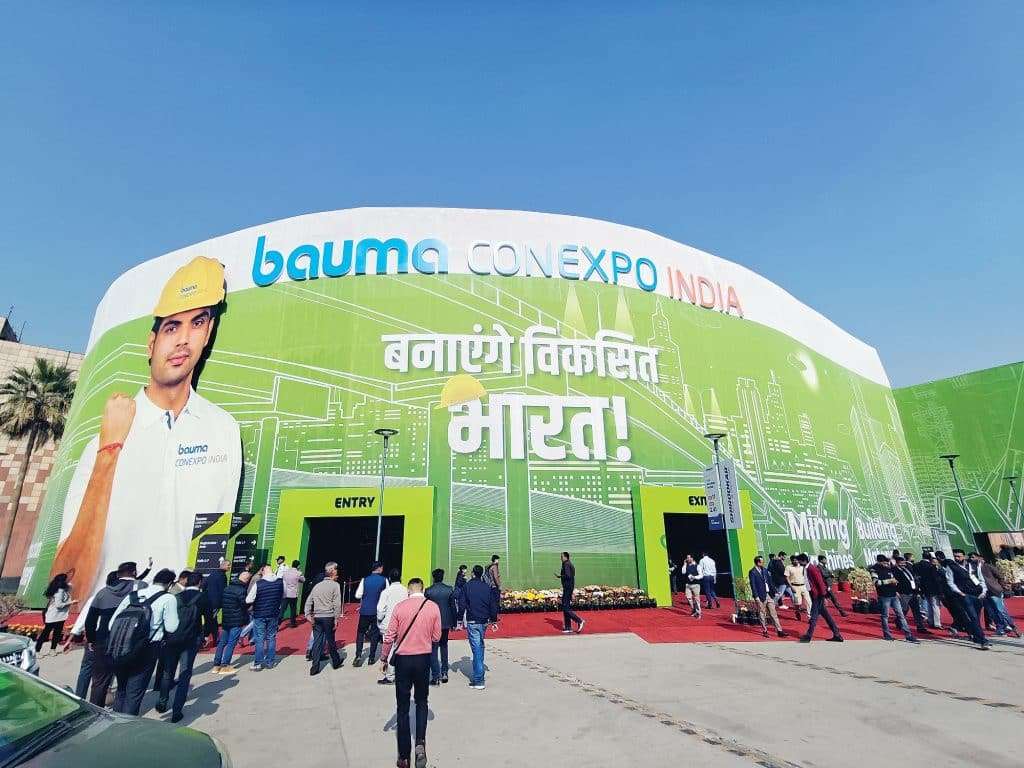
At bauma CONEXPO INDIA 2026, Ammann will have an opportunity to put this expanded proposition in front of the market at a time when the industry itself is beginning to move out of a difficult domestic cycle. The obvious attraction will be the machinery: asphalt plants, compactors, pavers and the broader ABG portfolio. The more revealing story, however, may sit behind the machines.
Ammann India has a sizeable domestic business, an established manufacturing operation, a meaningful export contribution and a product range that is wider than it was only a few years ago. Concrete gives it another adjacent market, while ABG opens access to larger paving applications and strengthens the company’s position in a segment closely tied to India’s infrastructure spending.
But none of these developments, taken individually, changes the standing of India within a global industrial group. The significance comes from what happens when they start working together. Can the larger paver range gain traction? Can concrete become a meaningful business? Can Mehsana take on more responsibility within the international manufacturing network? Can exports continue to grow without compromising the domestic opportunity? And can the company turn technology into something contractors can actually see in their project economics?
Those are more difficult questions than what Ammann will put on its exhibition stand.
They are also the questions that make the Indian operation worth watching.
From Langenthal to Mehsana, and from Mehsana to construction sites in India and potentially elsewhere, the distance between the Swiss headquarters and the Indian business is becoming less straightforward to measure. The Indian operation is already large enough to matter, but the next stage will be determined by whether its growing capabilities translate into a larger role within the group.
For now, Noida is the next opportunity to demonstrate that. The machines will show the market what Ammann India has added. What happens around them may tell Langenthal what India can become for Ammann.